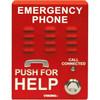
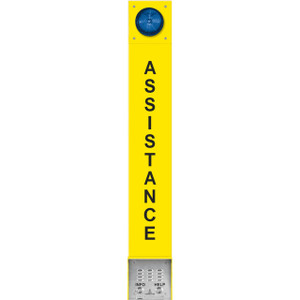
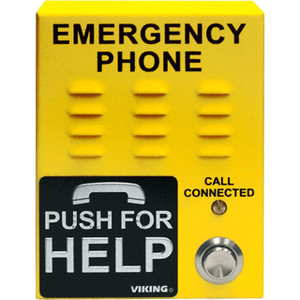
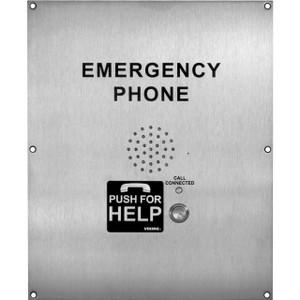
Viking Electronics E-1600-IP-EWP VoIP ADA Emergency Phone with Enhanced Weather Protection
Overview
The Viking Electronics E-1600-IP-EWP is a hands-free SIP VoIP emergency phone engineered for outdoor and harshly exposed installations where reliability isn't optional — parking structures, building perimeters, industrial yards, and campus emergency call stations. It ships in a red powder-coat finish with "Emergency Phone" verbiage embossed on the faceplate, making it immediately recognizable under stress. The E-1600-IP-EWP carries an IP66 ingress protection rating and Viking's Enhanced Weather Protection (EWP) treatment, pushing humidity tolerance to 100% — a meaningful step beyond the standard model's 95% non-condensing ceiling. It runs on a single Cat5e/6 run via PoE Class 1 (<4 Watts), meaning no dedicated power wiring and no separate power supply. If you're specifying VoIP emergency phones for a SIP-based campus or facility system, this is Viking's hardened outdoor variant.
Key Features
- IP66 + EWP Rating (Up to 100% Humidity): IP66 blocks wind-driven rain, hose-down spray, and heavy dust ingress — the minimum bar for any exposed outdoor enclosure. The EWP treatment extends humidity tolerance to 100%, which matters in coastal environments, covered but non-conditioned parking decks, and wash-down areas where condensation is routine. Standard IP66 phones cap at 95% non-condensing; the EWP variant closes that gap.
- Operating Range -40°F to 140°F (-40°C to 60°C): That 180°F operating window covers Minnesota winters and Arizona rooftops without derating or heater kits. Most SIP emergency phones are rated to -4°F or 23°F at the cold end; the E-1600-IP-EWP's -40°F floor is a real differentiator for northern installations.
- PoE Class 1, Under 4 Watts: Drawing under 4W, this phone is one of the lowest-power-draw devices you'll put on a PoE switch. A standard 802.3af port budgets 15.4W — you can provision this phone without scrutinizing port budgets or worrying about mid-span injector sizing. No dedicated power wiring required.
- 95 dB SPL at 1 Meter: 95 dB is loud enough to be heard in active loading docks, mechanical rooms, and open-air lots with moderate ambient noise. Size the coverage zone accordingly — this is a point-source device, not a wide-area paging speaker.
- SIP 2.0 RFC 3261 Compliant: Standard SIP means this phone integrates directly with any RFC 3261-compliant call server — Cisco UCM, Avaya, FreePBX, 3CX, and most enterprise IP-PBX platforms without proprietary gateways or adaptors. It registers as a standard SIP endpoint.
- Up to 5 Programmable Emergency Numbers: The dialer supports up to five stored numbers dialed in sequence until a call is answered. Configure primary dispatch, secondary backup, and facility security in a single device — no ancillary auto-dialer module required.
- G.711u, G.711a, and G.722 Audio Codecs: G.722 wideband audio delivers noticeably cleaner speech intelligibility versus G.711 narrowband. In a noisy outdoor environment where a caller is trying to communicate an emergency clearly, wideband codec support is worth specifying. G.711u/a compatibility ensures fallback interoperability with legacy endpoints.
- ADA Compliant: Meets ADA accessibility requirements — relevant for any installation subject to public accommodation rules (universities, transit facilities, municipal parking structures, federally-funded buildings). Verify local jurisdiction requirements, but ADA compliance is documented at the unit level.
- 2-Amp Relay Contacts: The onboard relay output lets you trigger a door strike, strobe light, or ancillary alarm device directly from the phone — useful for attended entry points or emergency access control integrations without a separate relay module.
- Three Gel-Filled Butt Connectors: The included gel-filled connectors are rated for outdoor wiring splices — the gel fill prevents moisture ingress at the connection point, which matters for direct-burial or exposed conduit terminations.
Integration and Compatibility
The E-1600-IP-EWP connects via a single RJ45 10/100BASE-Tx port and registers as a SIP 2.0 (RFC 3261) endpoint on any compatible call server. It draws power from the same Cat5e/6 run via IEEE 802.3af PoE — no separate power infrastructure required. The 2-amp dry relay contacts integrate directly with door hardware, strobes, or building automation systems. For network segmentation, place the phone on a dedicated voice VLAN and apply QoS markings at the switch port — wideband G.722 sessions are low-bandwidth but latency-sensitive. This phone is compatible with standard SIP-based VoIP PBX platforms and does not require Viking-proprietary call management software. For installations requiring coordinated access control integration, the relay output provides a direct hardware trigger path without middleware. Review the VoIP emergency phone selection guide for siting, coverage, and SIP trunk configuration considerations. Regulatory compliance covers CE, FCC Part 15, and Canada ICES-003 Class A — the device is cleared for sale and installation in the US and Canada without additional authorization steps. Pair with a managed PoE switch to apply per-port power budgeting and VLAN tagging at the network layer.
Frequently Asked Questions
Q: What is the difference between the standard E-1600-IP and the E-1600-IP-EWP?
A: The EWP (Enhanced Weather Protection) variant extends humidity tolerance from 95% non-condensing (standard model) to 100%, making it the correct choice for coastal installations, wash-down areas, covered parking decks, and any environment where condensation or near-saturation humidity is expected. Both models carry IP66 ingress protection and the same -40°F to 140°F operating range.
Q: Does the E-1600-IP-EWP require a separate power supply?
A: No. The phone operates on PoE Class 1, drawing under 4 Watts from a standard IEEE 802.3af PoE port on your switch or mid-span injector. A single Cat5e or Cat6 run delivers both power and network connectivity — no dedicated power wiring or transformer required.
Q: What SIP call servers is the E-1600-IP-EWP compatible with?
A: The phone complies with SIP 2.0 RFC 3261 and registers as a standard SIP endpoint. It is compatible with any RFC 3261-compliant call server including Cisco Unified Communications Manager, Avaya, 3CX, FreePBX, and similar platforms. No Viking-proprietary software is required.
Q: Is the E-1600-IP-EWP ADA compliant?
A: Yes. The E-1600-IP-EWP is documented as ADA compliant, which is relevant for public accommodation installations including university campuses, transit facilities, municipal parking structures, and federally-funded buildings. Verify applicable local jurisdiction requirements for your specific installation.
Q: Can the E-1600-IP-EWP trigger a door strike or strobe when a call is placed?
A: Yes. The phone includes a 2-amp relay output that can be wired to a door strike, strobe light, or ancillary alarm device. This provides a direct hardware trigger path for access control or alert integrations without requiring a separate relay module.
Q: How many emergency numbers can be programmed into the E-1600-IP-EWP?
A: The dialer supports up to five programmable emergency numbers, dialed in sequence until a call is answered. This allows you to configure primary dispatch, backup contacts, and facility security in a single unit without an external auto-dialer.
The E-1600-IP-EWP is the Viking model I reach for when a site has genuine outdoor exposure and the standard 95% non-condensing humidity ceiling isn't going to cut it. The EWP treatment pushing tolerance to 100% humidity, combined with the -40°F cold-temperature floor, covers the full range of uncontrolled outdoor environments — from coastal fog to northern winters — without adding heaters or supplemental enclosures.
Technical Highlights:
- PoE Class 1 (<4W): Under 4 Watts on a standard 802.3af port means this phone doesn't factor into switch power budget calculations in any meaningful way. You're not trading off a camera or access reader port to power it.
- G.722 Wideband Audio: Wideband codec support matters in emergency contexts — G.722 delivers roughly twice the audio frequency range of G.711 narrowband, which translates to more intelligible speech when a caller is distressed, masked, or competing with ambient noise at 95 dB SPL environments.
- 2-Amp Relay Output: The dry relay contact is underutilized on most deployments. Wiring it to a visible strobe or door release tied to the call event gives you a hardware-level integration with access control or visual alerting without touching the call server configuration.
Deployment Considerations:
- The phone registers as a standard SIP 2.0 RFC 3261 endpoint — provision it like any SIP station on your call server. Assign it to a dedicated emergency hunt group and enable auto-answer on the receiving extension if your platform supports it for unattended monitoring.
- Watch the codec negotiation on your call server: if the far-end extension doesn't support G.722, the call drops to G.711. Confirm your SIP trunk and terminating endpoints support wideband if audio quality is a specification requirement for your jurisdiction's emergency phone standard.
This phone is the right call for university blue-light networks, transit platform emergency stations, and outdoor industrial intercom points where the installation environment is genuinely harsh — not just 'somewhat exposed.' If your site is conditioned indoor space, the standard E-1600-IP without EWP saves cost with no functional tradeoff.