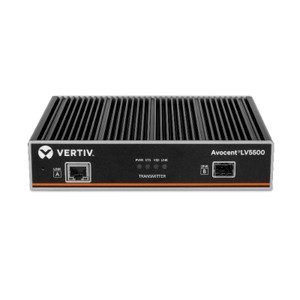
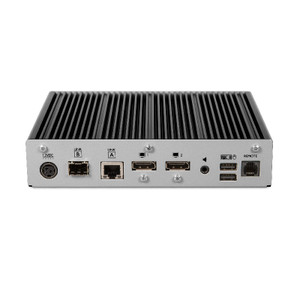
Vertiv LV5520T-400 4K Dual-Head KVM Extender Transmitter
Overview
The Vertiv LV5520T-400 is the transmitter unit of the Avocent Longview 5520 high-performance KVM extension system, purpose-built for operators who need to push dual 4K video signals — up to 4096×2160 — from a source workstation or server to a remote operator console over structured cabling. At 1U rack height and under 3 lbs, it installs directly into the equipment rack beside the host machine, keeping the computing hardware centralized in a secured, climate-controlled space while operators work from an ergonomic remote station. The LV5520T-400 (often searched as LV5520T 400) is the transmitter half of the Longview 5520 solution; pair it with the corresponding Longview 5520 receiver unit to complete the extension link.
For broadcast control rooms, post-production suites, military operations centers, and secure facility command posts, centralizing compute in a locked room while extending KVM to a separate operator position is a hard requirement — not a convenience. The LV5520T-400 is designed to meet that requirement without compromising on display fidelity at 4K graphic modes.
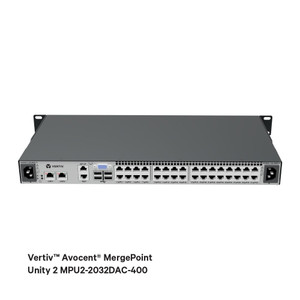
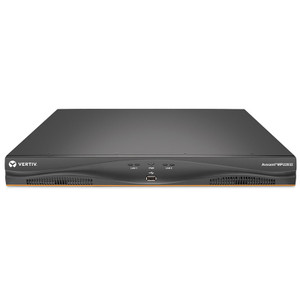
Browse the full Vertiv KVM and infrastructure management catalog to find the matching receiver, matrix switches, and KVM accessories that complete this deployment.
Key Features
- 4K Graphic Mode (4096×2160 max resolution): Supporting up to 4096×2160, the LV5520T-400 handles true 4K content — critical for 4K medical imaging workstations, multi-feed video monitoring walls, and GIS/mapping applications where pixel-accurate detail at the operator console is non-negotiable. Operators see exactly what the host generates, with no downscaling artifacts.
- Dual Head Video Output: Two independent display channels let operators run a side-by-side dual-monitor setup from a single KVM extension link. This eliminates the cost and complexity of running separate extension paths for each monitor — a practical advantage in space-constrained control room consoles where cable density is a real operational concern.
- 1U Rack-Mountable Form Factor: The 1U profile integrates cleanly into a standard rack alongside the host server or workstation. If your equipment room uses open racks or 2-post relay racks, the 1U chassis keeps the transmitter co-located with the source system, simplifying cable management and reducing the extension link's cable run to the shortest practical length.
- 18W Power Consumption: At 18W, the LV5520T-400 draws a predictable, low load on the rack PDU. In a dense rack with multiple KVM extension points, this keeps overall power budgeting manageable and won't stress standard branch-circuit capacity. Factor this against your PDU's per-outlet amp rating when planning rack density.
- 100–240 VAC Universal Input: The wide input voltage range (100–240 VAC) means the unit operates on North American, European, or international power infrastructure without a transformer or line conditioner — useful for deployments that span geographies or for integrators stocking a single SKU for global projects.
- Wired Connectivity Architecture: The LV5520T-400 uses a wired extension path — not wireless — which is the correct choice for any environment requiring deterministic latency and interference-free signal integrity. Control rooms, secure government facilities, and broadcast environments typically mandate wired-only KVM extension for exactly this reason.
- Compact and Light at 2.84 lbs: The 2.84 lb chassis is easy to handle during rack installation without a second technician — relevant during initial commissioning in tight equipment rooms or when retrofitting into existing populated racks.
Integration and Compatibility
The LV5520T-400 is the transmitter component of the Avocent Longview 5520 KVM extender pair. It connects to the host workstation or server at the source end, transmitting dual 4K video plus keyboard, mouse, and associated signals over the extension medium to the paired receiver. For full system design — including maximum extension distance, supported cable type, USB device support, and audio channel configuration — consult the Avocent Longview 5520 series documentation alongside this transmitter's datasheet.
If your deployment involves multiple operator stations accessing shared compute resources, review the KVM switches and matrix systems available alongside the Longview extender family — matrix-capable configurations allow a pool of transmitters and receivers to be switched under centralized management rather than fixed point-to-point pairs.
For power distribution in the equipment rack, plan your rack PDU selection to accommodate the 18W per-transmitter load, particularly in high-density racks with multiple extension nodes.
Operators evaluating KVM infrastructure for secure facilities should also consult a KVM extender buyer guide covering distance limits, USB 2.0 vs. USB 3.0 extension trade-offs, and latency budgets for different extension technologies — these factors determine whether the LV5520T-400 or an alternate Longview variant fits the specific use case.
Frequently Asked Questions
Q: What is the maximum video resolution supported by the LV5520T-400?
A: The LV5520T-400 supports a maximum video resolution of 4096×2160 (4K graphic mode), making it suitable for high-fidelity dual-display operator workstations in broadcast, medical imaging, and command-and-control environments.
Q: Is the LV5520T-400 a complete KVM extender solution on its own?
A: No. The LV5520T-400 is the transmitter unit only. It must be paired with the corresponding Avocent Longview 5520 receiver unit to form a complete KVM extension link from the source system to the remote operator console.
Q: What power supply does the LV5520T-400 require?
A: The LV5520T-400 operates on 100–240 VAC (universal input) and consumes 18W. It connects to a standard rack PDU outlet — no special power conditioning is required for North American or international installations.
Q: Can the LV5520T-400 support two monitors at the remote operator station?
A: Yes. The LV5520T-400 is a dual-head transmitter, meaning it carries two independent video channels simultaneously, supporting a dual-monitor operator console at the receiver end.
Q: What rack space does the LV5520T-400 occupy?
A: The LV5520T-400 occupies 1U (1.75 inches) of rack space and weighs approximately 2.84 lbs, making it straightforward to install alongside host equipment in a standard 19-inch rack.
Q: Is the LV5520T-400 suitable for wireless KVM extension?
A: No. The Longview 5520 uses wired connectivity. This is intentional for environments requiring deterministic latency and interference immunity — such as broadcast control rooms, government secure facilities, and industrial operations centers.
The LV5520T-400 addresses a specific, unambiguous requirement: centralize high-performance compute in a secured equipment room while delivering dual 4K display fidelity — up to 4096×2160 — to an operator position that may be across the room or across the building. This transmitter unit draws only 18W from the rack PDU, which matters when you are budgeting power across a dense rack of extension nodes in a control room infrastructure buildout.
Technical Highlights:
- 4096×2160 Maximum Resolution: Full 4K signal transmission means no resolution downgrade at the operator console — critical for 4K medical display workflows, high-resolution geospatial analysis, or multi-feed broadcast monitoring where pixel accuracy is a clinical or operational requirement.
- Dual-Head Video: Two simultaneous video channels over a single extension link reduce infrastructure cost versus running parallel single-head extenders — fewer cable runs, fewer rack units consumed, simpler management.
- 100–240 VAC Universal Input at 18W: The wide input range removes the need for region-specific power accessories on international deployments, and the 18W draw keeps per-node power cost low across multi-seat control room installations.
Deployment Considerations:
- The LV5520T-400 is the transmitter unit only — budget for the matched Avocent Longview 5520 receiver in your BOM; the extension system is non-functional without both ends of the pair.
- Confirm your structured cabling plant meets the Longview 5520 series distance and cable-type requirements before committing to extension topology — the transmitter's performance ceiling is determined by the physical medium, not the unit itself.
The LV5520T-400 is the right specification for dual-monitor operator positions in broadcast master control, secure government command centers, or industrial SCADA rooms where the host workstation must stay physically isolated from the operator — and where 4K display fidelity at the console is a hard requirement, not a preference.