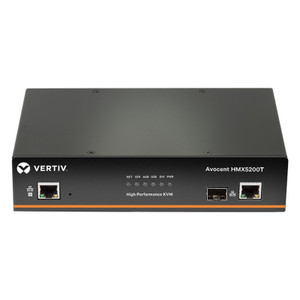
Vertiv ADX-2YGLD-IPUHD 4K IP KVM Digital Infrastructure Appliance
Overview
The Vertiv ADX-2YGLD-IPUHD is a compact digital infrastructure appliance built for IT and AV teams that need 4K resolution remote access over IP without relying on bulky legacy KVM hardware. Designed to sit at the device end of an IP-based KVM architecture, it delivers up to 3840×2160 at 30 Hz with 24-bit color over a single USB-C connection — giving remote operators a pixel-accurate view of connected equipment at full 4K fidelity. The ADX-2YGLD-IPUHD fits data center edge deployments, network operations centers, and broadcast or digital signage control rooms where display resolution directly affects operator accuracy.
Part of the Vertiv ADX product line, this unit represents Vertiv's approach to high-density, IP-native infrastructure access — pairing modern display interfaces with PoE-capable networking in a form factor sized for 1U shelf or equipment rack deployment.
Key Features
- 4K USB-C Display Output (Alt Mode DisplayPort): A single USB-C port with Alt Mode DisplayPort handles display signaling up to 4K at 30 Hz with 24-bit color depth. For operators monitoring complex dashboards, video walls, or high-resolution server consoles, this eliminates the resolution compromise common on older analog or HD-limited KVM endpoints — what you see remotely matches what's physically on screen.
- Dual 1G Network Interfaces with PoE+ on LAN1: Two independent Gigabit Ethernet ports provide network redundancy or segmented management/data paths. The LAN1 port carries 802.3at Type 2 PoE+, meaning this unit can both source and sink power depending on deployment configuration — a real advantage in structured cabling environments where running a separate power circuit to every remote access point adds cost and conduit complexity. Review your PoE switch power budget before connecting; 802.3at Type 2 delivers up to 30W at the port, well above the appliance's 25W draw.
- External 5V/25W Power Supply: The external PSU keeps the appliance's thermal footprint minimal — no internal transformer means no heat spike in tight enclosures. At 25W it draws less than a typical desktop switch port, so it won't stress rack PDU branch circuits in dense deployments.
- USB-C and Micro USB-C Connectivity: One USB-C port handles the display Alt Mode connection; a Micro USB-C port provides the serial/console access path. In environments where physical access to equipment is restricted, the Micro USB serial interface is the fallback management channel — no IP dependency required for out-of-band access.
- Wide Operating Temperature Range (0°C to 50°C / 32°F to 122°F): Handles the full range of conditioned data center environments through to warm IDF closets without thermal throttling. Storage tolerance extends further: -20°C to 70°C (-4°F to 158°F) means units can be warehoused or staged in non-climate-controlled spaces without risk of component damage before installation.
- Internal Fan Cooling: A single onboard fan keeps thermals in check under sustained 4K streaming load. In quiet NOC or broadcast environments, verify ambient noise tolerance — single-fan appliances are generally low-decibel but not silent. Check Vertiv's datasheet for the specific acoustic rating before specifying in open-plan operations centers.
- 5% to 80% Operational Humidity Tolerance: Standard for conditioned server rooms and wiring closets. Non-operational tolerance extends to 90%, which matters during shipping or staged storage in humid climates before final installation.
Integration and Compatibility
The ADX-2YGLD-IPUHD integrates into IP-based KVM over IP infrastructure architectures where centralized remote access management is handled at the network layer rather than through proprietary analog cabling. Its dual-GbE design supports deployments that physically or logically separate the management plane from the production network — a standard requirement in financial, healthcare, and government facilities operating under network segmentation mandates.
The USB-C Alt Mode DisplayPort output is compatible with displays and capture cards supporting DisplayPort over USB-C — confirm your target display or video capture device supports Alt Mode before specifying this unit in a deployment. Consult Vertiv's current compatibility documentation for validated VMS, KVM management software, and receiver hardware combinations, as IP KVM ecosystems are tightly paired between endpoint and management appliance. For infrastructure planning guidance, see the server and infrastructure management category for complementary access hardware.
Frequently Asked Questions
Q: What display resolution does the ADX-2YGLD-IPUHD support?
A: The ADX-2YGLD-IPUHD supports 4K resolution (3840×2160) at up to 30 Hz with 24-bit color depth via its USB-C Alt Mode DisplayPort interface.
Q: Does the ADX-2YGLD-IPUHD support Power over Ethernet?
A: Yes. The LAN1 network interface supports 802.3at Type 2 PoE+ (up to 30W at the port). The unit itself draws 25W from its external 5V power supply — verify whether PoE is sourced from or consumed by the unit in your specific configuration with Vertiv's deployment documentation.
Q: What is the operating temperature range for the ADX-2YGLD-IPUHD?
A: Operational range is 0°C to 50°C (32°F to 122°F). Storage temperature extends from -20°C to 70°C (-4°F to 158°F).
Q: Does the ADX-2YGLD-IPUHD (often searched as ADX 2YGLD IPUHD) include a power supply?
A: The unit uses an external 5V/25W power supply. Confirm whether the PSU ships in the box with your order, as inclusion can vary by configuration or bundle.
Q: How many network ports does the ADX-2YGLD-IPUHD have?
A: Two independent 1 Gigabit Ethernet interfaces. LAN1 carries 802.3at Type 2 PoE+; both ports support standard IP network connectivity for management and data path separation.
Q: What serial/console interface does the ADX-2YGLD-IPUHD provide?
A: One Micro USB serial port provides out-of-band console access independent of the IP network — useful for initial configuration or recovery when the network path is unavailable.
The ADX-2YGLD-IPUHD is one of the few IP KVM endpoint appliances currently shipping with native 4K/30Hz output over USB-C Alt Mode DisplayPort — that spec matters when your operators are reading dense server console output or monitoring 4K video feeds and every pixel of fidelity counts. I've specified Vertiv ADX units in NOC builds where legacy analog KVM left operators squinting at sub-HD console windows, and the jump to 4K remote access is immediately visible in error detection speed during incident response.
Technical Highlights:
- 4K 24-bit color at 30 Hz: Full 3840×2160 resolution with no color subsampling — operators get faithful representation of what's physically on the connected display, not a compressed or downscaled approximation common on older IP KVM hardware.
- 802.3at Type 2 PoE+ on LAN1: Up to 30W available at the port. In rack deployments where running a separate 5V supply to each endpoint adds wiring complexity, the PoE+ path can simplify installation — one Cat6 run handles both data and power.
- Dual independent 1G interfaces: Separate management and production network paths are a hard requirement in many regulated environments. The two Ethernet ports let you physically isolate KVM traffic from production data without a managed VLAN dependency at every IDF.
Deployment Considerations:
- The Micro USB serial port is your out-of-band lifeline during initial provisioning or IP misconfiguration — wire this to a terminal server or have a laptop with a Micro USB cable on-hand before racking the unit in a remote IDF.
- USB-C Alt Mode DisplayPort compatibility is not universal across all monitors and capture cards — validate your target display explicitly supports DisplayPort over USB-C Alt Mode before finalizing the bill of materials; adapters can introduce latency or signal degradation at 4K/30Hz.
The ADX-2YGLD-IPUHD is the right call for enterprise NOC, broadcast control room, or financial trading floor builds where 4K console fidelity is non-negotiable and the network infrastructure already supports PoE+ at the edge — it's not the unit for basic HD-only remote access environments where a lower-cost endpoint suffices.