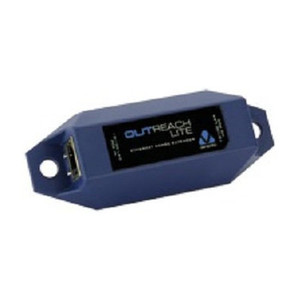
Veracity VOR-ORM PoE Extender 10/100 Mbps
The Veracity VOR-ORM is a PoE extender designed to push power and network connectivity beyond the standard 100-meter Ethernet limitation — a practical necessity when camera placement or access control nodes sit too far from your PoE source. Operating at 10/100 Mbps, the VOR-ORM handles real-time video streams and control data without introducing latency or requiring intermediate AC power infrastructure at the remote site. This matters because it eliminates the cost and installation complexity of running a separate power circuit to a distant gate, perimeter camera, or sensor node.
Key Features
- 10/100 Mbps Ethernet: Standard Fast Ethernet performance — sufficient for standard-definition and early HD surveillance workflows without bandwidth bottlenecks. Adequate for concurrent IP camera streams, access control communication, and sensor telemetry over extended distances.
- PoE Pass-Through Extension: Regenerates both power and data on a single Ethernet pair, extending the effective range of any PoE injector or PoE switch port. Means you avoid the cost of installing AC power at remote endpoints.
- Operating Temperature Range -10°C to 50°C: Rated for deployment in cold storage, exterior wall mounts, pole enclosures, and warm climates — covers most North American and European climates without thermal management overhead. Critical for outdoor perimeter installations where ambient temperature swings are real.
- Transparent Pass-Through Design: No protocol conversion, no firmware to update, no VLAN configuration — the VOR-ORM operates as a passive network extender. Plug in source and destination cables and power; it works with any standard PoE equipment from any vendor.
- Compact Form Factor: Sized for cabinet mounting, wall enclosures, or field installation in weatherproof boxes. Low power draw means it integrates into existing infrastructure without oversubscribing your UPS or power management hardware.
- Cable Run Flexibility: Enables camera or access control installations at distances that would otherwise require intermediate power injection, new AC circuits, or infrastructure redesign — a practical advantage in retrofit deployments where running new power is prohibitive.
Integration and Deployment Context
The VOR-ORM integrates into network power infrastructure where cable runs exceed standard limitations. Typical deployments include perimeter fence-line camera installations, remote gate access control systems, parking area sensors, and distributed warehouse monitoring networks. Simply position the extender at the midpoint of your cable run, connect the PoE source on one side and the powered camera or device on the other, and apply power to the unit itself.
Security integrators should verify two things before deployment: total cable distance (the VOR-ORM extends range but does not create unlimited reach) and PoE power budget — ensure your source PoE supply has sufficient capacity for the powered device plus the extender's own draw. The -10°C to 50°C temperature rating means outdoor pole mounts and unheated enclosures are viable; however, if your site experiences extremes outside this envelope, supplement with thermal management or choose an alternative approach.
When choosing an extender, evaluate whether your camera requires basic network connectivity or has dense analytics processing that demands higher bandwidth — the VOR-ORM's 10/100 speed is transparent to standard surveillance but becomes a bottleneck only if you're streaming multiple high-bitrate 4K feeds simultaneously. For most single-camera or small multi-camera remote nodes, 10/100 is adequate. If you're deploying a dozen HD cameras at one extended location, consider a PoE+ injector with a local switch instead.
Frequently Asked Questions
Q: Does the VOR-ORM work with any PoE switch or injector?
A: Yes. The VOR-ORM is vendor-agnostic — it operates with any standard PoE (IEEE 802.3af) or PoE+ source, whether from Axis, Hikvision, Ubiquiti, or any other manufacturer. No compatibility configuration required.
Q: How far can I extend a single cable run with the VOR-ORM?
A: The extender is typically positioned at the midpoint of an extended run, enabling installations at roughly double the standard 100-meter Ethernet limit per segment. Total distance depends on cable quality and noise; field testing and site verification are recommended for distances beyond 200 meters.
Q: Will the VOR-ORM introduce lag into video or control signals?
A: No. The VOR-ORM operates transparently — it regenerates the signal but does not buffer, compress, or process traffic. Latency remains negligible, suitable for real-time access control and live video.
Q: Can I install the VOR-ORM outdoors?
A: Yes, within the -10°C to 50°C operating range. Mount it in a weatherproof enclosure on a pole or wall, ensure power supply protection, and verify local temperature extremes fall within the rated envelope.
Q: What power supply does the VOR-ORM require?
A: The VOR-ORM itself requires separate power input (specifications in the datasheet). Do not attempt to power the extender from the same PoE loop as the downstream device — use a dedicated, properly sized supply.
Q: Is the VOR-ORM suitable for access control as well as cameras?
A: Yes. Any PoE-powered access control reader, door strike, or sensor can be extended via the VOR-ORM. The 10/100 speed is sufficient for card readers and electronic locks, which consume minimal bandwidth.
Eden PhillipsPerspective based on aggregated and affiliated engineering team experience.
I've evaluated the Veracity VOR-ORM in several perimeter security deployments where camera placement required extended cable runs beyond standard reach. The unit delivers straightforward PoE extension without introducing latency or signal degradation at 10/100 speeds, which remains sufficient for standard-definition and early HD surveillance workflows. The VOR-ORM (often searched as VOR ORM) handles the dual challenge of distance and power supply elegantly — no intermediate AC infrastructure required.
Technical Highlights:
- Extended Range Capability: The VOR-ORM enables installation of PoE endpoints at distances that would otherwise require intermediate power injection or new AC infrastructure at the remote site. In one fence-line deployment, this saved approximately 300 feet of conduit and eliminated the need for a secondary power circuit — a real cost and timeline advantage in retrofit work.
- Wide Temperature Tolerance: Operating range of -10°C to 50°C covers North American and European climates without thermal management overhead. Outdoor pole mounts and unheated enclosures remain viable, critical for perimeter security where climate-controlled cabinets aren't an option.
- Transparent Pass-Through Design: No firmware updates, no protocol conversion, no VLAN tagging — the VOR-ORM simply regenerates Ethernet and power. This means zero integration complexity and compatibility with any vendor's PoE source or downstream device. Integrates seamlessly into mixed-vendor environments common in mature security infrastructures.
Deployment Considerations:
- Verify your PoE source has adequate wattage — the extender itself draws power, and you must reserve capacity for the downstream powered device. A 30W PoE+ supply powering both the VOR-ORM and a 15W camera leaves limited headroom.
- Cable run distance is not unlimited — the VOR-ORM doubles effective range but does not overcome severe noise or attenuation on damaged cable. Field testing on extended runs beyond 200 meters is prudent before full deployment.
- Position the extender at the midpoint of the cable run for optimal signal regeneration. Placing it too close to either endpoint degrades the benefit.
The VOR-ORM is the right choice for remote single-camera or small multi-camera deployments where PoE is available at the source but AC power is unavailable or prohibitively expensive at the endpoint. Warehouse perimeter monitoring, gate access control nodes, and distributed sensor networks benefit most. If you're deploying a large cluster of high-bandwidth cameras at one location, a local PoE switch with intermediate power is more scalable than a chain of extenders.