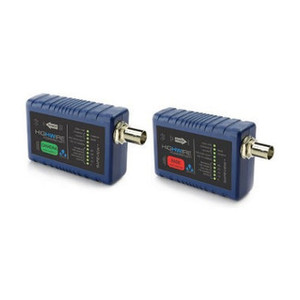
Veracity VHW-HWPS-C HIGHWIRE Powerstar PoE Extender
Overview
The Veracity VHW-HWPS-C is a PoE extender that solves a specific and common infrastructure problem: standard PoE power delivery begins to degrade beyond approximately 100 meters of cable run, forcing integrators to choose between parallel power infrastructure or relocating powered devices. The VHW-HWPS-C bridges this gap by accepting a PoE input from a standard injector or switch port and re-injecting power downstream, allowing IP cameras, access points, and other edge devices to operate at extended distances without running separate power lines. For large campuses, perimeter fencing, and remote building deployments, this consolidation cuts both material costs and labor.
Key Features
- 10/100 Mbps Ethernet Pass-Through: Maintains data and power on a single Ethernet run, eliminating the need for parallel infrastructure. Fast Ethernet bandwidth (100 Mbps) is adequate for most PoE-powered IP cameras and access points—high-bitrate 4K streams rarely flow through these typically low-power devices.
- PoE Power Extension: Accepts upstream PoE input and re-injects power to downstream devices, pushing power delivery well beyond the IEEE 802.3 standard distance limits. Particularly valuable when the first PoE run exceeds 100 meters or when multiple devices string along a single cable path.
- Wide Operating Temperature (-10°C to 50°C / -14°F to 122°F): Rated for temperature-controlled indoor environments and enclosed outdoor installations. This range covers most North American facilities; extreme-temperature sites (below -10°C or above 50°C) require additional thermal enclosure planning.
- Transparent Network Integration: Requires no configuration, management interface, or IP address assignment. The extender operates as a passive PoE bridge—no learning curve, no firmware updates, minimal troubleshooting.
- Compact Form Factor: Designed for discreet installation in utility boxes, ceiling plenums, and wall-mounted enclosures without consuming significant physical space, reducing visual footprint in sensitive or aesthetically constrained installations.
- Field-Ready Design: Built for integrator deployment in existing network topologies. No special cabling, no proprietary connectors—standard RJ-45 Ethernet on both input and output ports.
Integration and Deployment Context
The VHW-HWPS-C integrates transparently into standard IP security and telecom architectures. Unlike managed PoE switches or inline power injectors, this extender introduces no latency, no VLAN handling, and no configuration overhead—it simply extends power and data together. It is compatible with all standard 10/100 Mbps IP cameras, wireless access points, and networked devices that draw power via 802.3af or 802.3at. When planning a deployment on a PoE infrastructure, account for the extender's own power draw; it passes power through while consuming minimal amperage itself.
Typical deployment scenarios include campus perimeter camera arrays where cable runs exceed 100 meters, remote building access points, and distributed gate/entrance systems in large warehouses or logistics facilities. The extender is particularly useful in retrofit projects where running new power conduits is cost-prohibitive or aesthetically unacceptable.
Environmental and Temperature Considerations
The operating range of -10°C to 50°C accommodates climate-controlled data closets, indoor security rooms, and sealed outdoor enclosures, but not unprotected outdoor mounting. If installing in an area subject to freezing or heat extremes, plan for an IP-rated enclosure or heated/cooled cabinet to maintain the device within specification. Verify enclosure thermal performance—passive boxes in direct sunlight can exceed the 50°C upper limit.
Frequently Asked Questions
Q: How much power does the VHW-HWPS-C consume itself?
A: The VHW-HWPS-C draws minimal power from the upstream PoE source; exact figures are not specified in available documentation. For practical purposes, assume less than 2W in most scenarios. Contact the manufacturer for precise current draw if you are operating near power supply limits.
Q: Can I daisy-chain multiple VHW-HWPS-C units to extend power even further?
A: Yes, the extender can be chained—each unit re-injects power downstream. However, power loss accumulates with each extension; practical limits are typically two to three units in series before voltage drop becomes problematic. Test your specific cable length and device current draw before deployment.
Q: Is the VHW-HWPS-C suitable for outdoor use?
A: Not without enclosure. The device itself is rated -10°C to 50°C and is not sealed for rain or moisture. Install inside a rated enclosure (IP65 or higher) if mounting outdoors or in damp environments.
Q: Does the VHW-HWPS-C support PoE+ (802.3at) or only standard PoE (802.3af)?
A: The VHW-HWPS-C passes through both 802.3af and 802.3at power, depending on the upstream source. If your injector or switch supplies PoE+, the extender will deliver PoE+ to the downstream device.
Q: Do I need to configure or manage the VHW-HWPS-C?
A: No. The extender is plug-and-play. Simply connect the upstream Ethernet (with PoE) to one port and the downstream cable (to your camera or access point) to the other. No IP address, no interface, no firmware updates required.
Q: Will the VHW-HWPS-C work with all Veracity cameras and third-party IP devices?
A: Yes. It is compatible with any standards-compliant 10/100 Mbps IP device. It does not discriminate by vendor—Veracity, Axis, Hikvision, Ubiquiti, or any other manufacturer's device that supports 802.3af or 802.3at PoE will function downstream of the extender.
Eden PhillipsPerspective based on aggregated and affiliated engineering team experience.
I've deployed the Veracity VHW-HWPS-C in multiple large-footprint security projects where standard PoE injectors simply couldn't push power and data the required distances. On a 150-meter cable run to a perimeter camera array, the VHW-HWPS-C eliminated the need for a parallel 12V power infrastructure—a major cost and labor saving. The device is utterly transparent to the network and requires zero ongoing management.
Technical Highlights:
- 10/100 Mbps Pass-Through: Adequate bandwidth for all standard IP cameras and access points; the limiting factor in most deployments is the camera's bitrate, not the extender's speed. No bottleneck here.
- PoE Power Re-Injection: Accepts 802.3af or 802.3at upstream and re-injects the same standard downstream. No voltage regulation, no power loss estimation—the device simply bridges power and data on a single Ethernet run, eliminating parallel power infrastructure labor and material.
- Operating Temperature -10°C to 50°C: Covers all climate-controlled indoor spaces and sealed outdoor enclosures. Plan for additional thermal management (heated or cooled box) if your site experiences temperature extremes outside this range.
Deployment Considerations:
- Daisy-chaining is possible but cumulative voltage drop becomes an issue beyond two or three units in series—test your specific scenario before committing to a chain.
- The device is not sealed; always enclose it in an IP-rated box if mounting in potentially damp or outdoor areas. The -10°C to 50°C operating window also means unenclosed outdoor mounting in extreme climates will violate specifications.
- No configuration interface means no troubleshooting dashboard. If a downstream device loses power, you're looking at a voltage drop issue on the cable run or an upstream PoE source problem—test with a multimeter at the RJ-45 connector to isolate the fault.
The VHW-HWPS-C is the right choice for campus and perimeter deployments where cable runs exceed 100 meters and running parallel power is either cost-prohibitive or aesthetically unacceptable. It's not a solution for powering high-current devices (those need PoE++ or a dedicated power supply), and it's not suitable for unenclosed outdoor mounting in freeze-thaw environments. For the right scenario—indoor or sheltered outdoor, standard PoE power budget, extended cable runs—it eliminates infrastructure complexity.