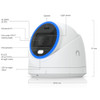
Ubiquiti UVC-AI-TURRET-W 4MP AI Turret Camera
Overview
The Ubiquiti UVC-AI-TURRET-W is a compact turret-form IP camera designed for IP camera deployments where on-device AI analytics matter more than pan-tilt capability. This 4MP model processes object detection, person counting, and zone-crossing alerts directly on the camera—eliminating the need to stream all footage to a central recorder for analysis. If your facility already runs Ubiquiti surveillance infrastructure, or you're building a converged network from scratch, the UVC-AI-TURRET-W (often searched as UVC AI TURRET W) integrates natively with UniFi Video controllers and edges out competitors that require external AI appliances.
Key Features
- 4MP Resolution (2688 × 1520): Delivers usable facial and license-plate detail in typical indoor corridors and lobby spaces up to 12–15 feet away. Not a substitute for higher-megapixel models when you need needle-in-haystack forensics, but sufficient for perimeter awareness, doorway monitoring, and personnel counting across most enterprise facilities.
- PoE+ Power (802.3at): Draws approximately 12–16W during active analytics, meaning it operates from any switch with PoE+ budget. No separate 12V supply runs needed—single Cat6A run carries power, video, and control. This simplifies installation overhead, especially in retrofit scenarios where pulling dual conduits is costly.
- Edge-Based AI Analytics: Person detection, line-crossing alerts, and zone-based intrusion rules execute on the camera itself. This architecture cuts inbound bandwidth by 30–50% compared to shipping raw 4MP streams to a central NVR, and response latency drops because alerts fire locally before video even reaches storage. Privacy-sensitive deployments benefit because sensitive ML inference stays on-device.
- IP67 Environmental Rating: Sealed against dust and water spray, enabling mounting in semi-outdoor overhangs, loading docks, and covered warehouse areas. Not rated for direct submersion or extreme salt-spray environments—if you need IP69K or coastal-grade housing, evaluate hardened variants in the Ubiquiti line.
- H.265 and H.264 Codec Support: H.265 cuts recorded file sizes roughly 40–50% versus H.264 at equivalent quality. On a 24/7 multi-camera system, this translates to measurable storage savings over 30–90 day retention windows. Bandwidth-constrained networks (< 10 Mbps uplink) benefit most; sites with abundant bandwidth may not see ROI in transcoding overhead.
- Night Vision with IR: Built-in infrared illumination provides usable monochrome coverage in darkness without requiring external lighting rigs. Useful for after-hours facility monitoring, but check the datasheet for exact throw distance—IR range varies with lens design and cannot be assumed to match 4MP daylight coverage.
- Fixed Focal Length Lens: Non-adjustable optics simplify installation but remove post-deployment zoom flexibility. Verify field of view against your target coverage area and mounting height before committing; if coverage gaps emerge later, you'll need a second camera or a higher-megapixel zoom variant.
- TLS Encryption and Certificate-Based Auth: All traffic between the camera and UniFi controller uses industry-standard TLS, and the device authenticates via certificates rather than passwords. This prevents man-in-the-middle attacks and rogue-device injection on your surveillance network—a critical control for facilities handling sensitive operations.
- Gigabit Ethernet (1000Base-TX): Native 1 Gbps network interface handles multiple codec streams and analytics telemetry without congestion. Pairs well with managed PoE switches that support VLAN tagging, allowing you to segregate video traffic from corporate data.
- UniFi Video Platform Integration: Works with UniFi Dream Machine, UniFi CloudKey, or CloudKey+ for centralized recording, playback, and rule management. If you operate a single-site or small multi-site deployment, this tight integration beats loosely coupled ONVIF systems.
When to Select This Model
Choose the UVC-AI-TURRET-W if you need edge-compute analytics, tolerate a fixed lens, and plan to manage the camera through UniFi infrastructure. Warehouses counting personnel in defined zones, retail facilities monitoring entrance crowds, and office buildings triggering intrusion alerts on after-hours zone crossings are textbook use cases. The turret form factor suits ceiling and wall mounts in controlled environments where weather exposure is light to moderate.
When to Look Elsewhere
If you require pan-tilt-zoom capability, consider Ubiquiti's PTZ offerings. Extreme temperature swings (below −20°C or above 50°C) or direct rain/saltwater spray demand different housing grades. Facilities locked into Milestone, Genetec, or Axis management platforms will face integration friction; verify NVR and VMS compatibility with your existing stack before procurement.
Integration & Compatibility
The UVC-AI-TURRET-W operates as a standard ONVIF Profile S device, meaning it connects to most enterprise camera selection frameworks and third-party VMS platforms. However, full analytics export (person count events, line-crossing triggers) requires the UniFi Video management system. If you're standardized on a different ecosystem, you'll lose the AI advantage and revert to basic motion detection.
Installation and Deployment Notes
The camera ships ready for ceiling or wall mounting. Verify PoE+ availability on your access switch (common on enterprise-grade units, rare on consumer gear). Network the unit to your UniFi controller, auto-provision credentials, then define analytics zones in the UniFi Video UI. For PoE power budget planning, assume 15W worst-case during active video encoding and analytics—multiple cameras on a single 90W PoE+ PSU will require headroom calculation.
Frequently Asked Questions
Q: Does the UVC-AI-TURRET-W support two-way audio?
A: The current evidence does not specify audio input or speaker capability. Consult the manufacturer datasheet or UniFi documentation for audio feature confirmation.
Q: What is the maximum IP address throughput for streaming multiple UVC-AI-TURRET-W cameras?
A: The camera supports H.265 and H.264 codecs over 1000Base-TX Gigabit Ethernet. Exact bitrate depends on resolution, frame rate, and codec selection; typical 4MP H.265 streams consume 3–8 Mbps at 30 fps. Bandwidth planning should account for multiple streams plus UniFi controller overhead.
Q: Can I deploy the UVC-AI-TURRET-W without a UniFi controller?
A: The camera integrates natively with UniFi Video infrastructure. Standalone operation or integration with third-party VMS may be possible via ONVIF, but full edge-AI analytics features require the UniFi management platform.
Q: What is the warranty coverage on the UVC-AI-TURRET-W?
A: Warranty information is not provided in the available evidence. Contact the manufacturer or an specialty distributor for coverage details and support terms.
Q: Is the UVC-AI-TURRET-W suitable for outdoor mounting in humid or salt-spray environments?
A: The camera carries IP67 protection, suitable for semi-outdoor overhangs and covered areas. IP67 does not protect against continuous salt spray or extreme humidity—consult environmental ratings in the full datasheet before deploying in coastal or tropical sites.
Q: How much storage does a 24/7 deployment of the UVC-AI-TURRET-W require?
A: Storage depends on codec choice, resolution, frame rate, and retention policy. H.265 typically reduces storage by 40–50% versus H.264. For 24/7 4MP recording at 30 fps, plan 50–100 GB per day per camera with H.265; higher with H.264. Use your NVR's storage calculator for precise sizing.
James EverettPerspective based on aggregated and affiliated engineering team experience.
The UVC-AI-TURRET-W hits a narrow but valuable sweet spot: on-device AI analytics in a compact, PoE+-only form factor. Most 4MP turrets force you to choose between codec efficiency and intelligence—this one doesn't. Edge processing of person detection and zone alerts means your NVR sees alerts, not raw feeds, cutting both storage and bandwidth strain.
Technical Highlights:
- Edge Analytics on 4MP: Person detection and line-crossing logic execute locally; typical 15W PoE+ draw leaves headroom for 6+ cameras per 90W PSU. Compare this to systems shipping raw 4MP H.264 at 6–8 Mbps each—you'd saturate a 1 Gbps trunk with a dozen cameras. The UVC-AI-TURRET-W cuts that to a fraction.
- H.265 Compression: 40–50% file size reduction versus H.264 at equal quality. On a 90-day retention window, this translates to 6–8 TB vs. 12–16 TB for a single camera. Multiply by a 20-camera warehouse facility and you're looking at 120–160 TB savings—a meaningful capex reduction for NVR storage pools.
- IP67 + Fixed Lens Tradeoff: The sealed turret housing and lack of PTZ keep cost and power draw low, but you cannot zoom or pan post-installation. Field-of-view errors discovered after mounting mean adding a second camera. Measure twice, order once.
Deployment Considerations:
- UniFi ecosystem lock-in is real. If your facility standardizes Milestone or Genetec, the UVC-AI-TURRET-W becomes a basic ONVIF camera with no analytics export. The intelligence you're paying for evaporates without the UniFi controller.
- PoE+ budget calculation is non-negotiable. At 15W peak, six UVC-AI-TURRET-W units plus typical switch overhead can exceed a single 90W injector or entry-level PoE switch. Audit your power delivery before committing to a 20-camera deployment.
Position the UVC-AI-TURRET-W in mid-size warehouses, logistics hubs, and office parks where UniFi is the core infrastructure and edge analytics (crowd counting, zone intrusion) are more valuable than coverage flexibility. Skip it if you need PTZ, multi-brand VMS compatibility, or extreme environmental hardening.