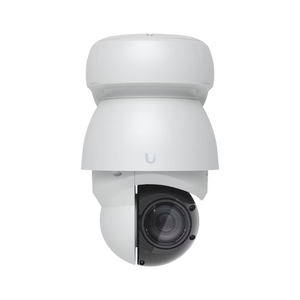
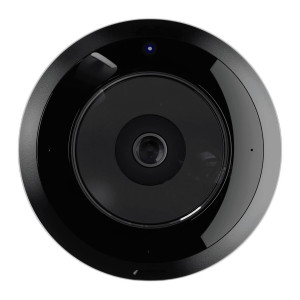
Ubiquiti UVC-AI-PTZ-B Pan-Tilt-Zoom AI Camera
Overview
The Ubiquiti UVC-AI-PTZ-B is a pan-tilt-zoom camera engineered to cover large areas—parking lots, industrial yards, sports facilities, campuses—with a single dynamic unit rather than deploying multiple fixed cameras. Operating on PoE++ (802.3bt) power delivery, the camera eliminates separate power infrastructure and simplifies retrofit and greenfield installations. The UVC-AI-PTZ-B integrates with the UniFi Video Management System for centralized monitoring, recording, and AI-powered analytics from one control interface.
Key Features
- 8MP Resolution: Delivers sufficient detail for identification tasks across medium to far ranges; the 8MP sensor balances frame rate, bitrate, and storage efficiency compared to higher-megapixel fixed cameras. Useful when zoom-in detail is required after an event is detected.
- Mechanical Pan, Tilt, and Optical Zoom: Operators or AI-driven automation can direct the camera toward areas of interest in real time, eliminating the need to install separate cameras for each monitored zone. Zoom capability bridges the gap between wide overview and narrow detail capture without frame loss.
- H.265 and H.264 Compression: H.265 cuts storage and bandwidth requirements roughly in half compared to H.264 on equivalent scenes—a significant factor when recording 24/7 across multiple PTZ units. Adaptive bitrate streaming accommodates variable network conditions and enables multi-stream viewing at different resolutions and frame rates.
- Edge AI Analytics: As a member of Ubiquiti's AI camera family, the UVC-AI-PTZ-B offloads object detection and classification (people, vehicles, packages) to the edge, reducing bandwidth consumption and latency compared to cloud-dependent analytics. Rule-based alerting and automation operate within UniFi Video without external analytics servers.
- Night Vision: Integrated low-light imaging supports broad daylight to low-light performance. In facilities with consistent illumination, the camera delivers clear capture across typical surveillance lighting. For extreme low-light or infrared-only scenarios, verify that supplemental IR or facility lighting aligns with your project requirements.
- 1000Base-TX Gigabit Ethernet: Full-gigabit connectivity supports smooth high-resolution streaming and reduces latency on congested networks. Powered entirely over the single Ethernet cable via PoE++, eliminating separate power conduits and reducing installation cost in retrofit settings.
Integration and Compatibility
The UVC-AI-PTZ-B is purpose-built for UniFi Video ecosystem deployments. All traffic between the camera and UniFi Video Management System is encrypted; the camera integrates with UniFi's role-based access control and audit logging to enforce network security policies. The unit supports standard ONVIF protocols, enabling integration with third-party network video recorders (NVRs) and video management platforms if required.
When to Choose the UVC-AI-PTZ-B
Deploy this model when dynamic coverage justifies the mechanical complexity—expansive outdoor areas, wide indoor spaces, or facilities where operators need to pan and zoom to track moving subjects or zoom in for identification. The PTZ form factor is ideal for sites where a single camera can eliminate the need for multiple fixed units.
When to Choose a Different Model
If your deployment requires fixed, persistent coverage of a specific zone (doorway, hallway, retail shelf), a fixed-dome or turret camera offers simpler installation, lower operational overhead, and better reliability. For ultra-wide overview shots with no zoom requirement, panoramic models may be more cost-effective. If your network lacks PoE++ infrastructure or you require compact form factors for discreet mounting, evaluate the full Ubiquiti surveillance lineup. Mechanical PTZ systems require more frequent maintenance than fixed cameras—factor this into long-term operational cost.
Environmental Suitability
Confirm IP rating and operating temperature range with your site conditions before deployment to ensure outdoor or harsh-environment suitability. The camera is manufactured to Ubiquiti design and quality standards; verify environmental specifications against your specific installation locale.
Deployment Considerations
PTZ cameras demand adequate network bandwidth for high-bitrate H.265 streams and must be mounted where pan and tilt motion doesn't interfere with other infrastructure or personnel. Ensure your network switch or PoE injector can supply the full PoE++ power budget if deploying multiple units. Plan for remote or on-site operator skill to configure AI detection rules and pan-tilt presets effectively.
Frequently Asked Questions
Q: What is the maximum zoom range on the UVC-AI-PTZ-B?
A: The datasheet specifies optical zoom capability; refer to the manufacturer PDF for exact magnification ratio. Optical zoom preserves detail without pixel loss, unlike digital zoom.
Q: Does the UVC-AI-PTZ-B work with non-Ubiquiti NVRs?
A: Yes. The camera supports standard ONVIF connectivity, allowing integration with third-party video management systems. However, edge AI analytics are optimized for UniFi Video; other platforms may not fully leverage the camera's analytics capabilities.
Q: What PoE++ power budget does the UVC-AI-PTZ-B require?
A: Verify the exact wattage in the manufacturer specifications. PoE++ (802.3bt) supplies up to 90W per port, ample for motorized PTZ systems. Confirm your switch or injector has sufficient available power if deploying multiple units.
Q: Can the camera operate in freezing temperatures?
A: Check the operating temperature range in the datasheet. Mechanical PTZ systems may experience slower responsiveness or component wear in extreme cold; verify suitability for your climate zone.
Q: Is the UVC-AI-PTZ-B suitable for indoor use?
A: Yes, provided ceiling/wall mounting is feasible and pan-tilt motion doesn't create safety hazards. Verify IP rating if the indoor environment includes moisture or dust exposure.
Q: What compression modes does the UVC-AI-PTZ-B support?
A: The camera supports H.265 and H.264 encoding. H.265 reduces storage cost and bandwidth approximately 50% compared to H.264 on equivalent quality scenes.
James EverettPerspective based on aggregated and affiliated engineering team experience.
The Ubiquiti UVC-AI-PTZ-B is a solid fit for warehouse and industrial yard surveillance where a single motorized unit can eliminate the need for three to five fixed cameras covering the same footprint. The PoE++ delivery and edge AI analytics mean you can push object detection (people, package, vehicle) to the camera itself, cutting cloud dependency and latency—meaningful if your integrators are building autonomous alerting workflows or triggering downstream automation based on detected intrusions or package arrival.
Technical Highlights:
- 8MP sensor + optical zoom: Captures sufficient resolution for mid-range identification (vehicle license plates, package labels) without forcing you into 12MP+ bitrate overhead; zoom-in detail capture happens on demand rather than continuous recording at the highest resolution.
- H.265 compression: Cuts bitrate roughly 50% versus H.264—critical when operating 24/7 on a single PTZ unit where bandwidth or storage becomes a constraint after a few months of continuous capture.
- Edge AI (people, vehicle, package detection): Offloads analytics to the camera; no cloud round-trip or external GPU server required. Reduces detection latency from hundreds of milliseconds to tens—meaningful for automation triggers.
- PoE++ single-cable delivery: Eliminates separate power runs in retrofit installations; PoE++ budget (90W max) is adequate for motorized PTZ without auxiliary power supplies.
Deployment Considerations:
- Mechanical PTZ introduces wear items (bearings, motors) that require periodic maintenance; budget 18–24 month intervals for lubrication and bearing inspection if the camera operates in dusty or high-vibration environments.
- Network bandwidth: high-bitrate H.265 streams from a PTZ still demand gigabit connectivity and adequate switch buffer; if your integration includes multiple PTZ units on legacy fast-ethernet infrastructure, you'll hit bandwidth ceilings quickly.
- Operator skill or automation rule complexity: the UVC-AI-PTZ-B's value proposition depends on either skilled operators who actively patrol coverage zones or well-tuned AI rules; a passively mounted PTZ that never pans or zooms wastes the mechanical complexity advantage.
Best deployment: large outdoor yards, parking structures, or industrial facilities where a single motorized unit covers a >180° horizontal span and operators (or motion-triggered automation) actively manage the zoom and pan to track or investigate events. Skip this model if your requirement is fixed, persistent coverage of a narrow zone—a turret camera will be more reliable and cheaper to own.
Key Specifications:
Color: Black