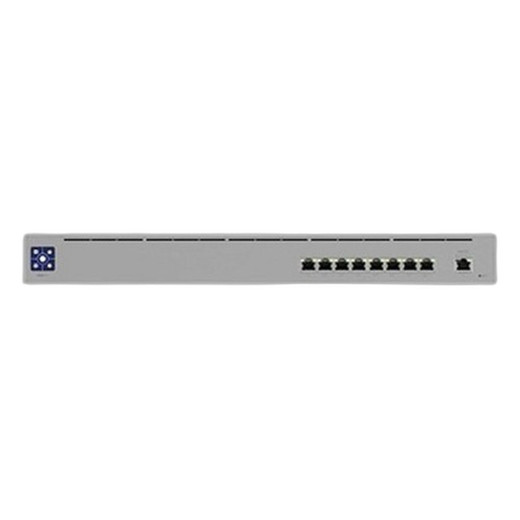
Ubiquiti USW-MISSION-CRITICAL 9-Port Managed Gigabit Switch
Overview
The Ubiquiti USW-MISSION-CRITICAL is a 1U rack-mount managed switch built for infrastructure where uptime and predictable latency are non-negotiable. Nine Gigabit Ethernet ports deliver 9 Gbps non-blocking throughput — meaning every port pair can forward traffic simultaneously without congestion, a critical requirement when backhaul links for network switches or IP camera surveillance streams cannot tolerate dropped packets. With 120W of PoE++ budget across all nine ports, the USW-MISSION-CRITICAL eliminates the need for external power injectors when deploying powered endpoint devices in distributed networks. A 13 Mpps forwarding rate ensures sub-millisecond decision latency — meaningful in real-time applications like VoIP and industrial control.
Key Features
- 9 Gbps Non-Blocking Throughput: Unlike lower-tier switches, non-blocking architecture means you won't hit congestion even if all nine ports are active simultaneously. Backhaul links and dense PoE loads don't degrade performance.
- 120W PoE++ Power Budget: Supports simultaneous operation of multiple power-hungry endpoints — IP cameras, access points, or sensors — without oversubscription. Typical surveillance cameras draw 10–15W; this budget handles roughly eight concurrent high-power devices.
- 13 Mpps Forwarding Rate: Sub-microsecond decision latency keeps VoIP call quality stable and industrial networks predictable. Frame-by-frame determinism matters when you're coordinating warehouse automation or time-sensitive sensor data.
- 1,000 VLAN Support: Enables sophisticated multi-tenant or multi-department isolation in enterprise campuses. Separate traffic streams for surveillance, voice, and operational technology (OT) without requiring separate physical infrastructure.
- Universal AC Input (100–240V, 50/60 Hz) with 240W Internal Supply: Operates identically in North American and international facilities without power supply reconfiguration. Only 50W typical draw — low enough that you won't strain UPS capacity in network closets.
- NDAA Compliance Certification: Meets U.S. federal government procurement rules (Section 889 compliance), mandatory for government contracts and classified facility upgrades. Eliminates certification delays in government sales cycles.
- SGCC Steel Construction, -5 to 40°C Operating Range: Withstands temperature swings common in uncontrolled network closets, warehouses, or outdoor equipment shelters. Steel chassis resists vibration in industrial environments.
- Managed via Ethernet to UniFi Controller: Configuration and monitoring integrate into centralized UniFi ecosystems — no serial console or out-of-band management channel required. If your UniFi controller is already deployed, this switch boots into the same dashboard.
- Compact 442 × 480 × 44 mm Footprint: Fits standard 19-inch racks without excessive vertical space. At 9 kg (19.9 lb), it's light enough for wall-mounting in smaller network rooms.
- Speed Negotiation (1G/100M/10M): Backward-compatible with legacy equipment still running Fast Ethernet. No separate VLAN or QoS tweaks needed to accommodate older surveillance or access control gear.
Deployment Scenarios
This switch is optimized for access-layer or aggregation-layer roles in enterprise campuses, industrial networks, and telecommunications facilities. Non-blocking throughput suits NVR backhaul scenarios where multiple surveillance cameras feed into a single recorder without packet loss. Multi-tenant healthcare or financial services environments benefit from VLAN isolation — compliance requirements like HIPAA or PCI-DSS often mandate traffic separation that this switch handles natively. Warehouse automation networks with distributed sensors, barcode scanners, and wireless access points rely on low-latency forwarding to keep real-time systems synchronized.
Integration & Compatibility
The USW-MISSION-CRITICAL functions as a managed access switch within UniFi ecosystem deployments. Nine Gigabit Ethernet ports operate at standard 1G/100M/10M negotiation, accommodating both modern devices and legacy equipment within the same switch. Ethernet-based management via UniFi controller eliminates the need for dedicated serial access or out-of-band channels — if your controller already manages UniFi access points or cameras, configuration occurs from the same interface. Layer 2 switching with up to 1,000 VLANs enables integration into multi-site networks where traffic isolation and QoS policies must align with enterprise security frameworks. PoE power planning guides help verify that your specific camera or access point mix fits the 120W budget.
Installation Considerations
The switch weighs 9 kg (19.9 lb) and ships with SGCC steel mounting hardware for standard 19-inch rack installation. Universal voltage input (100–240V, 50/60 Hz) accommodates both North American and international facilities without reconfiguration. Verify that your available rack power capacity supports the 240W internal supply, particularly in environments with existing thermal constraints or power distribution limitations. Certifications include CE, FCC, IC, and Anatel (06679-25-08356), confirming regulatory compliance across major markets.
Frequently Asked Questions
Q: What does 'non-blocking throughput' mean, and why does it matter?
A: Non-blocking means every port pair can exchange data at full line rate simultaneously. A switch with 18 Gbps total capacity but only 9 Gbps non-blocking throughput will drop packets if you try to use all nine ports at once. The USW-MISSION-CRITICAL's 9 Gbps non-blocking design guarantees no congestion — critical when you're aggregating multiple high-bandwidth feeds like surveillance camera backhaul or redundant links.
Q: Is the USW-MISSION-CRITICAL suitable for outdoor or industrial deployments?
A: Yes, within limits. The -5 to 40°C operating range handles uncontrolled indoor spaces like warehouse network rooms or equipment shelters. SGCC steel construction resists vibration and corrosion better than plastic housing. However, if you need direct rain/dust protection (IP67 or higher) or submersion tolerance, you'll need an outdoor-rated enclosure around this switch — the switch itself is not IP-rated.
Q: How much PoE power do I actually get, and what devices can I power simultaneously?
A: The 120W budget supports eight to ten typical surveillance cameras (12–15W each), or four high-power devices like WiFi 6 access points (25–30W each) with room to spare. The USW-MISSION-CRITICAL++ does not enforce per-port limits, so a single port can draw up to 90W if needed. Calculate your device mix against 120W total before deployment.
Q: Does this switch work with non-Ubiquiti cameras and devices?
A: Yes. The USW-MISSION-CRITICAL is a standard Layer 2 Gigabit Ethernet switch. Any device that speaks 1G Ethernet and standard PoE will work — Axis, Hikvision, Dahua, generic IP phones, and wireless access points all plug in seamlessly. UniFi controller integration is optional; you can manage the switch via standard SNMP or web interface if you prefer.
Q: Is the USW-MISSION-CRITICAL NDAA-compliant?
A: Yes. It meets Section 889 compliance, required for U.S. federal government procurement and classified facility upgrades. This certification is already in place — no additional paperwork or testing needed for government contracts.
Q: Can I mix this switch with other Ubiquiti UniFi switches in the same network?
A: Yes. The USW-MISSION-CRITICAL integrates into any UniFi topology — you can stack it with lower-tier access switches or higher-port-count models in the same controller deployment. Each switch retains its own performance characteristics (the USW-MISSION-CRITICAL keeps its 9 Gbps non-blocking throughput regardless of what else is on the network).
Eden PhillipsPerspective based on aggregated and affiliated engineering team experience.
The USW-MISSION-CRITICAL distinguishes itself through deterministic performance metrics rather than raw port count. Nine ports with 9 Gbps non-blocking throughput means every port pair can exchange data simultaneously without congestion — essential when backhaul links or PoE-powered surveillance feeds cannot tolerate packet loss. NDAA compliance is increasingly table-stakes for government contracts, and this USW-MISSION-CRITICAL carries that certification out of the box. If your architecture demands predictable latency and you're willing to sacrifice port density for reliability, this is a solid choice.
Technical Highlights:
- 9 Gbps Non-Blocking Throughput: At full line rate, all nine ports can forward simultaneously. Contrast this with lower-tier switches that advertise higher total capacity but only deliver 4–6 Gbps non-blocking — you'll see real packet loss on camera backhaul or redundant uplinks if you push them hard.
- 120W PoE++ Budget (9 Gbps aggregate): Enough for eight to ten surveillance cameras or a mix of access points and endpoints. The key insight: power budget is independent of throughput. You could theoretically run all nine ports at 1G and still only have 120W to distribute, so dense deployments need careful planning.
- 13 Mpps Forwarding Rate with Sub-Millisecond Latency: Critical for VoIP quality and industrial IoT sync. A 10 Mpps switch might seem close in specs, but it cuts latency margin in half — watch this number if your deployment includes real-time traffic.
Deployment Considerations:
- The -5 to 40°C operating range is tight if you're placing this in an unheated warehouse corner. Verify your mounting location's worst-case temperature before commissioning.
- Non-blocking throughput is only useful if your uplink can handle the backhaul bandwidth. A single gigabit uplink to your core will bottleneck nine full-rate ports — ensure your aggregation layer or core switch has adequate capacity.
- NDAA compliance is a real cost/benefit tradeoff. If you're not selling into government, this certification adds value but doesn't change day-to-day performance. Don't pay for compliance you don't need.
Position the USW-MISSION-CRITICAL where network architecture demands predictable forwarding and you're aggregating multiple surveillance backhauls or industrial device streams. It's the access switch you deploy when "good enough" isn't acceptable and you need proof that packets won't disappear into congestion.