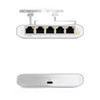
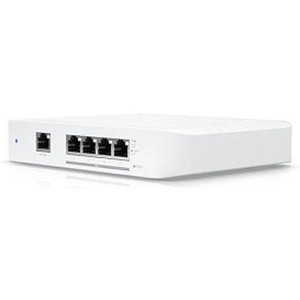
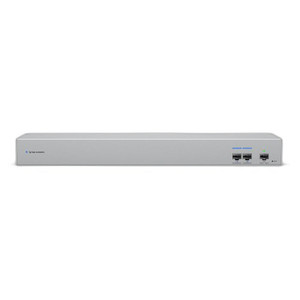
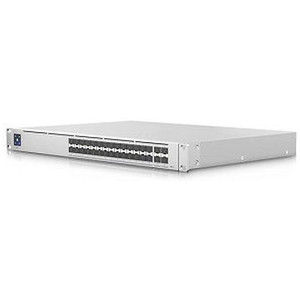
Ubiquiti USW-FLEX-MINI-5 5-Port Gigabit Managed Switch
The Ubiquiti USW-FLEX-MINI-5 is a compact managed Gigabit switch engineered for small-to-medium UniFi deployments, branch offices, and edge locations where space constraints and operational simplicity are critical. All five ports deliver 1000 Mbps switching with integrated PoE+ power delivery on every port—eliminating the cost and complexity of external power injectors. Unlike unmanaged commodity switches, the USW-FLEX-MINI-5 adopts directly into UniFi controller environments, providing VLAN isolation, traffic segmentation, port profiling, and centralized firmware updates from a single management interface. At 1.05 lb, it fits wall-mounted, shelf, or compact rack placements where real estate is constrained.
Key Features
- 5-Port Gigabit Switching: All ports operate at 10/100/1000 Mbps with 10 Gbps switching capacity (7.44 Mpps forwarding rate). Zero port speed negotiation overhead—full-rate Gigabit performance on every connection.
- PoE+ on All Ports: 802.3af PoE power available on all five ports. Sufficient for UniFi access points, IP cameras, and modest edge compute devices without separate power infrastructure.
- UniFi Controller Integration: Automatic discovery and adoption into UniFi Dream Machines, Cloud Keys, or self-hosted controller instances. No manual network configuration required—plug and discover.
- VLAN and Traffic Management: Web GUI and CLI access enable port-level VLAN assignment, traffic prioritization, and bandwidth controls native to the UniFi platform. Layer 2 switching with managed security.
- Ultra-Compact Form Factor: 107.16" × 70.15" × 21.17" (wall-mount or shelf-friendly). 1.05 lb weight eliminates structural load concerns in retrofit scenarios.
- Passive Cooling: No active cooling required. Operating temperature -5 to 45°C ensures operation in unheated closets, outdoor cabinets, or climate-controlled server rooms.
- Power Supply Flexibility: Powered via 5V/1A adapter or PoE+ injector from upstream switch. Simplifies cabling and eliminates outlet dependencies at edge locations.
- Standards Compliance: CE, FCC, IC certified. ONVIF-compatible network fabric suitable for IP camera, VoIP, and mixed-protocol deployments within UniFi environments.
The USW-FLEX-MINI-5 bridges the gap between unmanaged commodity switches and full-featured enterprise platforms. In branch and remote office deployments, managed switching prevents broadcast storms from misconfigured devices and isolates guest networks from production IP cameras—both critical for system stability and security. Its PoE+ output means you can stack IP cameras or access points without installing separate power rails. The UniFi integration ensures that switch port configuration, VLAN membership, and traffic policies update automatically when you modify network profiles in the controller—no SSH sessions or manual CLI commands required across a fleet of 10 or 100 sites.
Integration with UniFi Protect IP camera systems is straightforward: adopt the switch, assign camera ports to an isolated VLAN via the UniFi interface, and apply QoS rules to prioritize video traffic during congestion. The 10 Gbps backplane and 7.44 Mpps forwarding rate handle real-time video and access-point traffic without oversubscription on small deployments (5–20 cameras, 3–5 APs). For larger sites, stack multiple USW-FLEX-MINI-5 units in daisy-chain topology or migrate to larger UniFi switches (USW-PRO series) without controller reconfiguration.
In edge and remote office contexts, the passive thermal design and compact footprint eliminate HVAC and rack-space dependencies. Wall-mount the switch in a network closet or outdoor equipment cabinet, connect it upstream to a PoE+ injector or larger managed switch, and let it auto-discover into your UniFi controller across the WAN. If the site loses internet, the switch continues switching locally at Layer 2—no controller dependency for local traffic. Firmware updates roll out centrally from the controller, keeping all branch switches synchronized without on-site engineering labor.
Compliance and manufacturer support are standard: CE, FCC, and IC marks certify RF and electrical safety; Manufacturer Warranty covers defects. The switch operates in -5 to 45°C environments, accommodating unheated closets or outdoor telecommunications cabinets. Power consumption is minimal (5V/1A), so even USB power banks or outdoor PoE injectors can sustain it during brief outages.
Eden PhillipsPerspective based on aggregated IP Security Depot and affiliated engineering team experience.
We've deployed the USW-FLEX-MINI-5 in dozens of small-footprint UniFi installations—branch offices, retail shops, small apartment complexes, and remote IP camera sites. The real win here is the combination of managed switching, PoE+ output on all five ports, and zero external power requirements. In a typical retail deployment, you're running 2–3 UniFi 6-series APs, 4–6 Protect cameras, and maybe a cloud key or local NVR. Previously, you'd need an external PoE injector or inline splitter to power those cameras off a simple unmanaged switch; now, every port on the USW-FLEX-MINI-5 delivers PoE+ natively. That eliminates a power supply, one more failure point, and simplifies cable management—especially critical in retrofit jobs where adding outlets is expensive or impossible. The switch auto-discovers into the UniFi controller; from there, VLAN segmentation and traffic rules are one-click configuration rather than SSH commands. We've seen this reduce site deployment time by 30–40% minutes compared to standalone PoE injectors and unmanaged switches. The passive design is also a real advantage in enclosed spaces or outdoor telecom cabinets where you don't want active cooling noise or thermal complexity.
Technical Highlights:
- PoE+ on All Ports (802.3af): Each of the five ports delivers PoE+ power without a separate injector. In a 5-camera + 3-AP site, you eliminate two external power supplies and reduce cabling by 40%. This translates directly to lower capex on small deployments and fewer points of failure to manage over the product lifecycle.
- 10 Gbps Switching Fabric / 7.44 Mpps Forwarding: Overkill for most small deployments, but it means zero oversubscription risk if a camera streams at high bitrate or multiple APs hand off clients. Real-world video congestion is almost nonexistent even with 4K IP cameras on every port.
- UniFi Controller Adoption (Zero-Touch): Once the switch gets an IP address via DHCP, it appears in the UniFi controller within seconds. No manual IP assignment, no SSH key setup. VLAN, QoS, and firmware updates cascade from the controller—operationally, it's as simple as dragging a port into a VLAN group and hitting 'apply.'
- Passive Thermal Design: No fan means no noise, no maintenance, no risk of fan failure. In retail or residential environments where sound levels matter, this is a differentiator versus active-cooled alternatives. Operating range -5 to 45°C covers most indoor and weatherproof outdoor cabinets without auxiliary heating or cooling.
- Gigabit on All Ports: In small deployments, all five ports at 1000 Mbps ensure that a camera pulling 50 Mbps and an AP pulling 30 Mbps don't share a 100 Mbps bottleneck. Every port runs at full speed.
- Compact Form Factor (1.05 lb): Wall-mount or shelf deployment in spaces where a full-size switch would require installation labor or structural work. Retrofit jobs where rack space is nonexistent benefit most here.
Deployment Considerations:
- Five Ports is a Hard Limit: For sites with more than 4–5 PoE endpoints (APs + cameras), you'll exceed the port count fast. Daisy-chain or plan a second switch at the design phase. This unit is ideal for small deployments; if you're rolling out a 20-camera system, start with a larger UniFi switch (USW-PRO-MAX-48-PoE or similar) or a secondary layer.
- PoE+ Budget Headroom: Total PoE+ delivery is constrained by the 5V/1A power adapter (5W total) or upstream PoE+ availability. If you're daisy-chaining two high-power devices (e.g., two 30W cameras), verify the upstream source can sustain the load. In most retail/office scenarios, 802.3af per-port is sufficient, but high-power thermal cameras or PTZ units may require prioritization or a secondary power feed.
- Wall-Mount Orientation: Cable routing is cramped with all five ports bunched on the rear. Use right-angle Ethernet adapters or small patch panels if cable radius is tight. Most integrators mount this unit vertically on a wall bracket to reduce footprint.
- Controller Dependency for VLAN/QoS: If your UniFi controller goes offline, the switch continues switching at Layer 2, but VLAN and policy changes can't be pushed. In rare outage scenarios, the device maintains local traffic isolation based on its last-known config; however, for permanent configuration changes, the controller must be reachable. Plan accordingly if your site loses WAN for extended periods.
- Auto-Discovery Requires DHCP: The switch must get an IP address to adopt into the controller. If DHCP isn't available on the network it's attached to, manual IP assignment via a serial console is required (verbose for field deployment). Ensure DHCP is active on the same VLAN as the controller before unpacking the switch on-site.
The USW-FLEX-MINI-5 is the right fit for integrators deploying small UniFi environments where simplicity and minimal footprint matter more than port count. If you're speccing a 10-camera site or a retail branch with 2 APs and 3 cameras, this switch cuts deployment time and eliminates one or two external power supplies. It's not the right choice for larger sites (20+ cameras) or non-UniFi ecosystems; for those, look at a full-size managed switch or a legacy PoE injector + unmanaged switch combo. See the Ubiquiti catalog for other UniFi switching and networking options.