Ubiquiti UAP-NANOHD-5-US 802.11ac Wave 2 Access Point
Overview
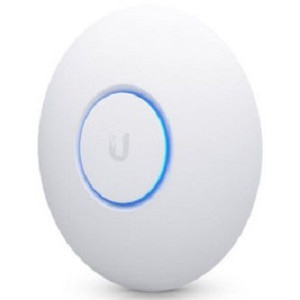
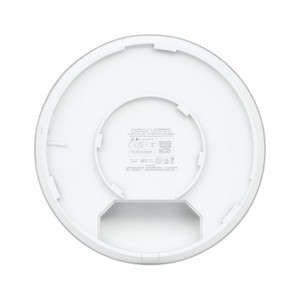
The Ubiquiti UAP-NANOHD-5-US is a compact 802.11ac Wave 2 access point designed for medium-density enterprise wireless deployments where centralized management and multi-client performance are non-negotiable. This model integrates into the Ubiquiti product family as a managed device within the UniFi ecosystem, meaning it requires a UniFi Network Controller (cloud or on-premises) for full capability unlock—provisioning, client steering, role-based access control, and airtime fairness all flow from the controller, not the access point itself. The UAP-NANOHD-5-US weighs 6.5 pounds and mounts flush to ceiling tiles or walls using included brackets, making it a natural retrofit choice when aesthetics matter as much as coverage.
Key Features
- 4x4 MU-MIMO Architecture: Serves multiple clients at full 802.11ac data rates simultaneously without performance degradation. In practice, this means a classroom full of tablets, a conference floor of laptops, or a hospitality lobby with guest devices all maintain individual throughput rather than sharing a single channel. Single-stream clients won't saturate the radio—the radio adapts to them.
- 802.11ac Wave 2 Standard: Delivers the throughput density required for knowledge worker environments, video streaming, and guest networks in offices, hospitality venues, and education settings. Wave 2 includes 160 MHz channel support where spectrum permits, doubling bandwidth compared to Wave 1 implementations on the same frequency.
- PoE Power Delivery (802.3at minimum): Draws within the 802.3at budget, eliminating the need for a separate power supply. No additional electrical runs, no UPS complications—standard Ethernet delivers both data and power. Simplifies wiring in retrofit scenarios and reduces installation labor.
- UniFi Network Controller Integration: Centralized SSID provisioning, per-SSID VLAN tagging, guest portal deployment, and band steering all emanate from a single controller dashboard. Multi-unit installations benefit from seamless roaming algorithms—client devices transition between access points without dropping connectivity. Controller can be cloud-hosted or on-premises; organizations using Dream Machine or UniFi Cloud Access Gateway can manage remote sites without maintaining local infrastructure.
- Compact Form Factor: 6.5-pound mounting profile fits ceiling tiles, wall plates, and retrofit spaces where larger access points won't suit aesthetics or space constraints. Not a bulky industrial box—design assumes professional environments where appearance factors into acceptance.
- Firmware Updates Over-the-Air: Once adopted into the UniFi Controller, the UAP-NANOHD-5-US receives firmware pushes over the network. No field visits for version management—your fleet stays synchronized without manual intervention.
Integration & Compatibility
The UAP-NANOHD-5-US coordinates with other UniFi devices—switches, security gateways, and storage appliances—for unified policy enforcement and traffic steering. If your infrastructure already includes UniFi switching, this access point deepens the integration: VLAN-aware switching can tag guest traffic separately from corporate traffic, enforcing policy at the switch level while the access point simply bridges the policy to wireless clients. Organizations mid-transition from consumer-grade Wi-Fi to managed infrastructure benefit from UniFi's role-based access control and user-centric airtime fairness—features unavailable in standalone mode but essential in mixed-device deployments.
Deployment Considerations
Pre-stage the device in the UniFi Controller before physical deployment for faster provisioning—no field reconfiguration needed. Plan RF coverage using UniFi's site survey tool; overlapping coverage areas rely on roaming thresholds to prevent client ping-ponging between access points. In open office layouts with concrete/drywall, expect 40–60 meter coverage per access point depending on client data rate tolerance. Monitor co-channel interference if deploying in a dense multi-tenant building; 802.11ac's 5 GHz spectrum is less congested than 2.4 GHz but requires line-of-sight or near-line-of-sight for optimal range.
Frequently Asked Questions
Q: Does the UAP-NANOHD-5-US work standalone without a UniFi Controller?
A: Yes, it can operate in standalone mode without a controller. However, advanced features—band steering, airtime fairness, per-SSID VLAN tagging, guest portal, and role-based access control—require active controller connectivity. Standalone mode is basic SSID broadcast only; not recommended for multi-device deployments.
Q: What's the maximum PoE power draw of the UAP-NANOHD-5-US?
A: The access point operates within the 802.3at (PoE+) budget. Standard 802.3af PoE supplies 15.4W maximum; the UAP-NANOHD-5-US draws less, making it compatible with any PoE injector or PoE switch output. Verify your switch output rating if daisy-chaining multiple access points on a single circuit.
Q: Can I mix the UAP-NANOHD-5-US with older UniFi access points in the same deployment?
A: Yes, older and newer UniFi access points coexist on the same controller. Roaming between mixed generations works but may not be seamless; devices roam based on signal strength thresholds, not generation. Modern clients (802.11ac compatible) prefer the UAP-NANOHD-5-US; legacy clients (802.11n or older) fall back to older access points if available.
Q: Does the UAP-NANOHD-5-US support 2.4 GHz and 5 GHz simultaneously?
A: Yes. It broadcasts on both bands simultaneously. Band steering (requires controller) automatically encourages 5 GHz-capable clients to prefer the less congested 5 GHz band, freeing 2.4 GHz capacity for legacy devices and IoT endpoints that don't support 5 GHz.
Q: What mounting options are included?
A: The UAP-NANOHD-5-US ships with ceiling tile and wall mounting brackets. Choose the one that fits your installation; PoE injector and Ethernet cable are separate procurement items.
Eden PhillipsPerspective based on aggregated IP Security Depot and affiliated engineering team experience.
The UAP-NANOHD-5-US is a workhorse for organizations scaling from ad-hoc Wi-Fi to managed infrastructure. The 4x4 MU-MIMO architecture matters most when you're serving concurrent clients—each client gets full 802.11ac rates instead of splitting a single pipe. Controller-based management is where this model earns its keep: unified SSID provisioning, per-SSID VLAN tagging, and transparent roaming reduce operational friction in multi-building deployments. Pair it with UniFi switching and you're looking at single-pane-of-glass visibility for both wired and wireless traffic.
Technical Highlights:
- 4x4 MU-MIMO (802.11ac Wave 2): Each concurrent client maintains full data rates; no throughput starvation when devices compete for radio capacity. Typical multi-user environments (offices, schools, hospitality) see real throughput gains versus single-stream access points.
- PoE Power (802.3at budget): Draws well within standard PoE limits—no special injectors, no power supply clutter at ceiling level. Means daisy-chaining multiple units without exhausting switch power budgets.
- UniFi Controller Requirement: Full-featured deployment (band steering, airtime fairness, guest portal) requires a controller. Standalone mode exists but strips away the features that justify managed infrastructure investment.
Deployment Considerations:
- Plan RF coverage before commissioning—802.11ac's 5 GHz range is shorter than 2.4 GHz, so expect 40–60m coverage per unit in open office. Pre-stage in the controller before mounting to avoid field reconfigurations.
- Watch out for dense multi-tenant buildings: 5 GHz spectrum is cleaner but requires near-line-of-sight. Co-channel interference from adjacent tenants can reduce effective range; use site survey tools to identify quiet channels before final placement.
Deploy the UAP-NANOHD-5-US in mid-market offices, K-12 schools, and hospitality chains where budget and performance must coexist. If your switching infrastructure is already UniFi, this access point completes the picture—zero-touch provisioning and unified troubleshooting reduce your NOC overhead. Not a fit for edge industrial sites (outdoor, temperature extremes) or single-AP deployments where controller overhead isn't justified.