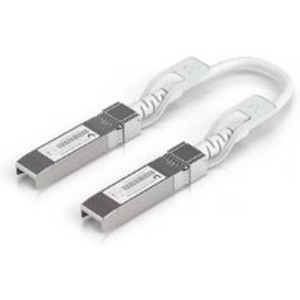
Ubiquiti UACC-OM-SFP28-SR 25G SFP28 Optical Transceiver
Overview
The UACC-OM-SFP28-SR is a 25 Gbps SFP28 optical transceiver designed for high-speed multi-mode fiber deployments on Ubiquiti switching and gateway infrastructure. This transceiver delivers sustained 25 Gigabit per second throughput over duplex LC UPC connections up to 100 meters—a useful ceiling for data center, campus backbone, and warehouse automation networks where fiber runs stay relatively short. The 850 nm operating wavelength is optimized for multi-mode fiber, the most common fiber type in enterprise local networks. Maximum power consumption is 0.8 W, meaning thermal load is minimal even in dense transceiver-packed switch chassis.
Key Features
- 25 Gbps sustained throughput: Full-duplex 25G line rate eliminates bandwidth bottlenecks on uplinks and inter-switch connections—critical when consolidating traffic from multiple 10G camera systems or high-speed NAS arrays.
- Multi-mode fiber (850 nm): Works with standard LC duplex multi-mode cabling already prevalent in enterprise networks; no need to source single-mode fiber or replace existing runs under 100 meters.
- 100-meter span: Covers typical data center and building backbone runs; exceeds most warehouse floor-to-control-room distances. Beyond 100 m, single-mode variants become necessary.
- Backward compatible to 1 Gbps and 10 Gbps: Negotiates down automatically if plugged into older SFP+ or 1G SFP ports, so you can repurpose or stage equipment without hard blocking incompatibilities. Useful for mixed-generation deployments.
- Hot-swappable SFP28 form factor: Fits SFP28, SFP+, and SFP slots on compatible Ubiquiti equipment without powering down the switch—allows module replacement or capacity expansion during live operation without planned downtime.
- Low power footprint (0.8 W max): Reduces cooling demand in high-density switch deployments and keeps per-port operational cost low, especially when scaling to dozens of fiber uplinks.
- Operating temperature 0–70°C: Suitable for standard enterprise server rooms and climate-controlled network closets; not rated for outdoor cabinets or uncontrolled storage areas.
- CLASS 1 LASER PRODUCT (IEC/EN 60825-1:2014): Standard laser safety classification; do not look into fiber ends or module when powered. Handle as you would any live fiber optic module.
Integration & Compatibility
The UACC-OM-SFP28-SR requires multi-mode fiber cabling with duplex LC UPC connectors (sold separately). Confirm your switch or gateway supports SFP28 slots before purchasing; many Ubiquiti UniFi and EdgeMAX devices feature SFP+ or 1G SFP but not SFP28. Backward compatibility to 10 Gbps and 1 Gbps allows use in existing SFP+ and SFP cages if needed, though throughput will be limited to the lower rate. For network design, this transceiver is an optical uplink component for building high-speed fabric between switches, NVRs, or servers. Pair with matching SFP28 transceivers on both ends of each run.
When planning fiber infrastructure, coordinate cable runs with network switch port planning to avoid exceeding 100-meter span or requiring unnecessary fiber splicing. Multi-mode fiber is cheaper than single-mode and easier to terminate in-house, but its distance limitation is a hard constraint—no amount of optical amplification changes that for unrepeatered links.
Deployment Context
This transceiver fits warehouse automation and larger IP security networks where camera clusters, NVRs, or analytics servers demand low-latency, high-throughput interconnect. If you're consolidating video streams from dozens of high-resolution cameras onto a central recorder, or daisy-chaining switches across a large facility, 25G fiber uplinks reduce encoding delay and eliminate packet loss on backbone segments. It also suits software-defined networking (SDN) deployments where orchestration traffic and redundancy protocols demand predictable, high-speed links.
When to Choose a Different Model
If your fiber runs exceed 100 meters, or if you need to cross building-to-building distances, step up to a single-mode SFP28 variant (e.g., an equivalent SR4 or LR4 transceiver) and plan for single-mode fiber installation. If you don't need 25G and are building a smaller network, standard 10G SFP+ or even 1G SFP transceivers are lower-cost and draw less power. If your switches don't have SFP28 slots, confirm backward-compatible SFP+ operation or budget for a switch upgrade.
Frequently Asked Questions
Q: Does the UACC-OM-SFP28-SR work in standard SFP or SFP+ slots?
A: Yes, the module is backward compatible and will negotiate down to 10 Gbps or 1 Gbps on older SFP+ or SFP slots. However, you forfeit the 25G throughput advantage. Install it in an SFP28 slot on compatible Ubiquiti switches to realize full speed.
Q: What's the maximum fiber run distance?
A: Up to 100 meters (328 feet) over multi-mode fiber. Beyond that, single-mode fiber and a single-mode transceiver variant are required.
Q: Can I use single-mode fiber with this transceiver?
A: No. The UACC-OM-SFP28-SR is designed for multi-mode fiber at 850 nm. Single-mode fiber requires a different transceiver optimized for longer wavelengths (1310 nm or 1550 nm).
Q: Is the UACC-OM-SFP28-SR hot-swappable?
A: Yes. You can insert or remove the module without powering down the switch, as long as the interface supports hot-swap (most modern Ubiquiti equipment does).
Q: What's included in the package?
A: Only the transceiver module itself. You must purchase multi-mode fiber cabling with duplex LC UPC connectors separately.
Q: What power consumption should I budget for?
A: Maximum 0.8 W per module. In high-density deployments (e.g., 24 SFP28 uplinks), total optical module power is under 20 W—negligible compared to switch chassis power draw.
Ted PerryPerspective based on aggregated IP Security Depot and affiliated engineering team experience.
I use the UACC-OM-SFP28-SR (often searched as UACC OM SFP28 SR) in warehouse automation and campus security backbone builds where you need fiber uplinks between switches but can't justify the cost or complexity of single-mode infrastructure. The 25 Gbps line rate is the real win here—it eliminates any question about whether your switch uplink is a bottleneck, and the 100-meter multi-mode span covers 90% of real facility runs.
Technical Highlights:
- 25 Gbps line rate: Dual-direction, full-duplex throughput means you're never starving downstream ports for capacity. On a 24-port camera switch pushing concurrent 4K streams to an NVR, this eliminates congestion tail events.
- 0.8 W power budget: Negligible thermal contribution in even the densest port configurations. Stack 12 uplinks without thermal management headaches.
- Automatic negotiation (1G / 10G / 25G): Backward compatibility prevents stranded hardware. If you swap in an older SFP+ switch, the module doesn't brick—it just runs at 10G.
- 850 nm, multi-mode optimized: Your existing campus fiber plant almost certainly has multi-mode runs. No re-cabling required for short spans.
Deployment Considerations:
- 100 meters is a hard ceiling for unrepeatered multi-mode. Measure your runs before committing. If a single run is 120+ meters, you need single-mode fiber and a different transceiver—retrofitting is expensive.
- Multi-mode cabling is cheap, but termination quality matters. Dirty LC UPC connectors cause optical power loss and frame errors. Invest in proper termination or buy pre-terminated runs from a reputable vendor.
- Not all Ubiquiti switches have SFP28 slots. Verify your hardware supports SFP28 before ordering. Many EdgeMAX routers use older SFP+ or 1G SFP only.
This transceiver is purpose-built for the moment when a switching fabric outgrows copper gigabit Ethernet but doesn't yet justify the cost and complexity of dark fiber leases or long-distance single-mode runs. It's the practical middle ground for facilities that are large enough to need true fiber backbone speed but small enough to fit under 100-meter runs.