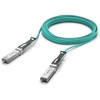
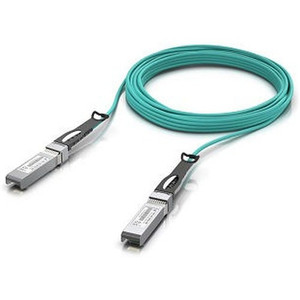
Ubiquiti UACC-AOC-SFP28-20M 25Gbps Active Optical Cable
Overview
The Ubiquiti UACC-AOC-SFP28-20M is a 25Gbps active optical cable (AOC) designed to connect SFP28-equipped ports on enterprise switches, routers, and network appliances over distances where copper direct-attach cables fall short. This 20-meter aqua-colored cable bridges the gap between high-density switching and distant infrastructure without the cost and power overhead of standalone optical transceivers. Deploy it in data center fabrics, campus backbone runs, and service provider environments where standard copper DACs max out around 3 meters.
Key Features
- 25GBase-AOC (25 Gbps rated): Delivers full-wire-rate performance for high-bandwidth infrastructure links. Unlike passive copper DACs, active optics consume power but handle significantly longer runs without signal degradation — critical when bridging equipment racks or buildings 20 meters apart.
- 20-meter reach: Copper DACs typically cap at 3–5 meters depending on gauge and quality. This 20m rating means you can route the cable through conduit, under floor plenum, or across longer equipment row distances without splitters or repeaters.
- SFP28 connector: Direct insertion into any SFP28 port supporting 25Gbps operation. No transceiver swaps or external optical modules needed — simplifies inventory and reduces per-connection cost versus buying separate SFP28-SR optics.
- Active electrical design: The cable includes integrated electronics to regenerate the optical signal. Power draw is minimal (typical active AOCs draw 0.5–1W), but verify your switch's SFP power budget if deploying many units simultaneously.
- Aqua jacket: Standard color-coding for 25G interconnects. Helps distinguish from lower-speed cabling during audits and maintenance.
- Third-party compatibility: Not locked to Ubiquiti hardware. Works with any switch, router, or appliance featuring standards-compliant SFP28 ports — including Cisco, Arista, Juniper, and other enterprise platforms. Verify port firmware supports 25GBase-AOC before deployment.
Integration & Compatibility
Designed to work with Ubiquiti UniFi enterprise infrastructure as well as third-party 25G-capable equipment. Compatible with standard 25GBase-AOC endpoints found in data center switching, edge routing, and service provider aggregation layers. Before ordering, confirm your target switch or appliance supports 25Gbps operation on the SFP28 ports and review any firmware or module qualification notes from the equipment manufacturer. Some older switches may require a firmware update to recognize active optical cables.
Deployment Context
This cable replaces the need for passive 25G copper DACs when distance or environment rules them out. Common scenarios: connecting top-of-rack to core switches 15–20 meters away; bridging two equipment rooms in the same building; extending an optical circuit the last 20 meters from the MDF to a remote cabinet. Not suitable for inline network TAPs, passive optical monitoring, or environments where active electronics cannot be powered.
Frequently Asked Questions
Q: Will the UACC-AOC-SFP28-20M work in my Cisco or Arista switch?
A: Yes, provided the switch has SFP28 ports rated for 25Gbps and firmware supports standard 25GBase-AOC. Verify the switch's port specifications and consult the vendor's compatibility matrix before purchase.
Q: What is the power consumption of this cable?
A: Active optical cables typically draw under 1W. Check your switch's SFP power budget (usually 1–2W per port on enterprise platforms) to ensure no overload.
Q: Can I use this cable with passive SFP28 modules or transceivers?
A: No. This is a direct-attach active cable. Do not attempt to plug it into standalone SFP28 transceivers or modules — it is a complete cable assembly with integrated drivers.
Q: What is the maximum distance the UACC-AOC-SFP28-20M supports?
A: Rated for 20 meters. Exceeding this distance risks signal degradation and packet loss. For runs beyond 20m, use separate 25G optical transceivers with fiber.
Q: Is this cable hot-swappable?
A: Yes. Like all SFP modules and cables, you can insert or remove it while the switch is powered on without hardware damage. However, the connection will drop during the swap — plan for brief traffic interruption on that link.
Ted PerryPerspective based on aggregated IP Security Depot and affiliated engineering team experience.
The UACC-AOC-SFP28-20M (often searched as UACC AOC SFP28 20M) solves a real problem in dense data center builds: copper DACs run out of range around 5 meters, and swapping in separate optical transceivers gets expensive fast. A 20-meter active optical cable removes that constraint without forcing you into a full fiber infrastructure project.
Technical Highlights:
- 25Gbps full-rate throughput: No speed negotiation or downgrade — you get wire-rate performance for modern switch fabrics. Useful when bonding multiple 10G circuits or running a single 25G uplink without bottlenecks.
- Integrated active optics: The cable houses its own laser drivers and receiver electronics. That means sub-1W power draw and zero manual transceiver configuration — plug and go if your switch firmware recognizes it.
- 20m distance rating: Real-world deployment distance. Covers most intra-building interconnects: top-of-rack to core, equipment room to remote cabinet, or cross-aisle runs in large data centers without conduit pinch-points.
Deployment Considerations:
- SFP power budget: Verify your switch allocates at least 1W per SFP port. Most enterprise switches do, but older gear or high-density line cards sometimes cap at 0.5W — check before bulk ordering.
- Firmware qualification: Some switches require a firmware update or specific module qualification to recognize active AOC cables. Passive copper DACs have no such requirement. Budget a test deploy and firmware check into your plan.
- Not passive-optical compatible: This is an active cable assembly, not a transceiver. You cannot remove it from the cable jacket and swap it into a separate module slot. Treat it as a complete unit.
Deploy the UACC-AOC-SFP28-20M when you need to bridge equipment 10–20 meters apart and cannot justify fiber runs with external optics. It's economical for campus backbones, small data centers, and edge aggregation where a handful of long-distance 25G links make sense.