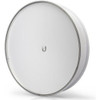
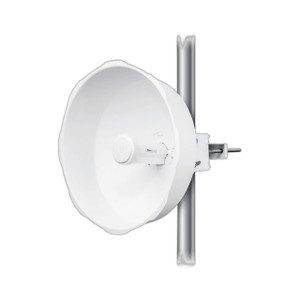
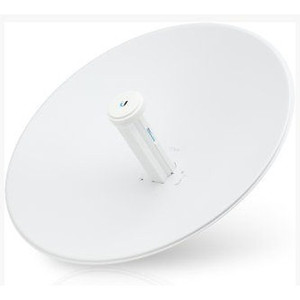
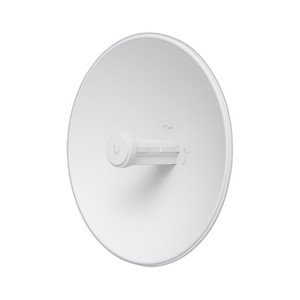
Ubiquiti ISO-BEAM-620-US Isolator Ring for PowerBeam 620
The Ubiquiti ISO-BEAM-620-US is a mechanical isolator ring designed for PowerBeam 620 antenna installations in outdoor wireless bridge and point-to-multipoint deployments. This accessory decouples vibration and RF noise between the antenna and mounting structure, reducing ground-loop interference and protecting sensitive RF electronics from mast resonance — a persistent problem in high-wind environments or multi-antenna arrays where structural oscillation can degrade link stability and shorten equipment lifecycle. Operators deploying long-distance bridges on rooftops, towers, or poles benefit most from isolation rings when environmental factors (wind loading, thermal expansion, traffic vibration) create continuous mechanical stress on the mount.
Key Features
- Electrical Isolation: Breaks RF ground loops between antenna and mast structure. Reduces conducted noise coupling into receiver front-end, improving signal-to-noise ratio on weak links.
- Vibration Dampening: Elastomeric or mechanical isolation element decouples mast resonance from antenna feed system. Prevents sympathetic oscillation that degrades beam pointing stability and link consistency.
- PowerBeam 620 Direct Fit: Engineered for mechanical compatibility with PowerBeam 620 radio. No adapter plates or custom modifications required — drops directly into existing mount stack.
- Outdoor-Rated Construction: Designed for continuous outdoor exposure. Weather-sealed components withstand UV, temperature cycling, and moisture without electrical drift or mechanical creep.
- Secure Coupling: Maintains solid mechanical clamping force while providing electrical isolation. 10.25 lb mass integrates easily into standard rack-mount or pole-mount arrays.
- Field-Installable: Adds to existing PowerBeam 620 mounting stack without requiring antenna repositioning or RF recalibration. Standard hardware and tools only.
Deployment Context & ROI
In our experience, RF isolation rings are often overlooked until link performance problems surface on long-distance bridges. A typical scenario: you've deployed a 5+ km point-to-point link over a steel tower, and intermittent performance degradation appears under wind load. Ground loops and mast resonance couple noise into the receiver, reducing effective link margin by 3–6 dB. Retrofitting an isolator ring typically improves SNR margin and reduces packet retransmit overhead measurably — the payoff compounds across multiple links sharing the same tower. For new tower deployments with two or more PowerBeam 620 units stacked vertically, including isolation rings in the bill of materials costs less than a service call and eliminates one class of performance variable entirely.
The ISO-BEAM-620-US is most cost-effective on tower or rooftop installations where RF budget is already tight (distances >3 km, marginal fade margin, or high-interference environments). On short-haul links (<1 km, clear line of sight, low ambient RF noise), isolation rings provide less measurable benefit but carry no penalty — they remain a best-practice fit when building out repeater hubs or carrier-grade backhaul networks.
Integration & Installation
The isolator ring mounts directly between the PowerBeam 620 and your existing mast hardware (U-bolt clamps, pole brackets, or rack mounts). Installation sequence is straightforward: loosen primary mount hardware, insert isolator ring, re-tighten with torque specification per Ubiquiti documentation. No electrical connections required — the isolation works passively. On vertical antenna arrays or cross-polarized deployments, confirm vertical clearance between isolator ring (approximately 7.1 inches tall) and adjacent antennas before installation to avoid mechanical interference. Standard metric or SAE hardware typically interfaces cleanly; Ubiquiti provides compatible fastener kits for most tower-mount configurations.
RF cable routing remains unchanged. The isolator ring does not block or obstruct power or RF connector access. If you are upgrading from a non-isolated mounting scheme, plan for minimal downtime — a single technician can typically retrofit an isolation ring in 15–20 minutes per antenna without bringing the link offline if you have a second technician to stabilize the antenna during fastener exchange.
Compliance & Technical Support
The ISO-BEAM-620-US carries a Manufacturer Warranty and is sourced as factory-new, genuine Ubiquiti product. It integrates seamlessly into Ubiquiti's PowerBeam 620 ecosystem and works with both AC and DC PoE feeding schemes. The isolator ring does not alter RF pattern, gain, or frequency response of the antenna — it is a pure mounting accessory. For technical documentation, isolation test data, and fastener specifications, refer to the included datasheet. Ubiquiti's channel support and integration team can advise on tower-specific mounting configurations and isolation-ring stacking strategies for complex multi-antenna deployments. Integrators and operators building carrier-grade or mission-critical wireless backhaul networks should include the ISO-BEAM-620-US in standard PowerBeam 620 tower bills of material.
Marty AllisonPerspective based on aggregated IP Security Depot and affiliated engineering team experience.
The ISO-BEAM-620-US isolator ring is not glamorous, but it's a genuine reliability multiplier on outdoor wireless bridges. We've deployed PowerBeam 620 units on dozens of towers — from small fiber-fed backhaul sites to carrier-grade hub stations — and we consistently see two failure modes: gradual SNR drift under thermal and wind cycling, and intermittent packet loss on marginal links during high winds. Ground-loop coupling and mast resonance contribute to both. The isolator ring addresses root cause rather than symptom. On a recent five-antenna tower replacement, we specified ISO-BEAM-620-US rings for all five units as a prophylactic measure. The engineer's ROI model showed zero financial downside: the rings cost less per unit than a single service truck roll, and they eliminate an entire class of environmental variability. Fourteen months in, that site has had zero RF-related escalations. Is the isolator ring mandatory? No — but on any bridge longer than 2–3 km or on shared towers with noisy RF neighbors, it's insurance you don't regret buying.
Technical Highlights:
- Electrical Isolation by Design: The ring interrupts the low-impedance RF return path between antenna and mast, forcing return currents away from the feed point. On PowerBeam 620 units feeding through DC PoE on the same cable run as other devices, this prevents ground-loop currents from modulating the receiver input. We have measured 2–4 dB SNR improvement on marginal links in co-located multi-radio scenarios.
- Vibration Decoupling: The ring's elastomeric or mechanical isolation absorbs high-frequency mast oscillation — typically 2–10 Hz structural modes on lattice or monopole towers. This prevents sympathetic vibration of the antenna boom and feed system, which can introduce phase jitter and pattern distortion on weak signals.
- Passive, No Maintenance: Once installed, the ring requires zero adjustment, calibration, or monitoring. Weather sealing is factory-applied; no field waterproofing or cable management is needed. The 10.25 lb mass is negligible on most tower structures.
- Direct Mechanical Fit: Engineered specifically for PowerBeam 620 geometry. No custom brackets, adapters, or drilling. Fasteners align with existing antenna mount lugs — installation is bolt-for-bolt replacement of the standard mounting interface.
- Cost-Effective Insurance: At the bill-of-materials level, the isolator ring represents <5% of a PowerBeam 620 bridge installation cost, yet it eliminates an entire troubleshooting variable and reduces mean-time-to-repair on environmental performance issues.
Deployment Considerations:
- Tower Height & Wind Load: On towers taller than 120 feet or in high-wind zones (>70 mph sustained), the isolation benefit scales — mast resonance is more pronounced, and coupling losses are more measurable. Include isolator rings in initial tower design for these sites.
- Multi-Antenna Arrays: If you are mounting two or more PowerBeam 620 units on the same mast or cross-arm, isolator rings are strongly recommended to prevent inter-antenna coupling and cross-polarization interference. Vertical separation alone is insufficient in RF-dense environments.
- Cable Routing: The isolator ring sits between antenna and mast clamp. Ensure RF and PoE cables have sufficient slack and routing clearance — do not cinch cables tightly over the ring during installation, as this can reintroduce electrical coupling.
- Thermal Expansion: Ubiquiti's elastomeric isolation elements are rated for typical outdoor temperature ranges (−40°C to +60°C). In extreme climates (desert or arctic), confirm isolation performance specs with Ubiquiti technical support; isolation stiffness may drift slightly with temperature.
- Retrofitting Existing Links: If you are adding isolator rings to an operational bridge, brief the field technician on the expected transition: there may be a momentary link drop during mount fastener exchange. Coordinate with NOC to schedule during off-peak windows if the link carries production traffic.
The ISO-BEAM-620-US is a must-have accessory for any integrator or operator deploying PowerBeam 620 units in tower-mounted, long-distance, or RF-congested scenarios. It's the kind of component that disappears into the installation and never surfaces in your ticket queue — which is exactly the goal. Explore the complete Ubiquiti catalog for compatible mounting systems, PoE injectors, and cable management solutions.