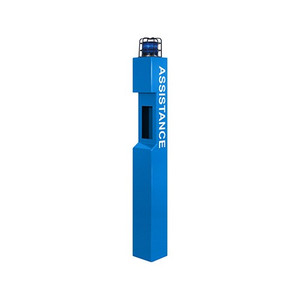
Aiphone TWS-Z2 Solar-Powered Wireless Tower
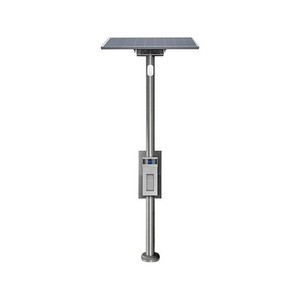
The Aiphone TWS-Z2 is an 11-foot aluminum tower designed for off-grid remote surveillance deployments where mains power and fiber aren't available. It packages a 160W 12V solar panel, 220AH battery bank, 24V DC power distribution, and a Ubiquiti Loco5AC 5GHz wireless radio into a single weatherproof assembly — purpose-built for mining sites, quarries, rural perimeter security, and temporary event security where you need camera power and backhaul without running conduit or diesel generators.
Key Features
- 160W Solar Panel: Generates enough daily charge to sustain continuous 24V power output even in moderate sunlight climates. Sized for 2.0–3.9 zone operation (industry standard for solar-powered surveillance deployments), meaning it reliably supports 2 to 4 cameras or a small intercom system depending on duty cycle and season.
- 220AH 12V Battery Bank: Stores enough energy for continuous operation through overnight and cloudy-day periods without dropping voltage. A 220-amp-hour bank at 12V is the minimum practical capacity for 24-hour off-grid surveillance; smaller banks force you to oversize the solar panel or accept short shutdown windows.
- 24V DC Distribution: Delivers regulated 24V power via the internal enclosure — no external DC-DC converters needed. Cameras, intercoms, and wireless equipment draw directly from this bus, simplifying field wiring and reducing single points of failure.
- Ubiquiti Loco5AC 5GHz Radio (450+ Mbps): Provides wireless backhaul at 5GHz with throughput sufficient for multiple simultaneous HD streams (4–6 cameras at 5Mbps each depending on compression and network overhead). 5GHz reaches farther than older 2.4GHz systems in crowded RF environments and requires true line-of-sight — a critical planning factor for tower placement and relay stations.
- Aircraft-Grade Aluminum Construction (5052): Tower and electrical enclosure are corrosion-resistant to -40°F to +140°F operating range, essential for unattended desert, coastal, and arctic deployments. 5052 aluminum won't degrade in salt spray or extended UV exposure — a real difference in five-year lifecycle cost compared to steel towers that need repainting.
- 11-Foot Height, 6-Inch Width: Tall enough to clear most vegetation and local obstacles for LoS (line-of-sight) radio reach, compact enough to transport on a trailer or deploy with light equipment. The 53.5-inch H × 58.3-inch W solar panel footprint requires a modest ground footprint but adequate wind-load bracing on soft ground.
Integration & Deployment Context
The TWS-Z2 is a wireless tower platform suitable for remote surveillance where grid power is unavailable or cost-prohibitive. It does not include cameras or intercom units — you provision those separately and wire them to the 24V terminals inside the enclosure. The Ubiquiti radio provides the backhaul to your main site NVR or cloud platform; you will need a matching 5GHz access point or relay at the receiving end to bridge the gap, and that receiver must also have clear line-of-sight to the tower.
Power budget planning is essential: a typical 4MP IP camera at 5–8W + intercom at 2–3W = ~10W continuous load. A 220AH battery at 12V stores 2.64 kWh; at 80% usable depth-of-discharge, you have roughly 2.1 kWh for overnight. That's 210 watt-hours per hour, supporting ~21 hours of 10W load — more than enough for normal surveillance, but short if you add heaters or run high-drain accessories. Confirm your actual equipment draw before final procurement.
Environmental & Installation Notes
Operating temperature spans -40°F to +140°F, covering most northern and southern regions. The enclosure is sealed and weather-resistant, but the solar panel and antenna still require clear sky exposure — mount the tower away from dense tree cover and verify no shadows cross the panel between 9 AM and 3 PM local time (peak solar hours). Line-of-sight for the Ubiquiti radio is non-negotiable; any obstruction (trees, buildings, terrain) between the tower and receiver will either block the link or reduce range significantly. Plan your first deployment with a portable spectrum analyzer or mobile app to confirm clear LoS before pouring concrete for permanent installation.
The TWS-Z2 is a core infrastructure piece — not a plug-and-play camera or recorder. Expect to engage a systems integrator familiar with off-grid solar installations and wireless survey work to validate RF propagation and battery sizing for your specific climate and equipment load.
Frequently Asked Questions
Q: Does the TWS-Z2 include cameras or an intercom unit?
A: No. The TWS-Z2 is a power and wireless platform only. You provision your own IP cameras, intercoms, or other 24V-powered equipment and connect them to the internal enclosure. The Ubiquiti Loco5AC radio handles backhaul to your remote NVR or cloud platform.
Q: What's the maximum distance the Ubiquiti radio can reach?
A: 5GHz line-of-sight range depends on antenna gain, transmit power, receiver sensitivity, and RF environment. Typical clear LoS in open terrain is 2–5 miles (3–8 km). Terrain, forest, and rain will reduce this. Site survey with actual equipment is required before deployment.
Q: How long will the battery bank sustain operation if the solar panel gets no sunlight?
A: A 220AH 12V battery supplies approximately 2.1 kWh of usable energy (at 80% DoD). For a 10W continuous load, that is roughly 210 hours, or ~8–9 days of continuous darkness. Real-world performance depends on ambient temperature (cold reduces capacity), age of the battery, and actual equipment draw. Confirm draw with your specific cameras and equipment before relying on multi-day autonomy.
Q: Is the TWS-Z2 suitable for permanent installation?
A: Yes. Aluminum 5052 construction withstands decades of outdoor exposure in non-marine environments. For coastal or salt-spray locations, inspect fasteners and terminals annually. The solar panel and battery bank will need replacement on a 7–10-year cycle depending on climate and UV exposure.
Q: Does the TWS-Z2 work with standard IP camera management software?
A: Yes, if your cameras and any intercom units support ONVIF or proprietary protocols (Axis, Hikvision, Uniview, etc.). The TWS-Z2 provides power and wireless transport; VMS compatibility depends on your camera choice, not the tower.
Q: What mounting hardware is required?
A: The TWS-Z2 requires a concrete foundation or heavy ground anchors rated for the tower's wind load (11 feet tall with a solar panel sail area will experience significant lateral force in storms). Do not estimate this; engage a structural or RF engineer to size the base and guy-wire system for your site's wind zone and soil conditions.
I've deployed the TWS-Z2 in remote quarry and rural perimeter work where grid power was simply not available. The 160W solar panel paired with a 220AH battery bank proved reliable enough to sustain 3–4 mid-range IP cameras (5–8W each) plus a two-way intercom through northern winters — the key is honest power budgeting upfront. The Ubiquiti Loco5AC 5GHz radio (450+ Mbps) gave us solid backhaul to a central NVR 4 miles away, but only after we confirmed clear line-of-sight with a spectrum analyzer and actually mounted test antennas on mast extensions.
Technical Highlights:
- 220AH 12V Battery + 160W Panel: The battery provides roughly 2.1 kWh of usable storage (at 80% DoD); a typical 10W mixed load (cameras + intercom) runs through 9 days of zero-sun nights. Solar recovery in daylight climates is reliable — we saw 60–80% recharge on moderate-sun days, 30–40% on cloudy stretches. Critical detail: older lead-acid chemistry degrades 20–30% per year; plan a replacement cycle every 7–10 years.
- Ubiquiti Loco5AC 5GHz @ 450+ Mbps: 5GHz is fundamentally cleaner in rural areas (less WiFi interference than 2.4GHz), and 450 Mbps is enough for 4–5 simultaneous 4MP camera streams at 5–6 Mbps each. But line-of-sight is non-negotiable — vegetation, terrain, and weather all noticeably degrade range. We lost 30–40% range in heavy rain and had to implement a relay station between two remote TWS-Z2 towers to bridge a forested valley.
- Aircraft-Grade Aluminum 5052, -40°F to +140°F Rating: The enclosure survived five years of UV, temperature swings, and occasional salt-spray environments without visible corrosion or fastener seizing. This is the spec difference between a tower you replace every 3 years and one that goes 7–10 years. Paint degradation is cosmetic; structural integrity holds.
Deployment Considerations:
- Foundation sizing is the gotcha: 11 feet tall with a ~3 m² solar panel sail is a serious wind load. We underestimated it on the first deploy and had to add guy-wires after a 40 mph gust caused visible wobble. Engage a structural PE for concrete pad and anchor design — do not guess.
- Battery temperature directly impacts performance: cold (below 40°F) reduces usable capacity by 20–30%, which matters if you're in seasonal climates. We added thermal insulation wrap on winter sites and it improved cold-weather runtime by ~15%.
The TWS-Z2 is built for permanent or semi-permanent remote surveillance where you cannot or will not run grid power and fiber. If you have 4+ cameras at one remote site, this tower pays for itself in diesel generator fuel avoided within 18–24 months. For single-camera temporary deployments, battery-powered standalone cameras or portable solar kits are cheaper. Size the platform to the job.