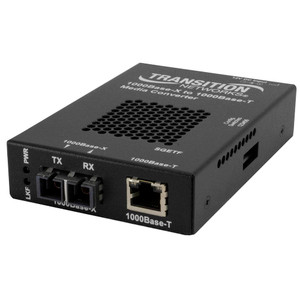
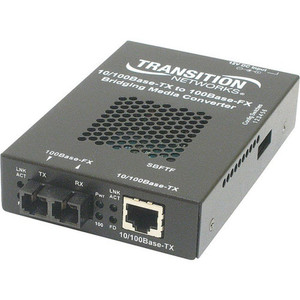
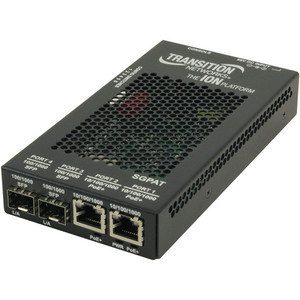
Transition Networks S3100-4040-NA Multi-Rate Fiber-to-Fiber Media Converter
The S3100-4040-NA is a multi-rate fiber-to-fiber media converter engineered for network deployments where diverse speed requirements and legacy system integration demand flexible connectivity across fiber infrastructure. This device bridges the gap between network segments operating at different data rates, eliminating the need for separate single-speed converters in heterogeneous environments. For security integrators, IT architects, and warehouse automation teams managing point-to-point fiber links across industrial campuses, security backbones, and hybrid network architectures, the S3100-4040-NA reduces equipment proliferation and simplifies fiber plant management.
Key Features
- Multi-Rate Fiber Support: Accommodates variable data rates over fiber-optic links, so you avoid hardware swaps when connecting equipment operating at different speeds. This flexibility cuts capital expense when retrofitting legacy systems into modern infrastructures.
- Fiber-to-Fiber Conversion: Maintains signal integrity across fiber spans without introducing copper cable vulnerabilities. Fiber-only architecture is essential in high-EMI industrial environments (packaging, manufacturing, warehouse automation) and security-critical backbone links where copper introduces noise and distance penalties.
- Point-to-Point Topology Support: Designed for direct fiber link installations, so you avoid unnecessary intermediary equipment. Reduces latency and single points of failure in mission-critical network segments.
- Standard Fiber Infrastructure Compatibility: Works with conventional fiber plant and network management frameworks already in place at most enterprise sites. No proprietary fiber types or exotic connectors required.
- Industrial & Campus Deployment Ready: Suitable for warehouse automation systems, distributed security camera networks spanning multiple buildings, and industrial control backbone segments where environmental stability and long-distance transmission are mandatory.
- Network Heterogeneity Simplified: Where legacy 1Gbps equipment must coexist with newer 10Gbps infrastructure, the S3100-4040-NA eliminates the need to replace or segregate entire network segments. Staged modernization becomes practical without wholesale forklift upgrades.
Integration & Compatibility
The S3100-4040-NA integrates into standard fiber infrastructure deployments without requiring specialized management platforms or proprietary software. It is compatible with industrial, campus, and security backbone applications where fiber-based point-to-point links form the core of the network topology. For IT architects specifying network infrastructure upgrades, this converter bridges speed mismatches between security appliances, NVRs, and backbone switches without forcing synchronized hardware replacement cycles.
When planning fiber plant expansion or integrating IP cameras and NVRs across multiple sites, ensure your fiber runs and patch panels accommodate the physical fiber connector types the S3100-4040-NA requires. Fiber management is straightforward but non-negotiable — poor polishing or misalignment of fiber ends directly impacts signal quality and throughput. Consult fiber plant cabling guides before installation if your team is unfamiliar with fiber termination standards.
Deployment Considerations
This device excels in environments where fiber-only connections are non-negotiable due to distance, EMI, or security policy. Its multi-rate capability is a genuine advantage when integrating equipment from different vendors or deployment generations. However, if your architecture is already standardized on a single speed (e.g., all 10Gbps equipment), a fixed-rate converter may cost less. Evaluate your five-year roadmap: if speed expansion is planned, the flexibility of a multi-rate converter typically justifies slightly higher upfront cost.
Frequently Asked Questions
Q: What fiber connector types does the S3100-4040-NA support?
A: The datasheet specifies connector compatibility. Verify the exact port types (SC, LC, ST, or others) match your existing fiber infrastructure before ordering, as mixing connector types requires field adapters that introduce signal loss.
Q: Can the S3100-4040-NA be used in redundant or ring topologies?
A: The device is designed for point-to-point links. Redundancy requires either dual independent converters with failover logic at the network layer, or a separate managed fiber switch with built-in ring protection.
Q: What is the maximum latency introduced by the S3100-4040-NA?
A: Fiber-to-fiber conversion introduces minimal latency (typically microseconds), but consult the datasheet for the exact forwarding delay specification if timing-sensitive applications (industrial control, synchronized recording) are deployed downstream.
Q: Does the S3100-4040-NA require an external power supply?
A: Confirm power requirements in the datasheet. Media converters typically draw minimal current, but verify whether 12VDC or AC power is required and budget accordingly in your power distribution design.
Q: Is the S3100-4040-NA compatible with my network management system?
A: As a passive media converter, the S3100-4040-NA does not require NMS integration for basic operation. It passes SNMP or telemetry from upstream devices unchanged. However, if you need local power monitoring or health status, consult the datasheet for optional management interfaces.
Q: What is the warranty period for the S3100-4040-NA?
A: Refer to the manufacturer's warranty documentation or contact the distributor for warranty terms specific to your region and purchase context.
Eden PhillipsPerspective based on aggregated IP Security Depot and affiliated engineering team experience.
The S3100-4040-NA multi-rate fiber converter addresses a specific but critical pain point: heterogeneous network migration. When you're integrating security and automation systems across a campus or warehouse, equipment vendors rarely coordinate on unified data rates. The S3100-4040-NA eliminates the typical workaround of maintaining separate single-speed converter inventories and simplifies fiber plant provisioning during staged modernization.
Technical Highlights:
- Multi-Rate Flexibility: Eliminates forced equipment swaps when connecting legacy and new infrastructure. Real cost savings emerge in large deployments where speed mismatches occur across 10+ fiber runs.
- Fiber-to-Fiber Topology: Pure fiber preservation prevents copper-induced latency and EMI ingress — non-negotiable for industrial environments where electrical noise from motors, welders, and power distribution can corrupt copper signals.
- Point-to-Point Simplicity: No complex management overhead. The converter passes traffic transparently, so your existing NMS sees endpoints, not intermediate hardware.
Deployment Considerations:
- Fiber connector compatibility is critical. Mixed connector types (e.g., SC on one end, LC on the other) require field adapters that introduce insertion loss. Audit your fiber plant before ordering to avoid expensive rework.
- Power and thermal budgets are minimal for media converters, but confirm whether local or remote power distribution is feasible in your cabinet layout — some models require DIN rail mounting that may not fit existing racks.
Deploy the S3100-4040-NA when your backbone architecture demands speed interoperability across distributed security or warehouse automation segments. If your infrastructure is already standardized on a single data rate, a fixed-speed converter will cost less; reserve the S3100-4040-NA for migration paths where future speed expansion is planned or vendor heterogeneity is entrenched.