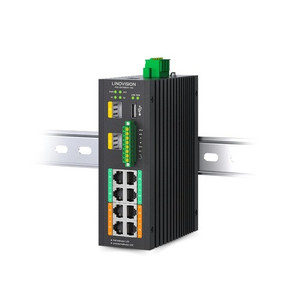
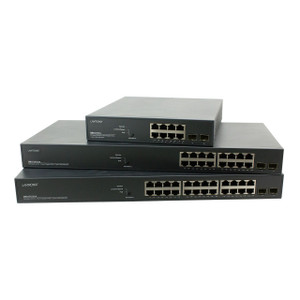
Transition Networks LSS2200-8P 8-Port Managed PoE++ Switch
Overview
The LSS2200-8P is an 8-port managed switch engineered for security infrastructure, surveillance networks, and industrial deployments where reliable power delivery and traffic management are non-negotiable. Built around hardened PoE++ (802.3bt) power delivery, this switch consolidates both network connectivity and high-wattage power distribution into a single managed device—eliminating the need for separate PoE injectors or power supplies at the edge.
Managed switching capability means you get VLAN segmentation, QoS traffic prioritization, and link aggregation—essential tools when integrating IP cameras, access control nodes, and sensor networks into a cohesive security fabric. The hardened form factor and extended operating temperature range address field-mounted installations where standard commercial switches falter.
Key Features
- PoE++ (802.3bt) on All 8 Ports: Delivers up to 90W per port at the device—enough to power high-draw endpoints like PTZ cameras, dual-sensor turrets, or powered access control readers without auxiliary power supplies. Real-world benefit: fewer cable runs to coordinate, simpler installation in distributed sites.
- 10G Uplink Options: Two 10G ports (SFP+) for backbone connectivity provide headroom when aggregating multiple 1G camera streams or connecting to core network infrastructure. Avoids bottlenecks in large multi-building or campus deployments.
- Managed Layer 2/3 Switching: VLAN tagging isolates camera traffic from access control and alarm streams—a security best practice. QoS queuing ensures critical alarm data doesn't stall behind video streams during congestion.
- Hardened Operating Range: Extended temperature tolerance (-40°C to 70°C / -40°F to 158°F) handles outdoor cabinet installs, rooftop enclosures, and unheated warehouses where standard enterprise switches aren't rated to operate. Eliminates the need for climate-controlled cabinets in many field locations.
- Redundancy & Fault Tolerance: Ring topology support and link aggregation enable sub-second failover in mission-critical surveillance loops. Particularly valuable in access control or alarm applications where a downed link can cascade into security gaps.
- Power Budgeting Control: Per-port power management allows you to cap wattage to specific endpoints—useful when daisy-chaining PoE devices or limiting draw during brown-out conditions. Prevents one misbehaving camera from starving power to others.
Integration & Compatibility
The LSS2200-8P integrates with any standard IP camera, access control reader, or PoE-powered device that conforms to 802.3af, 802.3at, or 802.3bt specifications. Backward compatibility with older 12.95W PoE devices is maintained while supporting modern 90W endpoints.
Managed switching supports industry-standard protocols (STP, RSTP, MSTP, SNMP, SSH) for integration into existing network operations centers. VLAN support enables logical segregation of video, access control, and voice traffic—critical when security networks share physical infrastructure with corporate data systems.
For detailed integration requirements, consult the manufacturer datasheet and confirm compatibility with your specific camera models and access control platform before deployment.
Frequently Asked Questions
Q: Can the LSS2200-8P power multiple high-draw cameras simultaneously?
A: Yes. With 90W per-port PoE++ capability, it can simultaneously support cameras rated up to that threshold. Calculate total draw across all 8 ports and verify it falls within the switch's total power budget (consult the datasheet for aggregate limits). High-draw endpoints like powered PTZ cameras may consume 60–90W, so plan accordingly if running many simultaneously.
Q: What is the difference between the LSS2200-8P and standard commercial PoE switches?
A: The LSS2200-8P is hardened for field deployment. Extended operating temperature range, sealed connectors, and managed switching (not just plug-and-play) distinguish it from consumer-grade switches. It's built to handle outdoor cabinets, rooftop installations, and industrial environments where standard switches require climate control or fail entirely.
Q: Does the LSS2200-8P require separate power conditioning?
A: The switch itself requires AC or DC power input (consult the datasheet for voltage/current specs). It does not need UPS integration for PoE delivery—the powered endpoints draw their power through the Ethernet ports. However, the switch itself should be on backed-up power if you want the network to survive a primary utility loss.
Q: Can I use VLAN segmentation to isolate camera traffic from access control?
A: Yes. The LSS2200-8P supports 802.1Q tagging and VLAN configuration, allowing you to isolate video streams on one VLAN, access control on another, and alarms on a third. This separation improves security and makes traffic shaping easier.
Q: What happens if I exceed the power budget on a single port?
A: The switch will either throttle that port's power or shut it down to protect the supply. Exact behavior depends on firmware configuration. To avoid this, verify each camera's actual power draw under worst-case conditions (full zoom, full illumination) before installation.
Q: Is the LSS2200-8P NDAA-compliant or subject to supply-chain restrictions?
A: Consult the manufacturer and your procurement policy. Network switches are generally less restricted than cameras or AI components, but Transition Networks' country of origin and manufacturing location should be verified against your compliance requirements.
Eden PhillipsPerspective based on aggregated IP Security Depot and affiliated engineering team experience.
The LSS2200-8P (often searched as LSS2200 8P) hits a genuine niche: if you're deploying distributed PoE cameras or access readers in locations that can't tolerate standard commercial switches, the hardened spec and per-port 90W capability make this a sensible choice. The combination of 8× PoE++ ports plus dual 10G uplinks gives you flexibility to mix power-hungry PTZ endpoints with lighter access control gear on the same backplane.
Technical Highlights:
- PoE++ (802.3bt) 90W per port: Eliminates the need for auxiliary 12VDC or 24VDC power supplies for high-draw cameras. One cable, one port, one management interface. In a 20-camera site, that's 20 fewer injector blocks to mount and terminate.
- Extended operating temperature (-40°C to 70°C): Field-rated performance means no climate-controlled cabinet requirement for rooftop, outdoor, or unheated warehouse installs. Real cost savings when conditioned space is scarce.
- Dual 10G SFP+ uplinks: Avoids bottlenecking when aggregating multiple 1G camera streams or connecting to a core 10G backbone. In a 50+ camera network, the 10G option is a practical safeguard against congestion.
- Managed Layer 2/3 with VLAN/QoS: VLAN tagging isolates video from access control from alarms—a hard requirement in regulated environments and simplifies troubleshooting when three separate security systems share one cable plant.
Deployment Considerations:
- Power budget math is non-optional: Eight 90W ports ≠ 720W of available power. Total supply capacity is lower (typically 400–500W aggregate depending on configuration). Map each camera's actual max current draw, account for inrush on startup, and leave headroom. Under-spec'd power supplies are a common field failure.
- Managed switch learning curve: If your integrators are accustomed to plug-and-play switches, VLAN and QoS configuration adds setup time. Training or factory preconfiguration may be worthwhile.
- Heat dissipation in sealed enclosures: Although the LSS2200-8P operates at extended temps, mounting it inside an unventilated outdoor cabinet can still cause thermal stress. Verify airflow or use a thermostatic fan kit if the enclosure is sealed and sun-exposed.
Best suited to multi-building campus security deployments, warehouse access control networks, or distributed surveillance sites where field mounting is unavoidable and power consolidation is a priority. If you're building a centralized control room with all cameras within 100m of a climate-controlled NOC, a standard commercial PoE switch is cheaper and simpler—save the hardened spec for the field.