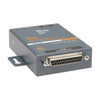
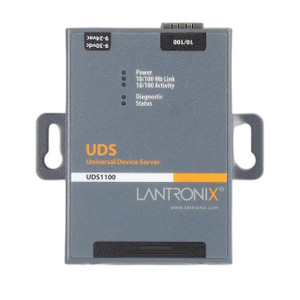
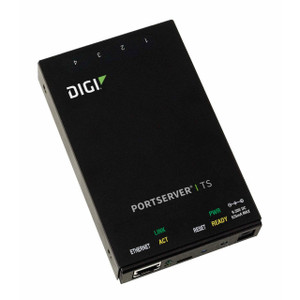
Transition Networks ED1100002-01 Single-Port Secure Device Server
Overview
The Transition Networks ED1100002-01 is a single-port, unmanaged device server designed to bridge legacy serial equipment to modern IP networks without adding switching or management overhead. This unit handles serial-to-IP conversion at 921 Kbps — fast enough for industrial controllers, security panels, and telecom equipment that need reliable remote access over standard Ethernet. Gigabit speed and single-mode fiber support mean you can run longer backbone distances without repeaters or signal degradation, a real advantage in warehouse automation, utility control, and distributed security deployments where cabling runs 2+ kilometers. DIN-rail mounting fits standard industrial enclosures, and the unmanaged architecture eliminates the complexity and cost of SNMP configuration — plug it in, wire it, and it works.
Key Features
- Single-port serial-to-IP conversion: Supports 921 Kbps data transfer, sufficient for legacy industrial devices, access control readers, and alarm panels that don't need gigabit throughput. Unmanaged operation means no VLAN, STP, or switching logic overhead — deployment is straightforward.
- Gigabit Ethernet interface: Native gigabit speed future-proofs the connection even if you upgrade serial-attached equipment later. Handles burst traffic without bottlenecking.
- Single-mode fiber support: Critical for long-distance backbone links (up to 40+ km on some single-mode transceivers) without the distance limitations of twisted pair. Eliminates ground loops and electromagnetic interference in industrial environments with heavy machinery or high-voltage switching.
- Management protocol support: Compatible with SNMP v2, Telnet, HTTPS, TFTP, CLI, HTTP, and FTP, so you can monitor health and push firmware updates without proprietary tools or vendor lock-in.
- DIN-rail form factor: Mounts directly into standard 35mm DIN rails, integrating into existing control cabinets and telecom racks without requiring separate shelving or brackets.
- External form factor design: Allows flexible placement outside primary enclosures — useful when serial devices are geographically dispersed or when you need to minimize cable runs to a central aggregation point.
Integration & Compatibility
The ED1100002-01 works with any equipment that uses standard serial protocols (RS-232, RS-422, RS-485) and can communicate over TCP/IP. Industrial control systems, security alarm receivers, legacy HVAC controllers, and telecom management consoles are all candidates. Because it supports standard management protocols, you can integrate it into network monitoring systems that use SNMP traps or syslog for alerting. No proprietary drivers or software required — treat it as a transparent serial-over-IP bridge.
Deployment Considerations
Choose the ED1100002-01 when you have a single serial device (or a single serial line per unit) that needs reliable remote IP access and distance or interference rules out copper runs. Its unmanaged nature is a strength for simple point-to-point links but a limitation if you need VLAN segmentation, QoS, or redundancy features — in those cases, a managed industrial Ethernet switch with serial modules would be more appropriate. The 921 Kbps cap is fast enough for most legacy equipment but won't support multiple high-speed serial devices on a single port. Gigabit and fiber options provide future headroom and environmental resilience in harsh industrial settings.
Frequently Asked Questions
Q: What serial protocols does the ED1100002-01 support?
A: The unit supports standard serial interfaces (RS-232, RS-422, RS-485). Specific protocol support depends on the attached serial device and its TCP/IP stack — the ED1100002-01 acts as a transport layer, not a protocol translator.
Q: Can I use the ED1100002-01 over long distances?
A: Yes. Single-mode fiber support allows backbone runs of 40+ km depending on transceiver and fiber quality, eliminating the 100-meter limit of twisted-pair copper and reducing noise in electrically harsh environments.
Q: Does the ED1100002-01 require network management?
A: No. It is unmanaged, meaning it requires no configuration for basic serial-to-IP bridging. You can optionally manage it via SNMP, Telnet, or HTTP for firmware updates and monitoring, but that is optional.
Q: Is the ED1100002-01 suitable for real-time control?
A: For applications sensitive to latency, verify the serial device and your IP network meet timing tolerances. The device itself introduces minimal delay, but IP networks are not deterministic. For hard real-time control, consult the datasheet and your system architect.
Q: What is the warranty on the ED1100002-01?
A: The unit includes a 2-year manufacturer warranty covering defects in materials and workmanship. Review the terms and conditions for exclusions and coverage scope.
Q: Can I mount the ED1100002-01 outside an enclosure?
A: Yes. The external form factor allows placement outside primary cabinets, useful for distributed deployments or when serial devices are geographically separated from your main equipment rack.
Ted PerryPerspective based on aggregated IP Security Depot and affiliated engineering team experience.
The Transition Networks ED1100002-01 solves a specific but common integration problem: getting legacy serial equipment online without swapping it out or overcomplicating your network infrastructure. The 921 Kbps serial speed is plenty for alarm receivers, access control panels, and legacy industrial controllers — most of that gear was never designed for gigabit throughput. What matters here is reliability and distance. Single-mode fiber support is the real differentiator. In a warehouse or utility control setting where your serial devices are spread across a 2+ km facility, single-mode fiber lets you run that distance without repeaters, ground loops, or EMI headaches from proximity to machinery or high-voltage switchgear.
Technical Highlights:
- 921 Kbps serial-to-IP conversion: Adequate for legacy industrial equipment without wasting bandwidth or adding unnecessary complexity. Unmanaged architecture means zero configuration overhead — wire the serial device, connect to Ethernet, done.
- Single-mode fiber backbone support: Extends deployment distance to 40+ km depending on transceiver, eliminating copper distance limits and ground-loop noise in electrically hostile industrial environments.
- Gigabit Ethernet interface: Ensures the IP side won't bottleneck even if you upgrade serial-attached equipment or add multiple devices downstream.
Deployment Considerations:
- Unmanaged operation is a strength for simple point-to-point links but a limitation if you need VLAN segmentation or QoS — those require a managed switch with serial modules.
- Watch the 921 Kbps ceiling: if you need multiple high-speed serial lines aggregated onto one unit, you'll exceed capacity. Plan for one ED1100002-01 per serial line or serial device in bandwidth-critical deployments.
Deploy the ED1100002-01 when you have isolated legacy serial equipment (security panel, industrial controller, telecom receiver) that needs reliable remote IP access across a distance that favors fiber or noise immunity. It is not a general-purpose managed switch — it is a transparent, plug-and-go serial bridge. In distributed security or utility automation where serial gear sits 500 meters to several kilometers from your aggregation point, this is the right choice.