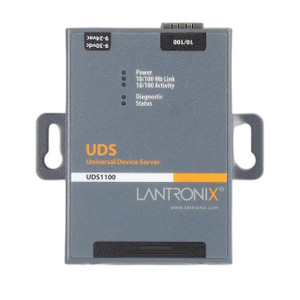
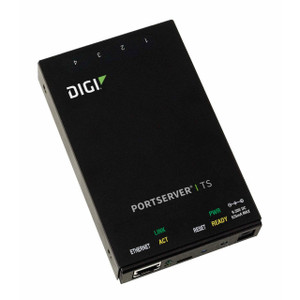
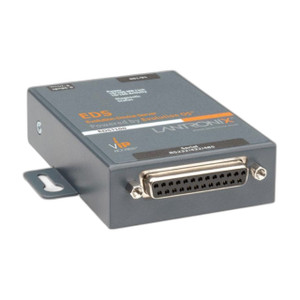
Transition Networks UD1100IA2-01 Industrial Device Server
Overview
The Transition Networks UD1100IA2-01 (also referenced as Lantronix UDS1100-IAP) is an unmanaged industrial device server built for infrastructure environments where uptime and serial-to-network conversion matter. This unit trades managed switch complexity for straightforward, deterministic performance in SCADA systems, industrial automation, and telecom deployments. The UD1100IA2-01 handles 10 Gigabit Ethernet connections over single-mode fiber, eliminating the copper distance limitations that plague traditional industrial networks — fiber can span kilometers with zero EMI interference, a critical advantage in electrical substations, manufacturing floors, and distributed control systems. DIN rail mounting means you bolt it into your control cabinet alongside PLCs and relays without custom fabrication.
Key Features
- 10 Gigabit Ethernet ports with single-mode fiber support: Fiber connectivity bypasses copper distance limits (typically 100m for standard twisted-pair) and eliminates electromagnetic interference from high-voltage equipment or induction motors. Ten gigabit throughput handles multiple serial-to-Ethernet bridges, redundancy links, or future bandwidth growth without saturation.
- Unmanaged operation: No VLAN configuration, no spanning tree tuning, no firmware updates to schedule. The device bridges serial devices to Ethernet and stays out of your way — lower complexity means fewer configuration errors and faster mean-time-to-repair if something fails.
- Industrial-grade operating temperature rating: Designed for control cabinet temperatures (typically 0°C to 60°C ambient, sometimes hotter with internal dissipation). If your enclosure hits 50°C regularly, a commercial-grade switch may throttle or fail; the UD1100IA2-01 is spec'd to handle that without derating.
- DIN rail form factor: Standard 35mm DIN rail mount uses 88mm of width, fitting alongside power supplies, terminal blocks, and I/O modules. No separate rack or shelf — integrates seamlessly into existing industrial panel layouts.
- SNMP, Telnet, and HTTP remote management: Minimal overhead for monitoring. You can query uptime and port status remotely without a full web UI or dedicated management software. Telnet access allows scripted configuration across distributed deployments.
- Serial-to-network bridging: Convert legacy RS-232, RS-422, or RS-485 devices into Ethernet-accessible assets. Lets you extend Modbus RTU networks, connect weigh scales or legacy RTUs, and centralize data in your SCADA platform without replacing hardware that works.
Integration and Deployment Context
This device sits at the boundary between your serial legacy systems and modern Ethernet-based SCADA or industrial Ethernet networks. It does not replace a switch — it augments one. Deploy the UD1100IA2-01 where fiber is mandatory (lightning-prone rural sites, high-noise electrical environments, long distances) or where you must bridge a serial device into an Ethernet backbone. Its unmanaged design eliminates configuration overhead, making it ideal for telcos and utilities managing hundreds of remote sites where centralised management overhead is a liability.
Compatibility with standard SNMP tools and Telnet means your existing OPC or SCADA integration will likely work without custom drivers. Confirm your management station supports RFC 1213 MIB-II queries for the most basic out-of-the-box health monitoring.
When to Choose a Different Model
If you need managed features — VLAN segmentation, STP redundancy, QoS prioritisation, or detailed traffic mirroring — this unmanaged device is not the answer. Step up to a managed industrial Ethernet switch from the same vendor family. If your site does not require fiber and copper distances are sufficient, an unmanaged copper switch will cost less and simplify inventory. If you need high port density (more than ten connections), evaluate larger industrial switching platforms.
Frequently Asked Questions
Q: Does the UD1100IA2-01 support redundancy or ring topologies?
A: No. Unmanaged devices do not run spanning tree or redundancy protocols. For fault-tolerant topologies, you must deploy managed switches or implement redundancy in your application layer.
Q: What is the maximum cable run for single-mode fiber connections?
A: Single-mode fiber (SMF) supports distances of 10+ kilometers depending on the transceiver and wavelength. The UD1100IA2-01 datasheet specifies the exact transceiver types and maximum reach — verify compatibility with your fiber plant before deployment.
Q: Can I mix copper and fiber ports on the UD1100IA2-01?
A: The device supports both. Copper Ethernet ports connect via standard RJ-45, while fiber modules insert into dedicated ports. Consult the product datasheet for exact port mapping and transceiver options.
Q: Is the UD1100IA2-01 suitable for outdoor cabinet deployments?
A: Check the operating temperature range against your worst-case cabinet temperature (including internal heat dissipation). If your outdoor enclosure regularly exceeds 60°C, verify with the manufacturer that thermal derating will not affect performance.
Q: Does the UD1100IA2-01 require a separate console cable or management interface?
A: Initial configuration typically uses Telnet or HTTP via one of the Ethernet ports. A console port may be present for out-of-band access — confirm in the datasheet if console management is required for your deployment workflow.
Q: What is the power consumption of the UD1100IA2-01?
A: Industrial device servers typically draw 15–30W depending on transceiver type and traffic load. Consult the datasheet for exact specifications and factor this into your cabinet power budget and UPS sizing.
Ted PerryPerspective based on aggregated IP Security Depot and affiliated engineering team experience.
The Transition Networks UD1100IA2-01 is a niche piece of infrastructure — not a workhorse switch, but a targeted bridge for serial-to-Ethernet conversion in environments where fiber and unmanaged simplicity are non-negotiable. I see this deployed most often in utility SCADA networks, where each substation needs to backhaul Modbus RTU data to the control center, and the copper run exceeds 100m or EMI from switchyard equipment makes copper unreliable.
Technical Highlights:
- 10 Gigabit throughput over single-mode fiber: Eliminates copper distance penalties and EMI — critical in electrical substations and high-noise industrial environments where twisted-pair networks degrade or fail. Fiber spans 10+ km without repeaters, so your remote sites stay connected even when traditional Ethernet maxes out at 100m.
- Unmanaged operation eliminates configuration overhead: No VLAN tuning, no STP calculations, no firmware rollout cycles. When your device is one of hundreds across a utility territory, unmanaged means fewer points of failure and faster troubleshooting — just plug it in and it works.
- DIN rail mounting integrates into control cabinets without custom brackets: Fits 88mm of width alongside power supplies and relays — no separate rack, no reconfiguring your enclosure layout. Reduces installation labor on remote deployments.
Deployment Considerations:
- Unmanaged design means no VLANs, QoS, or traffic shaping — if you need those, step up to a managed switch. This device is a point solution, not a general-purpose backbone.
- Fiber transceiver types and maximum reach are model-specific and not exposed in generic specs — confirm single-mode SMF vs multimode MMF requirements and wavelength (typically 1310nm or 1550nm for long-haul) before procuring fiber patch panels and splice equipment.
Deploy the UD1100IA2-01 into utility networks, telecom backhaul, or industrial sites where serial bridging and fiber reach justify the investment. For data center or campus networks with abundant copper and managed switching, look elsewhere.