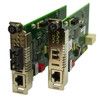
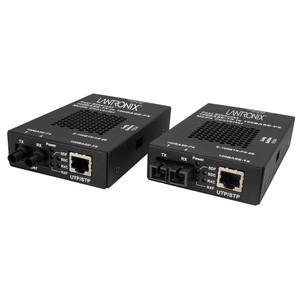
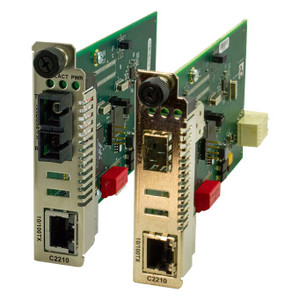
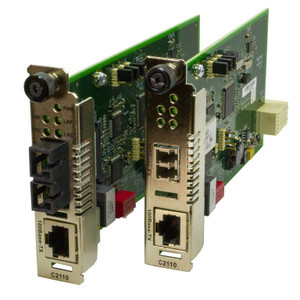
Transition Networks C2110-1039 100BASE-TX Fiber Media Converter
Overview
The Transition Networks C2110-1039 is a fiber media converter designed to bridge Fast Ethernet copper networks with single-mode fiber infrastructure. Operating at 100 Mbps, this unmanaged device supports 100BASE-FX (optical) and 100BASE-TX (copper) connectivity, enabling transmission distances up to 1.2 miles — far longer than standard copper Ethernet, which maxes out at 328 feet. This is a plug-in module form factor for network installations where copper-to-fiber conversion eliminates grounding loops, provides electrical isolation, or extends coverage across campus-scale deployments.
Key Features
- 100 Mbps bidirectional throughput: Standard Fast Ethernet speeds support legacy and modern infrastructure alike. At 100 Mbps, this handles IP cameras, access control systems, and network video recorders without bottlenecking — sufficient for most single-stream surveillance and industrial control applications.
- 1.2-mile transmission distance on single-mode fiber: Single-mode fiber shrinks the light pulse to a narrow core, allowing signals to travel much farther than multimode. This eliminates the need for intermediate switches or repeaters in large facility deployments — install once, extend coverage across parking lots, warehouses, or multiple buildings.
- Unmanaged operation: No configuration, no web interface, no firmware updates required. Plug the C2110-1039 into your network on both ends (copper side and fiber side), and it bridges traffic immediately. Zero management overhead makes it ideal for remote or low-touch deployments.
- 100BASE-FX optical and 100BASE-TX copper ports: Connects standard RJ-45 copper Ethernet on one side and standard single-mode fiber (SC connectors typical) on the other. Works with existing cabling infrastructure — no proprietary connectors or custom fiber runs needed.
- TAA compliance: Meets Trade Agreements Act requirements for federal, state, and government procurement. If your integrator or end-customer operates under GSA or FedRAPS guidelines, this model is pre-qualified for those channels.
- Low power consumption and passive operation: Fiber media converters generate minimal heat and draw minimal power — a practical advantage in unattended outdoor or enclosed plant rooms where cooling or power distribution is constrained.
Integration & Compatibility
Deploy the C2110-1039 anywhere you need to isolate noise-prone copper runs from fiber backbone infrastructure. Common scenarios include: extending camera feeds across high-EMI industrial environments (factory floors with large motors), bridging buildings separated by 500+ feet without running new copper, or isolating security systems from power distribution equipment that introduces ground loops. Compatible with any Fast Ethernet device — IP cameras, network video recorders, managed switches, access control readers — that accepts standard RJ-45 copper or SC fiber connectors. Pair with network switches on either side for multi-port aggregation, or use as a point-to-point bridge for a single isolated circuit.
Deployment Considerations
The C2110-1039 is a 100 Mbps device in a Gigabit world. If your deployment requires multiple simultaneous camera streams at 1080p or higher bitrates, or if you're upgrading to 10 Gigabit infrastructure, consider fiber converters rated for higher speeds. Single-mode fiber also requires skilled termination — splicing or connector installation is not a field-technician task. Budget for professional fiber installation if you're extending cable runs. Power consumption and physical dimensions are minimal; rack and cabinet integration is straightforward in network closets or equipment racks.
FAQ
Q: Does the C2110-1039 require power?
A: No. Fiber media converters operate passively — they convert electrical signals to optical and back without active amplification. No external power supply or PoE connection needed.
Q: Can I use multimode fiber instead of single-mode?
A: The C2110-1039 is designed for single-mode fiber to achieve the 1.2-mile distance specification. Multimode fiber would severely limit range — typically under 2 km for 100BASE-FX. Check with the manufacturer if multimode operation is necessary for your application.
Q: Is the C2110-1039 (often searched as C2110 1039) suitable for outdoor installations?
A: The converter itself is typically housed indoors or in protected enclosures. Fiber optic cable running outdoors is immune to lightning and EMI, but the converter module should be sheltered from moisture and temperature extremes. Mount in a network closet, equipment rack, or sealed weatherproof enclosure.
Q: What's the warranty coverage?
A: Warranty terms are not specified in the available product documentation. Contact your distributor or the manufacturer for warranty and support details.
Q: Will this work with my IP camera system?
A: Yes, provided your cameras use standard 100 Mbps Ethernet. If you're deploying a single camera or a small group of cameras across a fiber link, the C2110-1039 bridges the copper-to-fiber transition seamlessly. For large multi-camera installations, ensure total bandwidth at 100 Mbps accommodates all simultaneous streams.
Q: Can I daisy-chain multiple C2110-1039 converters?
A: Each converter creates a point-to-point bridge. To extend fiber coverage further or create a mesh, use fiber switches or backbone infrastructure. Daisy-chaining converters introduces additional latency and potential loop conditions — not recommended.
Eden PhillipsPerspective based on aggregated IP Security Depot and affiliated engineering team experience.
I review the Transition Networks C2110-1039 as a straightforward, no-frills workhorse. At 100 Mbps and 1.2 miles of single-mode reach, it solves a specific problem: extending Fast Ethernet across distances or EMI-heavy environments where copper breaks down. In practice, the C2110-1039 is the right pick for campus-scale security integration — bridging a camera system building-to-building without intermediate switches or repeaters — and for industrial sites where electrical noise or ground loops are issues. Passive operation means one less device to power or manage.
Technical Highlights:
- 100BASE-FX single-mode fiber + 100BASE-TX copper: Standard port types (SC fiber, RJ-45 copper) integrate seamlessly into existing infrastructure. No proprietary connectors or custom breakout cables. Plug and run.
- 1.2-mile (approximately 1.9 km) transmission distance: Single-mode fiber's narrow light propagation profile enables long-haul without signal regeneration. Compare this to multimode (typically 2 km max at 100BASE-FX) or copper (328 feet max). For distributed surveillance or industrial control, this eliminates repeaters and intermediate racks.
- Unmanaged, passive operation: No power supply, no configuration interface, no firmware to patch. Set-and-forget deployment is ideal in remote locations or low-touch network segments. Latency is near-zero; throughput is wire-speed.
Deployment Considerations:
- 100 Mbps is the hard ceiling. If you're streaming multiple 4K cameras or planning for future 1 Gbps upgrades, plan migration now — fiber converters at higher speeds (1 Gbps, 10 Gbps) exist but carry a different cost profile. The C2110-1039 is a legacy-speed device by design.
- Single-mode fiber termination requires professional installation. Splicing, cleaving, and connector crimping are not field-technician tasks — factor in fiber contractor labor if you're running new cabling beyond the converter's reach.
Position the C2110-1039 for point-to-point bridges on Fast Ethernet security circuits: isolated camera runs, access control readers on separate fiber spurs, or facility-wide copper backbones segmented by fiber isolation segments. Not a building block for converged IP networks, but an excellent isolation and extension tool for 100 Mbps infrastructure that will not migrate to Gigabit in the near term.