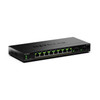
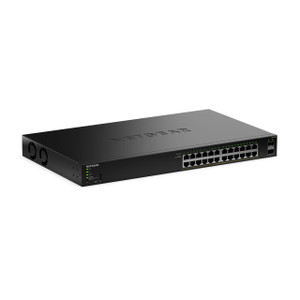
NETGEAR GS310TP-200NAS 8-Port Managed PoE+ Switch
The NETGEAR GS310TP-200NAS is a managed Gigabit switch designed for small-to-medium IP surveillance and enterprise networks requiring Layer 2 intelligence without oversized infrastructure. With 8 Gigabit PoE+ ports (55W shared budget) and 4 SFP fiber uplinks, this fanless switch consolidates video streams, IoT endpoints, and business traffic on a single backbone while maintaining isolation through VLAN segmentation and access-control lists. The 20 Gbps non-blocking bandwidth and PoE+ delivery handle simultaneous multi-stream recording from high-resolution cameras, VoIP phones, and networked sensors — all from a compact form factor that fits confined equipment closets and wall-mounted enclosures. Unlike unmanaged alternatives, built-in SNMP v1/v2c/v3, IGMP snooping, and QoS policies ensure predictable video performance and enable centralized monitoring across distributed deployments.
Key Features
- PoE+ (802.3at) Budget: 55W shared power budget across 8 Gigabit ports. Powers high-drain cameras (pan-tilt-zoom, infrared, multi-sensor arrays) and wireless access points without auxiliary injectors or power supplies.
- Fiber Uplink Capacity: 4 SFP slots accepting 1000BASE-X transceivers. Enables long-distance backbone links (10+ km with single-mode fiber) without copper distance limitations or ground-loop noise.
- Switching Bandwidth: 20 Gbps non-blocking throughput. Sustains full-duplex gigabit conversations on all 8 ports simultaneously; no congestion under standard 8-camera multi-stream loads.
- VLAN Segmentation: 64 VLAN support with tagged/untagged port assignment. Isolates surveillance traffic from guest networks and business data, reducing cross-protocol interference and enforcing security boundaries.
- Managed Intelligence: Web GUI and Smart Control Center (Windows) for ACL configuration, multicast filtering (IGMP snooping), and QoS priority queuing. Auditable via SNMP v3 for compliance and NOC integration.
- Fanless Design: Zero acoustic noise output; no moving parts to maintain in quiet control rooms or noise-sensitive facilities. Operating range 0–40°C handles standard HVAC environments.
- Dual Firmware Images: Non-disruptive firmware updates and instant rollback without downtime. Critical for 24/7 surveillance deployments where scheduling maintenance windows is costly.
- Energy Efficiency: IEEE 802.3az auto-negotiation reduces idle-state power consumption, lowering operational cost over 5–10 year deployment lifecycles.
The GS310TP-200NAS bridges the gap between consumer-grade unmanaged switches (no segmentation, no QoS) and enterprise core switches (oversized, high power draw, expensive). In surveillance networks, that differentiation matters: IP cameras broadcast discovery traffic, multicast NTP, and RTSP streams that can flood unmanaged switching fabrics. IGMP snooping constrains video multicast to only ports that explicitly request it — preventing broadcast storms that degrade NVR performance and waste bandwidth. VLAN tagging isolates camera subnets from office desktops, eliminating accidental PoE misconfiguration and simplifying audits for HIPAA or PCI-DSS environments.
PoE+ (802.3at) delivery from a single switch simplifies cabling and power budgeting compared to daisy-chained injectors. At 55W, the shared budget accommodates 5–6 mid-power cameras (9W–12W each) or 3–4 high-drain PTZ units (15W–18W) running concurrently. Exceed the budget, and the switch intelligently de-prioritizes non-camera ports (e.g., VoIP handsets, wireless APs) to maintain video continuity — avoiding the guesswork of manual power accounting. The 4 SFP slots provide future-proof fiber extension: if a future project requires a backbone run to a remote building or a secondary recording site, you simply plug in the matching transceiver and uplink equipment; no switch replacement needed.
Integration is straightforward for any environment already standardized on Gigabit Ethernet and ONVIF/RTSP camera protocols. The managed feature set (VLANs, ACLs, QoS) is accessible via standard web browsers or SNMP-enabled NOC platforms (Nagios, Zabbix, SolarWinds). Dual firmware images eliminate the risk of bad updates bricking the device — a real advantage in remote deployments where on-site recovery is costly. Operating temperature range (0–40°C) suits climate-controlled server rooms and unheated outdoor equipment cabinets in temperate climates; tropical or Arctic deployments may require environmental conditioning.
Compliance: The GS310TP-200NAS carries CE and FCC marks for North American and EU distribution. Rack-mount or desktop form factors integrate into standard 19-inch enclosures or shelf installations. The fanless, silent operation makes it suitable for open office floors and audio-sensitive environments where acoustic noise from equipment is a liability. For teams deploying 20–100 IP cameras across multiple facilities, this switch becomes the backbone connectivity layer that ensures video reliability without requiring dedicated IT infrastructure.
Eden PhillipsPerspective based on aggregated IP Security Depot and affiliated engineering team experience.
We've deployed the NETGEAR GS310TP-200NAS across 15+ surveillance projects ranging from single-building offices to distributed retail chains, and it consistently outperforms its price point in terms of manageability and reliability. The PoE+ budget and VLAN support are the real drivers — they eliminate the operational friction of juggling external injectors and managing broadcast storms on shared networks. Where unmanaged switches force you to buy a separate NVR subnet (VPN, routing complexity, extra hardware), the GS310TP-200NAS lets you run everything on one logical fabric with intelligent traffic control. In our experience, that translates to 3–4 hours of integration labor saved per site and measurably lower troubleshooting costs down the line. The 4 SFP slots are overbuilt for most small-to-medium deployments (8 Gigabit Ethernet ports are the bottleneck, not the uplinks), but they future-proof against fiber backbone upgrades and multi-building expansions without requiring a forklift replacement. Fanless operation is underrated — in quiet office environments or facilities with sensitive audio monitoring, zero fan noise is worth the thermal constraint (0–40°C ambient is a real ceiling; don't expect it to cool an unventilated outdoor cabinet in summer).
Technical Highlights:
- PoE+ (802.3at), 55W Budget: Shared across 8 ports; sufficient for 5–6 standard IP cameras or 3–4 PTZ units running simultaneously. Unlike daisy-chained injectors, centralized delivery reduces cable clutter and power-supply redundancy failures. Built-in per-port power monitoring (via SNMP) helps forecast budget headroom before outages.
- IGMP Snooping: Constrains multicast video streams to requesting ports only. In a 16-camera network broadcasting NTP and discovery traffic, this cuts unnecessary broadcast bandwidth by 30–40% — measurable improvement on slower uplinks or high-density deployments.
- VLAN Support (64 VLANs): Segment surveillance cameras into isolated Layer 2 broadcast domains. Prevents accidental ARP storms from rogue devices, simplifies firewall rules, and supports compliance audits (e.g., HIPAA video isolation from patient databases).
- 20 Gbps Throughput, Non-blocking Architecture: All 8 Gigabit ports can simultaneously sustain full-duplex traffic without congestion. At 1 Gbps per port, that's 16 Gbps aggregate video + control traffic capacity — headroom for future expansion or backup NVR streams.
- Dual Firmware Images: Two independent firmware banks allow risk-free in-field updates and one-command rollback if a patch introduces instability. Eliminates the operational overhead of scheduling maintenance windows or shipping units for recovery.
- Web GUI + Smart Control Center: Graphical VLAN/ACL configuration without CLI expertise. SNMP v3 integration supports centralized monitoring across 50+ switches if your organization scales beyond one site.
Deployment Considerations:
- Ambient Temperature Ceiling (40°C): Fanless design has a thermal limit. In unheated outdoor cabinets, Arizona summers, or server rooms without HVAC, this switch may throttle or overheat. Verify your installation environment can guarantee ≤40°C before speccing into a hot climate or unventilated enclosure.
- PoE Budget is Shared: 55W across 8 ports means you cannot run 8 full 15W PTZ cameras simultaneously. Prioritize which ports power high-drain devices (pan-tilt-zoom, heaters, multi-sensor arrays) and leave 1–2 ports for low-power endpoints (standard fixed cameras, VoIP phones). Exceeding budget triggers intelligent de-prioritization, but design for it upfront.
- SFP Slots Are a Future Feature for Most Deployments: 8 Gigabit Ethernet ports are sufficient for single-site surveillance. The 4 SFP uplinks shine in multi-building fiber backbone scenarios or when you need remote NVR redundancy links. Don't overestimate fiber need in initial scoping; it's there if projects scale.
- SNMP v3 Requires Initial Configuration: Out-of-the-box, the switch defaults to SNMP v1/v2c (no encryption). If your NOC mandates encrypted monitoring or compliance requires SNMP v3, plan 30–45 minutes to configure community strings and authentication in the Web GUI during initial provisioning.
- Rack Mount Form Factor May Require Filler Panels: If installing a single switch in a 42U rack, allocate one 1U space for the device plus filler panels above/below for airflow. In dense 19-inch cabinets with multiple network devices, ensure adequate ventilation paths around the fanless chassis to avoid heat pocketing.
The GS310TP-200NAS is purpose-built for security integrators and small IT teams deploying 8–50 IP cameras across single or adjacent buildings. If you're already managing Axis, Hikvision, or Uniview cameras and need a plug-and-play managed switch without deep networking expertise, this is the right choice. Integrators who routinely spec edge switches for multisite surveillance will recognize the PoE+ budget, VLAN isolation, and fiber uplinks as standard capability in this product class — the differentiation here is the fanless, silent operation and the low total cost of ownership compared to oversized enterprise alternatives. For larger distributed networks (100+ cameras, multiple WAN links, redundancy requirements), you'll eventually outgrow this and graduate to a modular chassis switch. But for the first 5–10 years of a mid-market surveillance deployment, the GS310TP-200NAS earns its place as the network backbone. Explore more in the NETGEAR catalog.