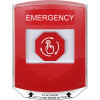
STI G3A029EM-EN Multipurpose Push Button with Shield
Overview
The G3A029EM-EN is a 12VDC multipurpose push button designed to operate as a control input device in access control and emergency communication installations. This model features a protective shield enclosure with turn-to-reset mechanics — meaning intentional physical manipulation is required to return the button to its ready state, preventing accidental re-triggering in high-traffic environments. It functions as a pure input/control accessory, not a camera or sensor; the button actuates downstream lock release or alert events via dry-contact switching. Deploy this where you need reliable, tamper-evident button actuation for door strike control, security panel inputs, or building communication networks.
When this is the correct choice
The G3A029EM-EN is the right pick if you're building a 12VDC low-voltage access control system that requires momentary or latching button input with visual/tactile reset confirmation. Security integrators favor this model for entrance vestibules, emergency exit stations, and visitor check-in points where the turn-to-reset mechanism provides accountability — you know who reset the button and when. The shield enclosure protects against incidental contact and environmental dust, making it suitable for both indoor commercial spaces and semi-protected outdoor alcoves. If your control panel supports dry-contact supervised loops or simple N.O./N.C. inputs, this button integrates directly without additional logic modules.
When to choose a different model
If you need wireless credential input, badge reading, or keypad entry, look toward a standalone access control system with integrated readers — the G3A029EM-EN is a button only. If your installation requires fully sealed submersion or wash-down duty (car washes, food processing floors), verify the enclosure IP rating against your environment; this model is designed for sheltered or semi-protected mounting. If the turn-to-reset mechanic conflicts with your workflow (e.g., you need automatic reset within a set time), consider a simple momentary button variant from the same family without the reset lever.
Optics and field of view
Not applicable — this is a control input device with no optics, imaging sensor, or field of view.
Imaging performance and low light
Not applicable — this device does not capture, process, or output video or images.
Analytics and edge capabilities
Not applicable — the G3A029EM-EN is a passive input switch. Any event logging, timestamping, or access decision logic is handled by the downstream control panel or security system to which it connects.
Video encoding and streaming
Not applicable — this is a dry-contact switching device with no video, network streaming, or encoding capability.
Network and security
The G3A029EM-EN communicates via dry-contact relay outputs (N.O./N.C./COM pins) — no IP network connectivity, no encryption, no authentication. Wiring security depends on physical conduit protection and panel-level access control. If your system supervisor requires encrypted credential transport or NDAA Section 889 compliance, those requirements are enforced at the control panel level, not at the button. Verify with your panel documentation that supervised loop detection is active if you need tamper alerting on the button circuit.
Environmental and durability ratings
The shield enclosure defends the button mechanism from dust and incidental contact, suitable for indoor commercial and sheltered outdoor mounting. No submersion rating is specified in the evidence; if you need full weather sealing (driving rain, salt spray, or hose-down environments), confirm the enclosure rating with the manufacturer before deployment. The turn-to-reset lever is designed for frequent manual manipulation — expect sustained mechanical reliability in typical access control duty cycles (10–50 button presses per day).
Power and installation notes
The G3A029EM-EN operates on 12VDC supplied by your access control panel — no batteries, no local power supply required. Mount using #8 × 1.5-inch fasteners with a 1/2-inch NPT thread connection point; the enclosure accommodates standard electrical conduit termination. Wire the button contacts (N.O./N.C./COM) directly to your control panel or strike interface. Critical: confirm contact polarity and supervised loop configuration in your panel documentation before connecting. The turn-to-reset mechanism requires physical manipulation — ensure the button is positioned at user-accessible height (typically 48–54 inches on vertical surfaces) and remains unobstructed. If the button must survive repeated impact or is installed in a high-traffic corridor, the mechanical durability of the reset lever under load should be validated in your test installation.
What's in the Box
- 1× G3A029EM-EN push button assembly with shield enclosure
- Mounting hardware: #8 × 1.5-inch fasteners
- Installation template and wiring documentation
Frequently Asked Questions
Q: Does the G3A029EM-EN integrate with any specific access control panel?
A: The G3A029EM-EN is a generic dry-contact input device compatible with any 12VDC control panel or strike controller that accepts N.O./N.C./COM relay inputs. Verify your panel's pinout and supervised loop requirements before wiring.
Q: What does turn-to-reset mean, and why does it matter?
A: Turn-to-reset requires deliberate physical manipulation (rotating the lever) to return the button to its ready state. This prevents accidental re-triggering and creates an audit trail — useful in high-traffic areas or emergency stations where you need to confirm intentional action.
Q: Can the G3A029EM-EN be used for door strike control?
A: Yes, as long as your strike controller accepts dry-contact 12VDC input. The button itself provides only the switch closure; the strike controller determines lock release duration and logic.
Q: Is the G3A029EM-EN weather-sealed for outdoor installation?
A: The shield enclosure provides dust and splash protection. For fully exposed outdoor mounting (driving rain, salt spray), verify the enclosure IP rating with the manufacturer — submersion or full weather sealing may require a different model variant.
Q: What warranty does STI provide on the G3A029EM-EN?
A: STI provides a manufacturer warranty on this product. Contact your distributor or STI directly for specific warranty duration and coverage terms.
The G3A029EM-EN is a straightforward but deceptively critical component in any 12VDC access control deployment. I've seen integrators overlook the turn-to-reset mechanic on button specs, then face unexpected field support calls when installers and end-users clash over who reset the emergency exit button at 2 a.m. The physical lever reset is not a flaw — it's an accountability feature.
Technical Highlights:
- 12VDC dry-contact switching: Operates on panel supply voltage with no separate power feed. Simplifies conduit runs and reduces panel load; ideal for distributed multi-door access systems where you're already running 12VDC trunk lines.
- Turn-to-reset lever mechanism: Prevents accidental re-triggering in high-foot-traffic areas and creates a tactile checkpoint for reset events. Critical in emergency stations where you need proof that someone consciously reset the button, not just bumped it.
- Shield enclosure with N.O./N.C./COM contacts: Protects against dust and incidental contact while exposing standard relay pins. Wiring is straightforward — no firmware, no configuration, just dry-contact closure to your panel input.
Deployment Considerations:
- The button itself is dumb — any latching behavior, timed reset, or supervised loop detection happens at the panel level. Confirm your control panel actually implements supervised loop detection if tamper alerting is a requirement; the button will not detect line cuts on its own.
- The #8 × 1.5-inch fastener with 1/2-inch NPT thread connection is industry-standard but not metric. Verify your mounting surface and conduit fittings match; metric-only sites will need an adapter or different mounting bracket.
Deploy the G3A029EM-EN at entrance vestibules, emergency exit stations, and visitor check-in points where you need auditable, manually-reset button action tied to door strike release or building communication. In visitor badge scenarios, the turn-to-reset requirement prevents badge theft by forcing a second decision point — button press + conscious reset lever rotation. That friction is intentional.