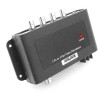
Speco Technologies VIDDIST 1-in/4-out Video Distribution Amplifier
Overview
The Speco Technologies VIDDIST is a professional-grade active video distribution amplifier designed for security integrators, control room technicians, and system engineers who need to route a single composite video source to multiple independent outputs without signal degradation. Unlike passive video splitters—which attenuate the signal and force you to accept visible quality loss across outputs—the VIDDIST uses active amplification to maintain signal strength and timing integrity at each of its four outputs. This matters in real deployments: a passive splitter on a 100-meter coaxial run will show noticeable ghosting, color shift, or sync loss on downstream monitors; the VIDDIST eliminates that problem. The unit supports standard CVBS (composite video baseband signal), making it compatible with the vast installed base of analog CCTV cameras, matrix switchers, multiplexers, and legacy video infrastructure still in active service across thousands of facilities.
Key Features
- 1 Input / 4 Output Configuration: One composite video input feeds four isolated amplified outputs. Each output operates independently with its own driving amplifier, so plugging in a high-impedance load on one output doesn't degrade the signal on the other three. This isolation prevents the ringing and impedance mismatches that plague passive designs.
- Active Amplification Architecture: Built-in line driver amplifies the incoming composite signal and redrives it at proper amplitude and impedance. Result: video quality remains consistent whether the farthest monitor is 50 feet or 200 feet from the VIDDIST, and whether you're feeding a sensitive matrix input or a robust display.
- Composite Video (CVBS) Support: Accepts standard 75-ohm coaxial composite video—the video signal type used by analog security cameras, multiplexers, and DVRs. No conversion, no compatibility surprises. If your source outputs composite, the VIDDIST handles it.
- Standard Coaxial Connectors: Input and output ports use BNC connectors, the industry standard for composite video. Existing coaxial cabling integrates without adaptation, reducing installation time and eliminating unnecessary connector transitions that introduce noise.
- Compact Rack-Mount Form Factor: Dimensions and mounting provisions allow installation in standard 19-inch equipment racks, wall-mount shelving, or integration into video distribution enclosures. Footprint is small enough that you won't sacrifice valuable rack or shelf real estate.
- Straightforward Signal Path: No software, no configuration, no network dependency. Plug in power, connect the video input and outputs, and the VIDDIST begins distributing signal immediately. Troubleshooting is intuitive: if the input signal is present and the amplifier is powered, all four outputs will carry that signal.
Integration & Compatibility
The VIDDIST integrates into analog CCTV systems, hybrid deployments mixing legacy analog infrastructure with newer IP components, and control room video wall architectures. Common installation points include downstream of analog camera outputs, multiplexers, or matrix switchers when multiple independent monitoring stations or recording devices require simultaneous access to the same source. This is especially valuable during analog system retrofit projects where replacing all cameras and infrastructure is not immediately practical or budgeted—upgrading the distribution amplifier extends system capability and picture quality without requiring wholesale replacement. Facility managers and integrators frequently deploy the VIDDIST in command centers, NOCs (network operations centers), and distributed monitoring facilities where a single camera feed or pre-processed composite output must reach multiple displays, DVRs, or third-party monitoring stations in real-time.
Frequently Asked Questions
Q: Will the VIDDIST work with my existing analog DVR outputs?
A: Yes. If your DVR outputs composite video via BNC connectors, connect the output to the VIDDIST input. The amplifier will distribute that signal to four independent destinations—additional monitors, multiplexers, or recording devices—without quality loss.
Q: Can I use the VIDDIST to replace a broken passive splitter?
A: Yes, and you'll immediately see the difference. If your passive splitter has been causing signal ghosting, color issues, or sync problems on remote monitors, switching to the VIDDIST will restore clean, bright video across all four outputs.
Q: Does the VIDDIST require network connectivity or software drivers?
A: No. The VIDDIST is a standalone analog component. Power it, connect your video input and outputs, and it operates immediately. No network interface, no configuration, no drivers to install.
Q: What type of power supply does the VIDDIST use?
A: Refer to the manufacturer datasheet for specific power input voltage and current requirements. Typical video distribution amplifiers operate on 12VDC or 24VAC; verify the VIDDIST specification sheet to confirm the correct supply for your installation.
Q: Is the VIDDIST suitable for long cable runs?
A: Yes. The active amplification in the VIDDIST restores signal strength, making it well-suited for installations where outputs feed monitors or equipment 100+ feet away via coaxial cable. Passive splitters degrade rapidly over distance; the VIDDIST maintains signal integrity.
Q: Can I daisy-chain multiple VIDDIST units?
A: Yes. You can feed an output from one VIDDIST into the input of another to create additional distribution taps. This is useful in large multi-zone facilities where a single source must reach many destinations across different areas.
Ted PerryPerspective based on aggregated IP Security Depot and affiliated engineering team experience.
The VIDDIST fills a specific but critically important role in analog and hybrid security deployments. During control room planning, I frequently encounter situations where a single video source—a camera output, a matrix output, or a DVR feed—must reach multiple monitors, recording devices, or processing nodes simultaneously. Passive splitters introduce unacceptable signal loss; the VIDDIST's active amplification solves this elegantly and reliably. It's a straightforward component that does one thing well, and that thing matters more than most integrators realize until they're standing in front of a ghosty, color-shifted monitor that a passive splitter created.
Technical Highlights:
- Active Line Driver Architecture: Each of the four outputs has its own amplifier stage, ensuring that video signal is re-driven at proper amplitude (1V peak-to-peak) and impedance (75 ohms) regardless of the load on any individual output. This eliminates the impedance reflections and signal sag that plague passive designs.
- Output Isolation: No output interferes with any other. Plugging a long cable run into output 1 doesn't steal signal strength from outputs 2, 3, and 4. This is the defining feature that makes active distribution worth the cost.
- Composite Video Fidelity: The VIDDIST preserves sync timing, color saturation, and brightness across all four outputs. Monitoring stations and recording devices see clean, consistent video quality, reducing false alarms and improving usability in multi-monitor control rooms.
Deployment Considerations:
- Install the VIDDIST at a central distribution point (rack, equipment closet, or wall-mounted shelf) between your video source and the four destination devices. Minimize the input cable length if possible; keep outputs moderate in length to avoid new cable-run losses.
- Verify the power supply voltage and current rating against the VIDDIST datasheet. Most analog amplifiers operate on 12VDC or 24VAC; confirm your facility's available power supply before installation.
- If you're upgrading from a failing passive splitter and notice immediate improvement in monitor picture quality, that's not unusual—active amplification restores signal that the passive design was silently degrading.
- Use quality 75-ohm coaxial cable (RG-59 or better) for all connections. Mismatched impedance on any run will introduce reflections; proper cabling eliminates that variable.
The VIDDIST is the right choice when you need reliable, transparent video distribution in analog or hybrid facilities where control room clarity and multi-destination routing are non-negotiable. It's particularly valuable in retrofit projects where camera replacement isn't budgeted but system performance needs improvement.