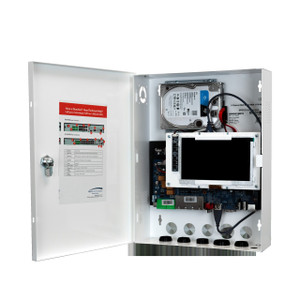
Speco Technologies SB11M 1024-Channel Enterprise NVR
The Speco SB11M is a server-class network video recorder engineered for large-scale IP surveillance deployments where a single appliance must manage hundreds or thousands of camera streams across multiple facilities. Unlike distributed edge recording systems, the SB11M centralizes video ingestion, storage, and playback in one platform, eliminating the operational overhead of managing dozens of standalone recorders. Built for network video recorders integrations in enterprises where multi-site visibility and unified incident response are non-negotiable, this is a backbone appliance for security integrators, facility managers, and telecom operators managing 100–500+ camera deployments across warehouses, campuses, transit hubs, or municipal networks.
Overview
The SB11M supports up to 1024 simultaneous IP camera channels in a single system—a capacity that eliminates the need for cascaded or redundant NVRs in large installations. The platform is ONVIF-compliant (Profile S, T, and G), meaning it ingests streams from any standards-conformant IP camera without vendor lock-in or proprietary driver dependencies. This flexibility is critical in environments where camera procurement happens over multiple years and manufacturers change—you avoid being locked into a single manufacturer's ecosystem.
The SB11M handles H.264, H.265, and MJPEG simultaneously, so legacy 1080p cameras and newer 4K/5MP units coexist on the same recorder without recoding penalties. H.265 compression cuts storage requirements roughly 40–60% compared to H.264 on the same scene—a tangible cost savings when recording 24/7 across hundreds of channels. The system is designed for continuous 24/7 operation with industrial-grade compute hardware, remote access via desktop and mobile clients, event-driven recording triggers (motion, line crossing, intrusion detection), and granular role-based access controls for operator, supervisor, and administrator functions.
Network administrators can deploy the SB11M on standard enterprise switching infrastructure—no proprietary networking appliances are required. However, careful switch architecture planning is necessary to handle the sustained bandwidth of a 1024-channel system recording mixed resolutions. A typical 24/7 multi-camera deployment at 3–5 Mbps per camera stream will consume 3–5 Gbps aggregate network capacity, so your core switch and uplink design must accommodate this without packet loss or congestion.
Key Features
- 1024-Channel Capacity: Single SB11M appliance ingests up to 1024 concurrent IP camera streams, eliminating multi-NVR complexity and fragmented storage in large installations. This means one management interface, one event log, one backup/recovery point—critical for coordinated incident response across multiple buildings or sites.
- Server-Class Architecture: Industrial-grade computing platform designed for continuous 24/7 operation without thermal or reliability constraints common in consumer-grade NVRs. Built for data center or secure facility deployment where uptime is non-negotiable.
- ONVIF Profile S, T, and G Compliance: Integrates third-party IP cameras from any major manufacturer without custom drivers, protecting camera procurement flexibility and reducing future integration risk. If you need to swap camera vendors in year three, the recorder stays; the cameras change.
- Multi-Codec Support (H.264, H.265, MJPEG): Processes mixed compression formats simultaneously. H.265 cuts storage requirements roughly in half versus H.264 on equivalent scenes—meaningful on 24/7 multi-camera recorders where storage cost scales linearly with channel count and retention days.
- Centralized Management Interface: Single-pane-of-glass operator dashboard for live video, playback, and alarm management across all connected sites. Critical for coordinated incident response in multi-building deployments where operators need unified visibility without tab-switching between separate recorders.
- Scalable Storage Architecture: Flexible attachment of network-attached storage (NAS) and direct-attached storage enables capacity expansion without replacing the recorder itself. Design for growth: add storage shelves as camera count increases, not new recorders.
- Event-Driven Recording: Integrates with camera-embedded analytics and edge motion detection to trigger recording on specific events (motion, line crossing, intrusion detection), optimizing storage utilization and reducing archival bloat from 24/7 idle-scene recording.
- Remote Access & Mobile Clients: Authorized users access live and recorded streams from desktop, tablet, and mobile devices for real-time situational awareness and incident playback beyond the operations center. Useful for facility managers checking incidents from field locations.
Integration & Compatibility
The SB11M's ONVIF compliance means it integrates with IP cameras and surveillance sensors from Axis, Hikvision, Dahua, Uniview, Hanwha, Bosch, and other standards-conformant vendors. No custom integration or driver installation required—stream discovery is automatic via ONVIF device discovery protocols. For VMS software, the SB11M works with Milestone XProtect, Genetec Security Center, and other enterprise platforms via standard RTSP/ONVIF APIs, though it also functions as a standalone recorder with its own operator interface.
Consult your network switching architecture before deployment: the SB11M is bandwidth-agnostic, but your upstream switches must sustain the aggregate bitrate of all 1024 streams without oversubscription. A 10 Gbps core link is typical for high-channel-count, high-resolution deployments.
Frequently Asked Questions
Q: What's the recommended network bandwidth for a fully loaded SB11M?
A: Depends on camera resolution and frame rate. A mixed deployment of 500 cameras at 3–5 Mbps per stream (1080p–3MP @ 30 fps) requires roughly 1.5–2.5 Gbps sustained bandwidth. For 1024 channels at similar specs, plan for 3–5 Gbps. Use H.265 on newer cameras to cut this by 40–60%. Your network core must sustain this without packet loss.
Q: Does the SB11M work with older analog cameras?
A: No. The SB11M is an IP NVR only. To record analog cameras, you need an analog DVR or a video encoder that converts analog feeds to IP streams first. Once digitized to IP, the SB11M can ingest them via ONVIF.
Q: Can I expand storage after installation?
A: Yes. The SB11M supports scalable NAS and direct-attached storage expansion. You don't need to replace the recorder itself—add storage shelves or NAS capacity as your camera count or retention requirements grow.
Q: What compression formats does the SB11M support?
A: H.264, H.265, and MJPEG simultaneously. H.265 is especially valuable for 24/7 recording because it roughly halves storage footprint compared to H.264 on the same scene.
Q: Is the SB11M suitable for municipal or transit deployments?
A: Yes. The 1024-channel capacity, server-class architecture, centralized management, and 24/7 reliability make it well-suited to large municipal surveillance networks, transit hubs, and campus-wide security operations where unified incident response and multi-facility visibility are critical.
Q: What kind of operator training is needed for the SB11M?
A: The SB11M's interface is designed for professional security operations staff familiar with VMS software. Role-based access controls allow you to restrict operators to specific sites or functions. Standard training for a Milestone XProtect or Genetec environment applies if you integrate the SB11M into a larger VMS ecosystem.
Ted PerryPerspective based on aggregated IP Security Depot and affiliated engineering team experience.
The SB11M is the appliance you install when a single NVR must handle 1024 concurrent IP camera streams without fragmentation. This is not a multi-unit daisy-chain or a distributed edge-recording mess—it's one recorder, one management interface, one event timeline. That architectural simplicity solves a real operational problem in large deployments: unified incident response. If a breach or security event occurs, you don't hunt through separate NVR logs; you pull from a single timeline and cross-reference all cameras on the network simultaneously.
Technical Highlights:
- 1024-Channel Ingestion: Industrial-grade server-class compute handles simultaneous RTSP/ONVIF streams from up to 1024 cameras without frame drops or resource contention. Meaningful for warehouse, campus, or municipal networks where camera count will exceed 500.
- H.265 Support at Scale: H.265 compression cuts storage footprint 40–60% versus H.264 on the same scene. On a 24/7 recorder with 500–1000 channels, this translates to millions of dollars saved in NAS capacity over a 5-year retention cycle. Deploy H.265 on all new cameras; legacy H.264 cameras coexist without recoding overhead.
- ONVIF Profile S, T, G Compliance: No vendor lock-in. You procure Axis cameras one year, Hikvision the next, Uniview the year after—the SB11M ingests them all without custom drivers or firmware patches. Protects your capital investment and gives procurement real flexibility.
- Scalable Storage Without Recorder Replacement: Add NAS capacity as your camera footprint grows. You don't throw away the SB11M and buy a new one; you expand the storage backend. Reduces capex friction for large organizations with multi-year rollout plans.
Deployment Considerations:
- Network Bandwidth Planning is Non-Optional: A fully loaded 1024-channel SB11M at 3–5 Mbps per stream consumes 3–5 Gbps of sustained aggregate bandwidth. Your core switch and uplinks must be engineered for this—do not deploy on oversubscribed network fabric. A 10 Gbps core link is typical; gigabit edges are insufficient for high-channel-count, high-resolution deployments.
- Centralization vs. Resilience Trade-Off: The SB11M's single-appliance architecture means all eggs in one basket. If the recorder fails, all 1024 streams stop recording. Plan for redundancy (dual recorders, failover architecture) or accept the single-point-of-failure risk. Edge recording on cameras themselves (microSD, local NAS) provides a secondary recording tier if network connectivity is lost.
- ONVIF Compliance ≠ Feature Parity: ONVIF guarantees basic video stream ingest and playback. Advanced camera analytics (face recognition, vehicle plate reading, people counting) are proprietary and may not flow through the ONVIF interface into the SB11M's event timeline. Test analytics integration with your specific camera models before full deployment.
The SB11M is built for large municipal surveillance networks, warehouse and logistics automation sites, transit hubs, and campus-wide security operations where unified incident response and multi-facility visibility are non-negotiable. If your deployment is under 100 cameras or you need distributed edge recording for resilience, consider a multi-unit NVR architecture instead. If you're a security integrator or facility manager responsible for 500+ cameras across multiple buildings, the SB11M's centralized architecture and 1024-channel capacity eliminates the operational complexity of cascaded recorders.