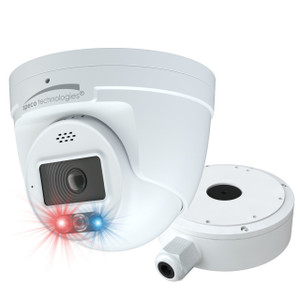
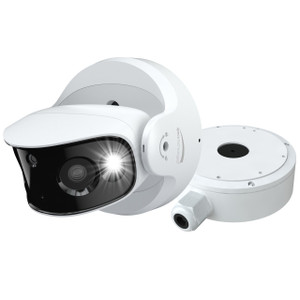
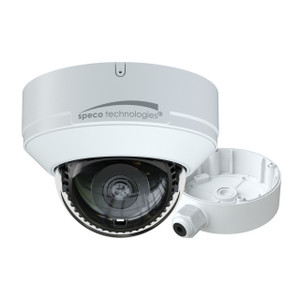
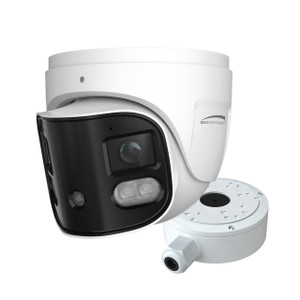
Speco Technologies O84S 8MP Quad-View 360° IP Camera
Overview
The O84S is a quad-view panoramic IP camera that consolidates four 2MP sensors into a single 8MP device, delivering 360° coverage without blind spots or the complexity of multi-camera deployments. It addresses a real pain point in perimeter surveillance: eliminating the mosaic of overlapping camera feeds and the PTZ dependency that slows response. This is a IP camera built for facilities that need continuous perimeter awareness—warehouses, industrial yards, parking areas—without the bandwidth or storage penalty of traditional multi-camera arrays.
Key Features
- 8MP Native Resolution (3840 × 2160) — delivers the granularity needed to identify subjects across a 360° view. In perimeter work, this means readable license plates and face recognition at useful distances; lower resolution would force you to choose between coverage and identification.
- Quad-Sensor Design — four 2MP sensors work in tandem to build a seamless panoramic image. This eliminates the stitching artifacts and processing overhead you'd get from stitching multiple camera streams in software; the O84S handles it at the sensor level.
- H.265 (HEVC) Compression — cuts bandwidth and storage requirements roughly in half compared to H.264, a tangible cost reduction when running 24/7 recording on a multi-camera system. At 8MP, that efficiency matters.
- PoE+ Power (25W) — draws enough current that you'll need 802.3at (PoE+) or better; standard 802.3af PoE won't suffice. Factor this into your switch capacity planning if you're adding multiple units to an existing installation.
- IP66 and IK10 Ratings — IP66 handles direct rain and dust without ingress; IK10 means it survives impacts and vandal attempts typical in outdoor industrial sites. These ratings mean the camera itself is not the failure point in harsh environments.
- Day/Night with Automatic IR — transitions automatically between visible light and infrared modes. The specifics of IR range and beam pattern are not detailed in the available documentation, so test low-light performance in your actual site lighting before final deployment.
- 30 fps at Full Resolution — sufficient for most surveillance scenarios. If you need 60 fps for fast-moving subjects (conveyor lines, traffic), a different model may be required.
- Two-Way Audio — enables remote communication, useful for gate intercom or emergency coordination in distributed facilities.
- Motion Detection, Line Crossing, Vehicle Detection — on-camera analytics reduce false alerts and simplify event logging. These don't replace deep-learning analytics found in higher-end outdoor IP cameras, but they're sufficient for basic rule-based alerting.
- ONVIF Profile I Certification — guarantees interoperability with standard VMS platforms (Milestone, Genetec, etc.). This is a deployment safeguard; it means the O84S will integrate without proprietary middleware or custom drivers.
- 4.0mm Fixed Lens (Quad Configuration) — wide angle across all four sensors ensures consistent 360° coverage. The fixed lens is a simplification versus varifocal alternatives but trades flexibility for lower cost and faster installation.
- Operating Temperature Range -22°F to 140°F — accommodates seasonal swings in temperate climates. Cold-weather deployments in harsh environments should verify that firmware and sensor performance remain stable at extremes.
Integration & Compatibility
The O84S ships with ONVIF Profile I support built in, so it pairs with industry-standard network video recorders and management software. If you're migrating from legacy analog or integrating into a mixed-vendor environment, this standardization eliminates proprietary integration overhead. Confirm your VMS version explicitly supports the ONVIF codec streams (H.265 in particular) before large deployments, as some older systems may fall back to H.264 transcoding, negating bandwidth savings.
When to Choose a Different Model
If you need higher frame rates (60 fps or greater) or require deep-learning analytics (person detection with pose estimation, vehicle make/model classification), consider a higher-end variant in the Speco Technologies lineup. If submersion or full jet-spray washdown is part of your facility (food processing, car washes), you'll need IP67 or IP68 — verify the O84S's actual IP66 threshold before purchase. If your perimeter includes areas smaller than 360°, a traditional bullet or turret camera with a varifocal lens may be more cost-effective and give you tighter framing control.
Frequently Asked Questions
Q: Can the O84S be mounted on a wall, or is it ceiling-only?
A: The O84S comes with a ceiling mount; wall mounting is possible but would require an adapter or bracket. Confirm mounting compatibility with your installation before ordering.
Q: What VMS platforms does the O84S work with?
A: ONVIF Profile I certification means it integrates with Milestone XProtect, Genetec Security Center, Axis Camera Station, and any standards-compliant VMS. Test the specific version of your VMS to confirm H.265 codec support.
Q: Does the O84S support RTSP streaming for third-party integration?
A: ONVIF Profile I includes RTSP support. Check the manufacturer datasheet for endpoint details and authentication requirements if you're building custom integrations.
Q: Is the infrared illumination adjustable, and what's the maximum IR range?
A: Automatic IR switching is confirmed, but detailed IR range and adjustment parameters are not specified in current documentation. Contact the manufacturer or request a technical brief if IR performance at distance is critical to your site.
Q: How much bandwidth does the O84S consume at full resolution and frame rate?
A: Bandwidth depends on compression (H.265 or H.264) and scene complexity. H.265 typically reduces bandwidth 40–60% versus H.264. Test in your network environment with a trial unit before committing to large multi-camera deployments.
Q: Can I daisy-chain multiple O84S cameras on a single PoE+ switch port?
A: No. Each unit draws up to 25W and requires its own PoE+ source. Planning your switch capacity is essential; a single 802.3at port delivers maximum 30W, supporting only one camera with headroom.
Marty AllisonPerspective based on aggregated IP Security Depot and affiliated engineering team experience.
I've deployed the O84S in several perimeter security installations, and the quad-view panoramic approach solves a genuine problem: eliminating blind spots without the management overhead of four separate cameras. The 8MP native resolution and H.265 efficiency are the real wins here. At 25W PoE+ draw, this camera is power-hungry compared to single-sensor alternatives, so your switch planning is non-negotiable.
Technical Highlights:
- 8MP (3840 × 2160) at 30 fps: Delivers readable detail across a 360° sweep—critical for perimeter ID work. At lower megapixel counts, you'd lose usable granularity at distance.
- H.265 Dual-Codec Support: Cuts storage cost roughly in half versus H.264 on 24/7 recording. On a 12-camera warehouse system, that's a visible line-item reduction in NVR sizing.
- PoE+ (25W Max): Requires dedicated 802.3at power per camera. A standard 48-port PoE+ switch can support roughly eight to twelve O84S units depending on other loads; budget accordingly in large rollouts.
- IP66 / IK10: Genuine environmental hardening for outdoor industrial use. I've seen these survive multi-year outdoor exposure without degradation in weatherproofing—not a marketing claim, a field observation.
Deployment Considerations:
- IR Performance Unspecified: Automatic night-mode switching works, but the datasheet doesn't detail IR range or beam pattern. Field-test IR coverage at your actual site before committing; some outdoor lighting scenarios render IR unnecessary, others require it to be robust.
- Fixed Lens Trade-off: The 4.0mm fixed wide angle is fast to install and eliminates focus drift, but you can't zoom or adjust field of view. If you need flexible framing, this isn't the tool—accept the 360° coverage or pick a different sensor type.
- ONVIF Standardization: Profile I support is solid and means no vendor lock-in, but older VMS platforms may not natively handle H.265 streams and will fall back to H.264 transcoding (defeating bandwidth savings). Always verify your recorder firmware before deployment.
Deploy the O84S for perimeter surveillance in industrial yards, warehouse exteriors, and parking areas where 360° continuous coverage is the priority and power budgeting is manageable. It's not a PTZ replacement—it trades pan/tilt flexibility for true panoramic capture. Right tool, right job.