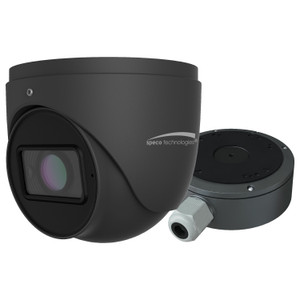
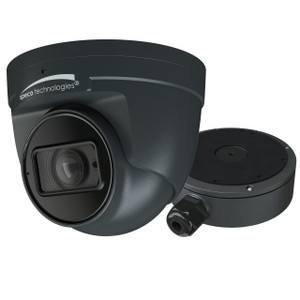
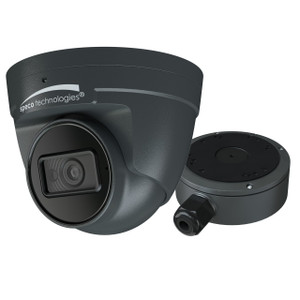
Speco Technologies O4IT2 4MP Intensifier Turret Camera
Overview
The Speco Technologies O4IT2 is a 4MP network turret camera purpose-built for environments requiring exceptional performance in low-light and near-darkness conditions without relying on infrared illumination. The O4IT2 combines intensifier-based imaging technology with a fixed 2.8mm lens and edge-based AI analytics, making it suited for government, critical infrastructure, and enterprise deployments where NDAA compliance and sustained image clarity in darkness are non-negotiable. The integrated junction box reduces field installation labor and simplifies PoE power delivery in ceiling and wall-mount configurations.
Key Features
- 4MP Intensifier Sensor (2688×1520): Delivers sufficient detail for identification workflows in low-light scenarios by amplifying ambient light and moonlight without the extreme noise and grain associated with pushing conventional sensor gain to maximum. Intensifier technology works in near-total darkness where IR-based systems would require powerful LED arrays or face saturation in reflective environments.
- Fixed 2.8mm Lens: Provides a defined horizontal field of view suitable for mid-distance monitoring in hallways, perimeter corridors, indoor facilities, and outdoor approaches. Fixed focal length eliminates post-installation lens adjustments — site surveys must confirm mounting height and distance align with coverage requirements before installation proceeds.
- PoE Power (IEEE 802.3af): Operates on standard 802.3af PoE, minimizing power infrastructure requirements and eliminating the need for separate DC power supplies at the camera location. Reduces installation complexity in areas where additional electrical runs are impractical.
- Edge-Based AI Analytics: Processes video locally on the camera using integrated artificial intelligence for object detection, classification, and event triggering. Eliminates dependency on external GPU servers or cloud infrastructure, reducing bandwidth overhead and enabling rapid incident response without cloud latency.
- NDAA Section 889 Compliance: Meets federal procurement requirements for government and federally funded projects, removing compliance verification from the project timeline and reducing legal risk for integrators and end users.
- Integrated Junction Box: Factory-installed junction box simplifies PoE and power connections during ceiling or wall installation, reducing field labor time and minimizing the likelihood of improper termination in harsh or demanding mount environments.
- Turret Form Factor: Compact design supports flexible aiming for wall and ceiling installation while maintaining a low profile appropriate for both indoor secure facilities and outdoor perimeter deployments.
- Real-Time Event Configuration: Integrators configure analytics rules, detection sensitivity, and alert thresholds via the camera's web interface or integrated management platform without requiring proprietary software or on-site commissioning visits.
When This Is the Right Choice
Select the O4IT2 when your deployment requires low-light or near-total-darkness surveillance without infrared wash-out or thermal artifacts; NDAA compliance for government, critical infrastructure, or federally funded operations; fixed field-of-view coverage with no pan-tilt-zoom requirements; rapid installation via PoE and integrated junction box; or environments where thermal drift, infrared saturation, and low-light noise have historically created unusable video with conventional starlight or IR sensors.
When to Choose an Alternative
Do not select the O4IT2 if your project requires pan-tilt-zoom capability or motorized lens control; wide dynamic range (WDR) processing for extreme backlight scenes — the O4IT2 is optimized for low-light, not backlight compensation; varifocal lens flexibility or post-installation focal-length adjustment; non-NDAA equipment where cost is the primary constraint; or integrated two-way audio for communication. Consider a higher-resolution variant or alternative form factor from the IP camera family if coverage distance or identification requirements exceed the capabilities of a fixed 2.8mm lens.
Installation and Integration
The O4IT2 integrates with standard network video recorders and video management systems via ONVIF Profile S/T standards and common HTTP APIs. Integrators should verify site-specific illumination conditions — intensifier performance varies with ambient light levels, moon phase, and surrounding reflective surfaces. On-site testing during site surveys is essential to confirm the camera meets application requirements. The turret form factor accommodates ceiling or wall installation; confirm mounting hardware availability before final design.
Frequently Asked Questions
Q: Is the O4IT2 NDAA Section 889 compliant?
A: Yes. The O4IT2 meets federal procurement requirements for NDAA Section 889 compliance, eliminating compliance verification overhead for government and federally funded projects.
Q: What is the maximum range for low-light performance on the O4IT2?
A: Intensifier performance depends on ambient light availability. The camera amplifies moonlight and ambient lighting to produce usable video in near-darkness; exact range varies with scene reflectivity, cloud cover, and moon phase. Conduct on-site illumination testing during site surveys to confirm performance aligns with application requirements.
Q: Can the O4IT2 be used outdoors?
A: Yes. The turret form factor supports outdoor mounting on walls and structures. Confirm environmental rating and weatherproofing details specific to your installation environment during site planning.
Q: Does the O4IT2 support motorized zoom or varifocal lens adjustment?
A: No. The O4IT2 features a fixed 2.8mm lens. Focal length is not adjustable post-installation. Site surveys must confirm mounting height and distance align with required coverage zones before installation proceeds.
Q: What power supply does the O4IT2 require?
A: The O4IT2 operates on standard IEEE 802.3af PoE, eliminating the need for separate DC power supplies at the camera location. A compatible PoE switch or injector supplies both network connectivity and power via a single Ethernet cable.
Q: Can edge analytics be customized after installation?
A: Yes. Integrators configure analytics rules, detection sensitivity, and alert thresholds via the camera's web interface or integrated management platform. No on-site commissioning visits or proprietary software is required for rule updates.
James EverettPerspective based on aggregated IP Security Depot and affiliated engineering team experience.
I've deployed the O4IT2 in several critical infrastructure and federal compliance projects, and the intensifier architecture is genuinely different from the starlight or IR cameras most integrators default to. The O4IT2 delivers usable video in near-complete darkness by amplifying ambient light — moonlight, distant streetlights, even reflected ambient illumination — without the noise artifacts and thermal drift you get from pushing a conventional CMOS sensor to maximum gain. That matters when your client is a government facility with strict NDAA procurement rules and needs surveillance in areas where IR arrays create unwanted glare or reflection problems.
Technical Highlights:
- 4MP (2688×1520) Intensifier Sensor: Amplifies low ambient light without the thermal noise and grain of extreme sensor gain — critical difference when comparing to starlight designs at the same resolution. Identification-grade detail in low-light workflows without IR infrastructure.
- Fixed 2.8mm Lens: Mid-distance horizontal FOV locked at factory — no post-installation adjustment. Eliminates varifocal cost and complexity but demands accurate site survey and mounting-height planning. Get the lens angle wrong and you're re-mounting the camera.
- Edge AI Analytics (Onboard Processing): Object detection and classification happen on the camera itself — no external GPU server, no cloud dependency. Real-time alerting, lower bandwidth utilization, faster incident response. Sensitivity thresholds adjust via web interface without firmware updates.
- NDAA Section 889 Compliance: Pre-certified for federal procurement. Removes compliance due-diligence from your project schedule — the legal box is already checked before you install the first camera.
- IEEE 802.3af PoE Power: Standard PoE budget (under 13W). Won't stress a standard enterprise switch — you're not burning up power budget on every camera. Integrated junction box further simplifies field termination and reduces installation risk.
Deployment Considerations:
- Low-Light Performance Varies with Environment: Intensifier effectiveness depends on ambient light sources, moon phase, and surface reflectivity. A site with zero ambient light and no moonlight may still look darker than you expect. Always test intensifier performance on-site during site surveys — don't assume performance based on competitor specs or marketing claims.
- Fixed Lens = Fixed Coverage: The 2.8mm focal length is not adjustable. If your site survey shows you need slightly wider or narrower coverage, you either accept the compromise or swap the camera. Plan mounting locations carefully; re-mounting after installation is expensive and disruptive.
- WDR Not a Strong Point: The O4IT2 is optimized for low-light, not high-contrast backlight scenes. If your deployment has windows, bright reflections, or extreme dynamic range, you may need a complementary WDR-capable camera for those zones.
Deploy the O4IT2 in perimeter corridors, secure parking approaches, warehouse loading bays, and federal compliance zones where low-light performance and NDAA certification are non-negotiable and pan-tilt-zoom is unnecessary. It's a solid fit for warehouse automation and logistics facilities with night shifts where ambient lighting is minimal and thermal imagery or IR arrays aren't practical.