Ted PerryPerspective based on aggregated IP Security Depot and affiliated engineering team experience.
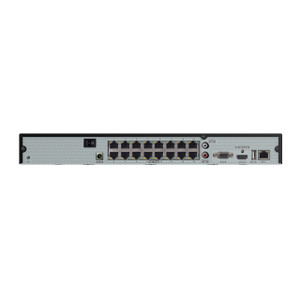
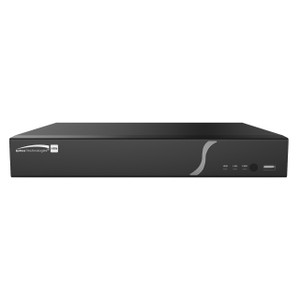
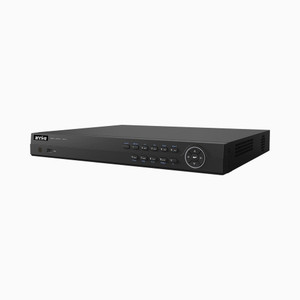
We've deployed the Speco N16NRN6TB across a range of environments—from municipal parking facilities and warehouse perimeters to corporate campus security operations—and it consistently delivers a balanced combination of processing horsepower, storage capacity, and plug-and-play integration. The real differentiator versus competitive 16-channel platforms is the integrated PoE port array. That single design choice eliminates an entire category of installation headaches: no external injector boxes to rack-mount, no separate PoE switch procurement, no additional power feeds to spec. On a 16-camera site with 100–150m cable runs, that's labor savings of 10–15 hours and roughly $2,000–$3,500 in avoided auxiliary equipment. The appliance sits in a standard 19-inch rack or under a desk; the compact form factor is genuinely useful in space-constrained NOCs.
H.265 is the second major win. On a 16-channel 4K platform recording 24/7, the bitrate difference between H.264 and H.265 directly impacts your storage arithmetic. A 6TB drive that stores 10 days of footage in H.264 stores 17–18 days in H.265 at equivalent image quality. For compliance and forensic retention (especially on larger deployments), that extended retention window reduces the need for external archive or cloud egress fees.
Candid limitations: The 6TB fixed storage is not expandable—if you need more than the native capacity, you are either shortening retention periods or adding a separate NAS appliance for warm archival. That's a workflow choice, not a fatal flaw, but integrators used to modular NVR designs (hot-swap drive bays) should budget for it. Second, the integrated PoE ports typically support PoE and PoE+ (802.3at); PoE++ (802.3bt, 90W+) cameras will require external power injection, so check your camera spec against the port ratings before committing. Third, while ONVIF compatibility is rock-solid, the appliance is optimized for Speco and common third-party cameras; deep integration with specialized analytics or edge AI platforms (face recognition, license-plate reading) may require supplementary VMS middleware.
Technical Highlights:
- H.265 Compression (HEVC): Reduces bitrate 40–60% versus H.264 at equivalent quality. On 16 simultaneous 4K 30 fps streams, that translates to roughly 240–400 Mbps network overhead savings—visible benefit on gigabit infrastructure and critical for sites with bandwidth-constrained uplinks or remote archival pipelines.
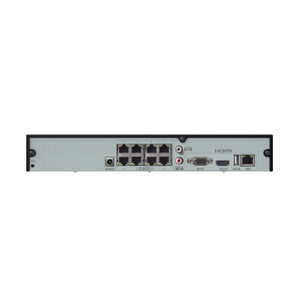
- Integrated PoE (8–16 ports): Eliminates external injector boxes, separate switch procurement, and associated power distribution complexity. Each port typically supports PoE (802.3af, 15.4W) or PoE+ (802.3at, 30W); verify camera power draw before deployment to avoid saturation or external injector workarounds.
- 6TB SATA Hot-Swap Storage: Factory-installed 6TB supports 7–14 days of 16-stream 4K retention at 15–30 fps (codec-dependent). Drive is replaceable without appliance shutdown; no RAID overhead, single-drive architecture simplifies management but requires external NAS or cloud archival for long-term retention policies exceeding 30 days.
- ONVIF Profile S/T Compliance: Standards-based ingest ensures interoperability with any compliant third-party IP camera and VMS platforms (Genetec, Milestone, Avigilon, ExacqVision, Axis, Hanwha). No vendor lock-in; metadata and events export via RTSP/ONVIF for downstream analytics or alerting.
- NDAA Compliance (Section 889): Unit meets U.S. Department of Defense supply chain security requirements. Eligible for federal, state, and municipal competitive procurement without geographic sourcing restrictions. Critical for integrators bidding government or critical-infrastructure contracts.
Deployment Considerations:
- Verify integrated PoE port ratings (PoE vs. PoE+) against your camera power draw before ordering. PoE++ cameras will require external injectors or separate switch ports, negating the integrated PoE capex advantage.
- Storage arithmetic: 6TB is fixed and non-upgradeable. If your retention policy exceeds 14–20 days at your target frame rate, plan for external warm archival (NAS) or budget cloud storage fees; don't assume the appliance alone will cover long-term compliance retention.
- Network bandwidth: 16 simultaneous 4K streams at 30 fps consume 240–400 Mbps (H.265) on the LAN side. Verify your network infrastructure (switches, uplinks) can sustain that throughput during peak recording, especially if you also need concurrent remote viewing or export traffic.
- Rack-mount footprint is compact (2U equivalent). Confirm vertical clearance and cooling airflow in your intended NOC or server cabinet; the unit dissipates heat, so avoid stacking without gap or mounting above heat-sensitive equipment.
- ONVIF compatibility is broad, but proprietary motion-detection or analytics features (if any) from your camera vendor may require supplementary VMS software. Test driver/firmware pairing with your specific camera models in a pre-deployment lab environment.
The N16NRN6TB is the right choice for integrators building municipal security networks, corporate multi-location surveillance, or government/critical-infrastructure deployments where NDAA compliance is non-negotiable and operational simplicity (integrated PoE, compact form factor, standards-based architecture) outweighs the need for modular storage or advanced edge analytics. For larger environments with dynamic scaling requirements or specialized AI workloads, consider a distributed NVR architecture or edge-compute platform. For mid-scale, standards-based, compliance-first deployments, this appliance eliminates unnecessary complexity and delivers measurable ROI through installation labor savings and extended retention on fixed capex. Explore the full Speco Technologies catalog for compatible IP cameras and integrated solutions.