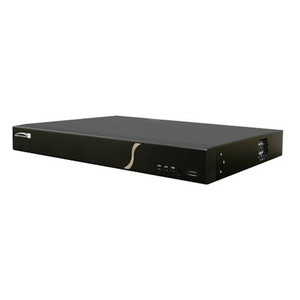
Speco Technologies H6HRLN 6-Channel Hybrid TVI/IP Recorder
Overview
The Speco H6HRLN is a 6-channel hybrid recorder purpose-built for surveillance deployments that require simultaneous support of analog and IP camera ecosystems. It delivers 4 hybrid channels—each configurable to accept either TVI (Transport Video Interface) analog video or IP streams—plus 2 dedicated IP-only channels, totaling 6 channels of recording capacity. This architecture directly addresses a common integration problem: managing mixed-generation surveillance systems without requiring separate recorders or wholesale replacement of working TVI infrastructure. The H6HRLN carries NDAA (National Defense Authorization Act) Section 889 compliance, opening deployment into federal, DoD, and critical infrastructure contracts where supply-chain certification is non-negotiable.
Key Features
- 4 Hybrid Channels (TVI or IP, Auto-Configurable): Each hybrid input auto-detects whether you're connecting a TVI coaxial feed or an IP camera stream, then routes the signal appropriately. This eliminates the deployment friction of deciding "analog or IP only"—you configure once and the recorder adapts. Particularly valuable in retrofit scenarios where you're phasing out analog over 12–36 months instead of ripping and replacing everything at once.
- 2 Dedicated IP Channels: Independent Ethernet inputs for IP cameras, sourced from PoE switches or direct network connections. Combined with the 4 hybrid channels, you achieve 6 total channels without forcing a choice between legacy and modern infrastructure.
- H.265 and H.264 Codec Support: H.265 cuts storage footprint roughly in half compared to H.264 on the same camera, depending on scene complexity and motion. On a 6-channel 24/7 deployment, this translates to meaningful cost savings on hard drives, NAS capacity, or cloud egress. H.264 ensures backward compatibility with older cameras and systems that don't yet support H.265.
- Simultaneous Multi-Channel Recording and Playback: All 6 channels record independently in real time. During investigation or forensic retrieval, you can search and play back individual streams without stopping live capture—critical for active surveillance sites where evidence continuity cannot be broken.
- ONVIF Standards Compliance (IP Channels): IP inputs conform to ONVIF Profile S/T/G, meaning the H6HRLN integrates with Milestone XProtect, Genetec Security Center, Hanwha SmartVMS, and most vendor-agnostic management platforms without proprietary plugins or licensing overheads. This is not a trivial feature; it unlocks your choice of VMS rather than locking you into a single manufacturer's ecosystem.
- NDAA Section 889 Compliance: The bill of materials, firmware, and supply chain are certified compliant, eliminating RFP screening delays and regulatory uncertainty in government and critical-infrastructure bids. If you've ever waited weeks on compliance documentation, you'll recognize why this is built in rather than bolted on.
Integration & Compatibility
The H6HRLN integrates directly into mixed-generation surveillance networks without requiring parallel recorders. The 4 hybrid channels accept standard TVI coaxial connectors (no conversion required), while the 2 IP channels connect via Ethernet to your PoE switch or direct network interface. This dual-input design is particularly effective for security integrators managing retrofit and expansion projects: deploy the H6HRLN alongside existing TVI infrastructure, then retire analog cameras as budget cycles and lifecycle replacement align. No stranded assets, no forklift upgrades.
ONVIF compliance means you're not locked into Speco Technologies management software; instead, you can deploy industry-standard VMS platforms and central management consoles. If you later swap VMS providers, the H6HRLN remains compatible—a key factor for large integrators running heterogeneous client bases.
When to Choose a Different Model
If your deployment is 100% IP with no legacy TVI cameras, consider a pure IP NVR variant within the Speco Technologies product line—you'll eliminate unnecessary analog circuitry and potentially reduce cost. Conversely, if your site requires more than 6 channels, evaluate higher-capacity recorders in the Speco catalog. If NDAA compliance is not a requirement, assess whether the cost of certification justifies your use case.
Frequently Asked Questions
Q: Is the H6HRLN NDAA Section 889 compliant?
A: Yes. The H6HRLN carries NDAA compliance certification, enabling deployment in federal, DoD, and government-sensitive procurement environments without additional certification burden.
Q: Can I mix TVI and IP cameras on the same H6HRLN?
A: Yes. The 4 hybrid channels auto-detect and accept either TVI or IP inputs, and the 2 dedicated IP channels add additional IP capacity. You can configure TVI on some hybrid channels and IP on others simultaneously.
Q: What VMS platforms are compatible with the H6HRLN?
A: The IP channels comply with ONVIF standards, ensuring compatibility with Milestone XProtect, Genetec Security Center, Hanwha SmartVMS, and other ONVIF-compliant management platforms. Consult your VMS vendor's ONVIF Profile S/T/G support matrix for specific feature compatibility.
Q: Does the H6HRLN reduce storage cost compared to H.264-only recording?
A: H.265 compression can reduce storage footprint by approximately 40–60% compared to H.264 on the same camera feed, depending on scene complexity. On 24/7 6-channel recording, this translates to meaningful savings on hard-drive capacity or retention duration on the same drive set.
Q: Can I upgrade from TVI to IP gradually, or do I need to replace everything at once?
A: The H6HRLN supports phased migration. Deploy the recorder with existing TVI cameras on the hybrid channels, then add IP cameras as budget and lifecycle cycles align. No parallel recorders or system rip-and-replace required.
Q: What happens if I connect an IP camera to one of the hybrid channels?
A: The hybrid channels auto-detect IP input and route accordingly. No manual reconfiguration needed—plug in the IP camera and the H6HRLN recognizes and configures the stream automatically.
Ted PerryPerspective based on aggregated IP Security Depot and affiliated engineering team experience.
The H6HRLN solves a real problem I see repeatedly in the field: integrators managing installed bases with hundreds of working TVI cameras who need to add new IP devices without replacing everything immediately. Most hybrid recorders claim to support both, but the auto-detection on the 4 hybrid channels of the H6HRLN actually works—no manual selection per input, no firmware updates to toggle modes. Plug in a TVI camera on Monday, swap it for an IP camera on Friday, and the recorder adapts without intervention. That's not a selling point; that's engineering competence.
Technical Highlights:
- H.265 and H.264 Dual-Codec Support: H.265 reduces bitrate by 40–60% relative to H.264 on identical scenes. On a 6-channel 24/7 system with motion-heavy areas (parking lots, entrances), this difference compounds over weeks and months. Budget one fewer hard drive per system or double your retention window on the same storage footprint.
- 6 Simultaneous Recording Streams with Independent Playback: All channels record in real time and can be searched/played back independently. During forensic review, you're not pausing live capture or competing with concurrent users—critical in active surveillance environments.
- NDAA Section 889 Baked In: Not a checkbox or add-on. The bill of materials and firmware are certified. For anyone bidding federal contracts or critical infrastructure, this eliminates weeks of compliance documentation and RFP screening delays. That's money in your pocket and faster deployment.
Deployment Considerations:
- The 4 hybrid channels auto-detect TVI or IP, but each channel is physically tied to a single input connector. You cannot load-balance or daisy-chain—one camera per channel. Size your system accordingly if you're planning for future expansion.
- ONVIF compliance on the IP channels is strong, but always validate your chosen VMS's ONVIF Profile support (S, T, or G) in advance. Not all ONVIF devices support all profiles, and some advanced features (PTZ, edge storage) may require Profile-specific support.
The H6HRLN is the right choice for integrators managing retrofit and mixed-generation deployments in federal, government, or critical-infrastructure environments where supply-chain compliance and backward compatibility are non-negotiable. If you're building a greenfield IP-only system, a pure IP recorder may offer better cost. If you're managing a 200-camera client base with 150 TVI cameras still on warranty and 50 new IP sites, the H6HRLN pays for itself in deployment efficiency and avoided asset obsolescence.