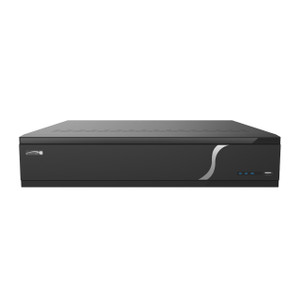
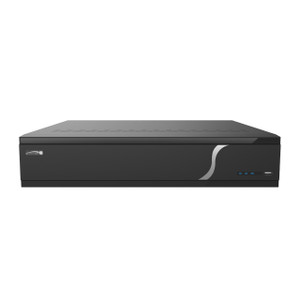
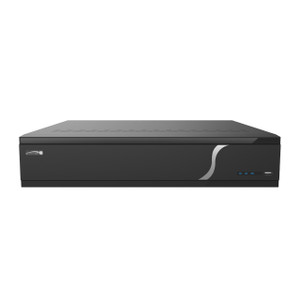
Speco Technologies H40HR2TB 40-Channel Hybrid Recorder
Overview
The Speco Technologies H40HR2TB is a 40-channel NDAA-compliant hybrid recorder designed for mid-to-large-scale security deployments. This system supports mixed analog and IP camera environments, delivering flexibility for integrators managing heterogeneous camera infrastructures. With 24 dedicated TVI (analog) channels, 8 hybrid channels that accept either TVI or IP input, and 8 additional IP channels, the H40HR2TB enables organizations to leverage existing analog investments while scaling toward IP-based surveillance. The unit includes 2TB of onboard storage and dual NIC architecture for redundant network connectivity.
Key Features
- 40-Channel Capacity: 24 TVI channels + 8 hybrid (TVI/IP selectable) + 8 IP channels accommodate mixed-technology environments without requiring forklift upgrades
- Dual NIC Architecture: Redundant network interfaces support failover and load balancing for enterprise-grade availability
- 2TB Internal Storage: Pre-installed 2TB hard drive provides baseline recording capacity; expandable for extended retention policies
- NDAA Compliance: Meets National Defense Authorization Act requirements for government and federal contractor deployments
- Hybrid Channel Flexibility: Designate the 8 hybrid ports as TVI or IP on a per-channel basis, enabling gradual network camera migration strategies
- TVI Video Support: Native TVI codec compatibility eliminates transcoding overhead for analog camera feeds
- IP Camera Integration: 16 dedicated IP channels (8 hybrid + 8 native) support ONVIF-compliant network cameras
- Centralized Management: Single recorder consolidates video from analog and IP sources, reducing operational complexity and licensing overhead
Integration & Compatibility
The H40HR2TB integrates with standard TVI analog cameras and ONVIF-compliant IP cameras, making it suitable for retrofit and greenfield deployments. The dual NIC configuration supports redundant network paths, critical for mission-critical facilities. Organizations can connect the recorder to existing security operations centers (SOCs) via standard Ethernet infrastructure. Channel configuration is performed through the integrated management interface, allowing integrators to assign hybrid ports dynamically based on camera availability and deployment phases.
Typical Deployment Scenarios
The H40HR2TB is commonly deployed in multi-site corporate environments, municipal facilities, educational campuses, and transportation hubs where analog TVI cameras remain in service alongside newer IP deployments. Its 40-channel capacity supports facilities with 4-8 access points or distributed monitoring zones. The NDAA compliance certification qualifies it for federal property, government IT procurement, and defense contractor networks requiring provenance validation.
Ted PerryPerspective based on aggregated IP Security Depot and affiliated engineering team experience.
I've evaluated the Speco H40HR2TB during planning phases for several mid-market deployments, and its hybrid architecture solves a real integration challenge: customers rarely migrate camera infrastructure overnight. This recorder lets you keep existing TVI analog cameras operational while phasing in IP cameras at your own pace—all on a single system. The dual NIC design is particularly valuable for facilities where network redundancy is non-negotiable, such as government buildings or critical infrastructure sites.
Technical Highlights:
- Channel Flexibility: The 8 hybrid ports eliminate the need to purchase separate analog-only or IP-only recorders; you configure them per deployment stage
- Scalability: 40-channel capacity covers mid-sized multi-building campuses without requiring a second recorder unit
- NDAA Compliance: Eliminates procurement friction for federal and government contracting environments
Deployment Considerations:
- Plan network capacity for IP cameras—16 channels of concurrent IP streams can consume significant bandwidth; validate switch PoE budget and uplink throughput
- Test hybrid port assignment workflows in staging before field deployment to ensure your team understands dynamic reconfiguration
- Leverage the dual NIC for network segmentation; use separate VLANs for analog vs. IP camera traffic to isolate legacy devices from core enterprise network
- Confirm ONVIF camera support through your camera vendor before bulk procurement—not all IP cameras implement Profile S compatibility identically
For integrators managing mixed-camera environments, the H40HR2TB reduces SKU complexity and support overhead. The NDAA certification is a genuine compliance advantage in the federal space, where device origin and supply-chain assurance carry operational weight. Recommended for projects where analog-to-IP migration is a phased business requirement, not a same-quarter flag.