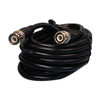
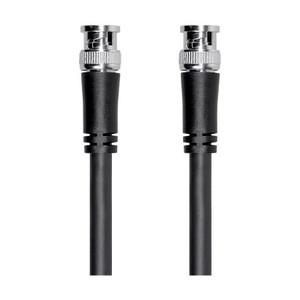
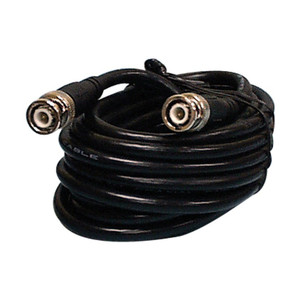
Speco Technologies BB3 3-Foot BNC Male-to-Male Coaxial Cable
Overview
The Speco Technologies BB3 is a 3-foot BNC male-to-male coaxial cable engineered for analog video signal transmission in surveillance and broadcast installations. This standard interconnect cable serves as a direct link between camera outputs, equipment panels, or patch systems where short-run video routing is required. The BB3 delivers uncompressed analog video without signal loss over its 3-foot span — critical when routing between adjacent wall-mounted cameras and DVRs or between rack-mounted components in a security operations center.
Key Features
- 3-Foot Length: Ideal for patch panels, equipment racks, or short runs between wall-mounted infrastructure and nearby enclosures. Reduces clutter and slack compared to longer cables while maintaining full signal integrity over this distance.
- BNC Male-to-Male Connectors: Industry-standard BNC connectors ensure compatibility with any analog camera, DVR input, matrix switch, or monitoring equipment using BNC termination. No adapters needed for direct connection to standard interfaces.
- Coaxial Construction: Shielded coaxial design minimizes EMI (electromagnetic interference) and maintains video signal quality in installations where analog cables run near AC power lines or other RF noise sources. Critical in warehouse and industrial environments where electrical noise is common.
- Direct Analog Routing: Works as a passive cable — no power, no electronics, no active conversion required. Plug directly from camera BNC output to DVR input, distribution amplifier, or matrix switch input without configuration or power supply dependencies.
Integration & Compatibility
The BB3 integrates seamlessly into both new analog surveillance installations and existing system expansions. Compatibility extends to any equipment with standard BNC connectors: analog CCTV cameras, DVRs, analog matrix switches, distribution amplifiers, RF modulators, and legacy monitoring equipment. Because it is a passive cable with no electronics, there is no firmware, no driver, and no compatibility matrix to check — it works with any analog video source and any analog video input rated for standard CVBS (composite video baseband signal) levels.
This makes the BB3 particularly useful in retrofit or mixed-technology environments where older analog infrastructure coexists with newer IP cameras and recorders. Analog legs of a hybrid system often benefit from reliable short-run passive cabling to avoid unnecessary active components and points of failure.
For integrators managing large deployments, the BB3 simplifies inventory — a single standard cable type works across multiple camera manufacturers and DVR brands without compatibility concern.
Frequently Asked Questions
Q: Is the BB3 suitable for long cable runs (e.g., 50+ feet)?
A: No. The BB3 is designed for short interconnect applications — patch panels, rack-to-rack, or wall-mount to nearby equipment. Signal degradation increases over longer distances in analog coax. For runs exceeding 20 feet, consider a distribution amplifier or migrate to IP-based cameras and network video recorders to eliminate distance limitations.
Q: Can the BB3 carry audio signals?
A: No. The BB3 is a video-only cable. It terminates analog composite video (CVBS) between BNC connectors. Audio requires separate cabling — typically balanced XLR or unbalanced RCA connections, depending on your equipment.
Q: What connector standard does the BB3 use?
A: Standard BNC (Bayonet Neill-Concelman) male connectors on both ends. BNC is the de facto standard for analog CCTV video interconnects. No adapters needed if your equipment uses BNC inputs and outputs.
Q: Is the BB3 shielded?
A: Yes. The coaxial construction includes shielding to reduce EMI ingress. This is important in industrial and warehouse settings where AC power and RF noise can degrade video quality on unshielded cables.
Q: Does the BB3 work with both analog and HD-SDI cameras?
A: The BB3 is rated for standard composite analog video. While some HD-SDI (high-definition serial digital interface) equipment also uses BNC connectors, HD-SDI requires a cable designed for its higher bandwidth and impedance characteristics. Confirm with your HD-SDI equipment vendor before using the BB3 for SDI signals.
Q: What gauge is the coax inside the BB3?
A: Specific wire gauge is not documented in the manufacturer specifications provided. For detailed internal construction, contact the manufacturer or your distributor directly.
Ted PerryPerspective based on aggregated IP Security Depot and affiliated engineering team experience.
The Speco Technologies BB3 is a workable choice for analog surveillance cable runs under 10 feet. I see it specified often in retrofit jobs and patch-panel applications where you need a known-good interconnect between legacy cameras and DVRs without introducing untested or cheap cable that introduces noise. At 3 feet, it's short enough that signal loss is negligible — you're not fighting attenuation that would require equalization or amplification.
Technical Highlights:
- Shielded Coaxial Design: The coax shielding handles EMI rejection in noisy environments (warehouses, manufacturing floors with VFDs and industrial power distribution). Unshielded cable in those spaces will pick up hum and color crawl that degrades video quality noticeably.
- Male-to-Male BNC Termination: No gender-mismatch surprises. Both ends are male, so your camera output and DVR input both need female BNC receptacles. Confirm this before ordering — mixing male and female can force adapters into your rack.
- Passive, No-Config Deployment: There is zero electronics in this cable. No power draw, no firmware, no ONVIF negotiation. Plug it in and video appears — or it doesn't. Troubleshooting is straightforward: terminate it correctly, check your DVR input is enabled, and move on.
Deployment Considerations:
- The 3-foot length is its primary strength and limitation. It works perfectly for patch panels, short runs within a rack, or between a wall-mounted camera bracket and a nearby conduit drop to the server room. Beyond 10 feet, analog coax starts showing signal loss — brightness drop, color shift, or visible noise. Use a distribution amplifier or plan an IP camera migration instead.
- HD-SDI and higher-bandwidth analog formats (like AHD) may not perform reliably on standard CVBS coax. Confirm your camera output format matches composite analog CVBS before committing inventory.
The BB3 belongs in your cart if you're wiring a small analog patch panel, doing a proof-of-concept with legacy DVR hardware, or backfilling a single camera run in a hybrid IP/analog facility. For new deployments or anything beyond 20 feet, migrate to IP surveillance cameras and eliminate cable-distance headaches entirely.