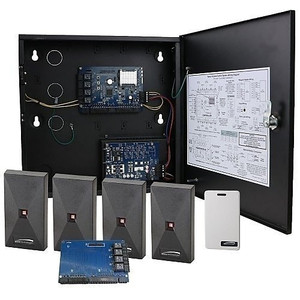
Speco Technologies A2M 2-Door Expansion Board
The Speco A2M is a dedicated expansion module that bridges capacity gaps in single-door or dual-door access control deployments. It adds two independent doors to an existing A2E4 or A2E4P controller, scaling your installation from 2 doors to 4 doors total without replacing the main panel. This approach is cost-effective for phased rollouts or multi-zone facilities where you need independent access logic per zone without the expense of a second full controller.
Key Features
- 2 Independent Doors with Dual Wiegand Support: Each door has its own Wiegand reader pair (one in, one out), delivering 300mA @ 12V per reader. This means you can assign separate credentials to entry and exit paths—critical when you need to track direction or enforce one-way flows (stairwell egress, warehouse staging areas).
- 2 Form C Door Lock Relays at 24V @ 2.0A: One relay per door for lock control. Form C contacts give you normally-open and normally-closed options, so you can fail-safe or fail-open depending on your security posture. At 2.0A, you can drive most 24VDC solenoid locks directly without an intermediary relay.
- 2 Form C Auxiliary Relays at 24V @ 2.0A: Secondary relay per door for alarm signals, door strike integration, buzzer activation, or light control. Synchronized with door state, not the reader.
- Request to Exit (REX) Input per Door: Connects a pushbutton or motion sensor to unlock without a credential—essential for fire egress, emergency exits, or ADA compliance. One input per door means independent REX logic.
- Door Position Status (DPS) Monitoring: Real-time input per door to detect if a door is open or closed. Used for audit trails, alarm generation, and dwell-time detection. Prevents lock timeout on physically open doors.
- 2 Global Auxiliary Inputs: General-purpose inputs for system-wide signals (alarm bus, fire panel integration, tamper switches). Not door-specific, so they apply across the entire 4-door framework.
- 1000mA @ 12V Internal Power Budget: The A2M includes its own power supply for the controller and all readers. Plan your 12VDC source accordingly—dedicated 2A PSU recommended for headroom, especially if you add external readers later.
- Compact Form Factor (6.125" W × 4.25" H × 0.75" D): Fits standard electrical boxes or cabinet rails without excessive space demand. Low profile is useful in retrofit scenarios where panel real estate is tight.
- ETL Listed for North America: Meets UL and CSA safety standards—required for most commercial and institutional builds. Insurance carriers and code inspectors recognize this certification.
- 50°F to 95°F Operating Range: Standard indoor climate tolerance. Do not install in unheated sheds, parking structures, or outdoor cabinets without additional thermal management.
- 5-Year Manufacturer Warranty: Covers defects in materials and workmanship. Does not cover misapplication, physical damage, or power surges—use a 24V surge protector on relay outputs if lightning is a concern in your region.
Integration & Compatibility
The A2M integrates only with Speco A2E4 and A2E4P controllers. It cannot be used standalone or with other brands' panels. Wiegand readers (125 kHz HID or equivalent) connect directly; no separate controller needed. Relay outputs are dry-contact (Form C), so they work with any 24VDC solenoid, magnetic lock, or auxiliary device that accepts a relay signal. DPS inputs expect a dry contact closure when the door is closed—magnetic reed switches or door position sensors work fine. REX inputs likewise accept any dry contact (button, motion detector, wireless exit device with relay output). Do not connect high-impedance analog signals or active logic inputs directly; they will not function.
When to Choose a Different Model
If you need more than 4 doors, you cannot daisy-chain multiple A2M boards—each expansion adds exactly 2 doors to an A2E4/A2E4P pair. For 6+ door deployments, evaluate a higher-capacity panel or multiple independent A2E4P systems. If you require IP-based integration, LDAP directory sync, or cloud reporting, the A2M has no native networking—it is a hardwired, standalone module. For those scenarios, compare to networked access control platforms (different product family entirely). If you need more than 2 auxiliary inputs system-wide, the A2M's 2 global inputs may be insufficient for complex alarm or integration schemes.
FAQ
Q: Can I expand an A2M with a second A2M module?
A: No. An A2E4 or A2E4P controller supports one A2M expansion only, bringing the total to 4 doors. Multiple expansions are not supported by the architecture.
Q: What voltage do the Wiegand readers require?
A: 12V, supplied internally by the A2M's power supply at up to 300mA per reader. Total system draw is capped at 1000mA @ 12V, so plan accordingly if you add auxiliary devices.
Q: Can I use the REX input for a different function, like fire panel integration?
A: Technically yes, if your controller firmware allows reassignment, but the REX input is dedicated to emergency egress by design. For fire panel signals, use the 2 global auxiliary inputs instead.
Q: Does the A2M support remote monitoring or reporting?
A: No. The A2M is a passive expansion board. Logging and remote access depend entirely on the A2E4 or A2E4P controller it is connected to. Check the parent controller's feature set for network or cloud capabilities.
Q: What is the maximum distance between the A2M and the A2E4/A2E4P?
A: Speco documentation does not specify a maximum cable run. Standard practice for access control is to keep control wiring under 100 feet and use shielded cable to avoid crosstalk. Consult the A2E4/A2E4P manual for exact limits.
Q: Is the A2M compatible with wireless Wiegand readers?
A: No. The A2M requires hardwired Wiegand readers. Wireless readers would need a separate wireless-to-Wiegand bridge converter, which is outside the A2M's scope.
Marty AllisonPerspective based on aggregated IP Security Depot and affiliated engineering team experience.
The Speco A2M is the right answer when you have an A2E4 or A2E4P already installed and need to scale to 4 doors without replacing the controller or adding a second panel. It's common in retrofit scenarios where you're adding a second secured zone (stairwell, server room, second entrance) to a building that started with single-door or dual-door access. The A2M handles that expansion cleanly and cost-effectively.
Technical Highlights:
- Dual Wiegand Reader Pairs (300mA @ 12V each): The A2M gives you 4 total Wiegand ports—one in/out pair per door. This matters because you can enforce directional credential checks: badge-in to the main entrance, badge-out at the stairwell. Many basic panels don't offer this flexibility. The 300mA per reader is adequate for standard HID or EM4100 readers; if you're running passive readers or older high-draw units, verify draw before installation.
- Form C Relays (2 lock + 2 auxiliary @ 24V, 2.0A): Form C contacts let you wire either normally-open or normally-closed logic. On the lock relay, this means fail-safe (de-energize = unlock, door release on power loss) or fail-secure (energize = lock). Most people choose fail-safe for life-safety code compliance. The 2.0A capacity is sufficient for direct 24VDC solenoid drive—no intermediate relay needed in most installations.
- Door Position Status Input per Door: Real-time monitoring of door state prevents a common access control headache: someone props a door open, you never know, audit trail looks clean but the door is unlocked 8 hours later. DPS input ties the lock relay to the physical door switch, so if a door doesn't close within a timeout window, the system can trigger an alarm or log an event.
- 1000mA @ 12V Power Budget: The A2M includes an internal PSU, but the total draw is capped at 1000mA. If you plan to add external devices (wireless repeaters, additional sensors, badge readers beyond the stock 4), budget this carefully. A dedicated 2A @ 12V supply provides safe headroom.
Deployment Considerations:
- The A2M is not a standalone device—it depends entirely on the parent A2E4 or A2E4P controller for logic, credential database, and event logging. If the controller fails, the A2M cannot function independently. Plan controller redundancy if uptime is mission-critical.
- Wiegand readers are hardwired only; no wireless option. If your site has poor conduit access or budget constraints preventing new runs, this is a painful limitation. Plan cabling before committing to this expansion.
- The 12V supply is shared across controller, readers, and auxiliary devices. If you daisy-chain many external devices (motion sensors, bell circuits, etc.), monitor total draw to avoid brownout. Use a separate 24V supply for high-current auxiliary relays if possible.
Deploy the A2M in multi-tenant office buildings where each suite gets independent door access (one suite = 2 doors on the A2M + 2 on the main controller). Also solid for warehouse staging areas, data center zoning, and building additions where you need controlled egress without justifying a full second panel. Avoid this module if you need more than 4 doors, require IP-based credential sync, or cannot run hardwired Wiegand from the reader locations.