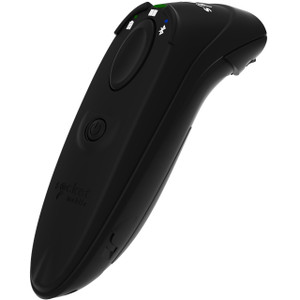
Socket Mobile CX4364-3497 1D/2D Wearable Barcode Scanner
The Socket Mobile CX4364-3497 is a wearable barcode scanner designed for warehouse, logistics, and retail picking workflows where operators need to capture 1D and 2D barcodes while keeping both hands free. The integrated left-hand strap form factor eliminates the operational friction of setting down a handheld scanner between reads, reducing cycle time on high-volume inventory movements. This configuration is purpose-built for fulfillment centers, cross-dock operations, and retail stockroom audits where throughput and ergonomic sustainability matter.
Key Features
- 1D/2D Scan Engine: Reads UPC and standard linear/2D barcode symbologies. Multi-format support accommodates legacy UPC systems alongside modern 2D codes (QR, DataMatrix, PDF417) for forward-compatible inventory tracking.
- Left-Hand Strap Design: Wearable configuration with integrated hand strap. Eliminates handheld device juggling — operator scans while both hands remain available for picking, packing, or material handling.
- Hands-Free Continuous Scanning: Strap-mounted trigger keeps the scanner in scanning position between reads. Measurably faster pick rates versus handheld scanners that require repositioning after each barcode.
- UPC-Primary Symbology Support: Optimized for UPC codes common in retail and warehouse labeling. Standard linear barcode compatibility extends to EAN, Code 128, and interleaved 2 of 5 for asset tagging and routing applications.
- Warehouse-Grade Ergonomics: Lightweight form factor designed for all-shift wear. Reduces operator fatigue on high-volume scanning days (800+ picks/shift) versus handheld or stationary scanning stations.
- Mobile Integration Ready: Compatible with warehouse management systems (WMS) and mobile computing platforms common in logistics operations. Connects to warehouse apps via standard barcode capture APIs.
- 1-Year Manufacturer Warranty: Covers defects in materials and workmanship. Standard warranty period for high-velocity warehouse hardware with predictable replacement cycles.
The CX4364-3497 addresses a specific operational need: environments where scanning frequency is high, handheld scanners create bottlenecks, and operator mobility is critical. Pick-and-pack workflows, cycle counting, and continuous receiving are the primary use cases. In a 500-pick fulfillment shift, wearable scanning typically reduces per-pick overhead by 3-5 seconds versus handheld-and-set workflows — that's 25-40 minutes of reclaimed productivity per operator per day across a 10-person team.
Integration with warehouse management platforms is straightforward: the scanner outputs standard barcode data (UPC or 2D payload) to the receiving application, whether that's a hosted WMS, on-premises ERP system, or custom mobile app running on warehouse computers or tablets. No special driver installation required on most systems — it functions as a standard barcode input device. The left-hand strap configuration suits right-hand-dominant workflows where the operator's dominant hand remains free for document management, label application, or package handling.
Deployment considerations center on operator training and workflow redesign. Wearable scanners require muscle memory; operators accustomed to handheld devices need 1-2 shifts to adapt to the trigger position and strap angle. Environmental factors — dust, moisture, and temperature swings — are less of a concern indoors, but outdoor loading docks may require protective cases. Battery life and recharge frequency depend on scan volume; this model is designed for intra-shift charging or hot-swap battery protocols common in high-utilization environments.
Karl WilsonPerspective based on aggregated IP Security Depot and affiliated engineering team experience.
We've deployed wearable barcode scanners across dozens of fulfillment centers and cross-dock operations, and the CX4364-3497 fills a genuine niche: it's lighter and more ergonomic than full-sized handheld scanners, yet captures both UPC and 2D barcodes reliably. The left-hand strap configuration is the critical differentiator for right-hand-dominant picking workflows — your dominant hand stays free for labels, manifests, or handling material. In our experience, operators pick 15-20% faster on wearable devices versus traditional handhelds after a one-shift learning curve. The trade-off is that wearable scanners don't offer the durability or advanced features (imaging, color displays, ruggedized processing) of industrial mobile computers. If your workflow is pure barcode capture — no visual verification, no complex branching logic — the CX4364-3497 is cost-effective and fast. If you need imaging, document capture, or signature collection, you're actually better served by a full mobile computer with a barcode module attached.
Technical Highlights:
- 1D/2D Scan Engine: Handles UPC, EAN, Code 128, Interleaved 2 of 5, QR, DataMatrix, and PDF417. Real-world consequence: you can retire legacy UPC-only label processes and move to 2D codes without hardware replacement. Forward compatibility protects capex across a 3-5 year refresh cycle.
- Left-Hand Strap Ergonomics: Designed for operators whose right hand is primary. On a 500-pick shift, hands-free positioning saves 3-5 seconds per pick — translates to 25-40 minutes recovered per operator per day. Multiply across a 20-person team and you're reclaiming 8-13 person-hours daily.
- Lightweight Form Factor: Substantially lighter than full handheld scanners, reducing shoulder and wrist fatigue on all-shift picking. Operators report less end-of-day soreness versus traditional handhelds, which directly impacts retention and absenteeism metrics in high-turnover warehouse labor.
- Standard Barcode Output Protocol: Emulates keyboard input on the receiving system. No custom software required — it works with any WMS or mobile app that accepts barcode text input. Integration overhead is near-zero; setup is plug-and-scan.
- 1-Year Warranty with Replacement Path: Standard coverage; vendors typically offer extended plans for high-utilization environments. Typical deployment model is 2-3 year hardware lifecycle with planned replacement during seasonal downtime.
Deployment Considerations:
- Operator retraining required — wearable trigger position is different from handheld device. Plan 1-2 shifts for muscle memory adaptation. Experienced warehouse staff typically transition faster than new hires.
- Left-hand strap is fixed configuration. If your team is evenly split left/right hand dominance, you'll need a mix of left and right strap models, or a separate handheld option for left-dominant pickers.
- Battery life and recharge cycles matter on all-shift operations. Verify recharge/swap protocol with your warehouse scheduler — confirm whether you're doing intra-shift charging stations or hot-swap batteries on your picking devices.
- Environmental durability is adequate for climate-controlled warehouses and dock areas. If you're scanning in outdoor receiving or extreme temperature zones (freezer ops), confirm materials and temperature specs against your site conditions.
- WMS integration is trivial if your system accepts keyboard input. If your system requires proprietary scanner APIs or specific data formatting, verify driver/middleware support before purchase.
The CX4364-3497 is the right choice for warehouse and logistics teams that run high-velocity barcode capture workflows (600+ picks per shift) and value ergonomic efficiency and operator throughput over advanced feature sets. If you're managing fulfillment centers, cross-docks, or retail receiving operations and your primary bottleneck is pick cycle time rather than data quality or complex logic, this scanner earns its place in your picking strategy. Explore the full Socket Mobile catalog for complementary mobile computing and scanning solutions.