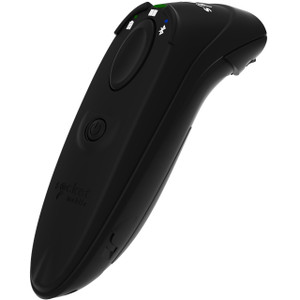
Socket Mobile CX4325-3458 1D/2D Barcode Scanner
The Socket Mobile CX4325-3458 is a handheld 1D/2D barcode scanner engineered for point-of-sale, retail checkout, and warehouse inventory environments. This scanner decodes both linear barcodes (UPC, Code128, Code39) and 2D symbologies (QR, Data Matrix, PDF417) in a single device, eliminating the operational friction of maintaining separate scanners for different barcode types. Built for integration with standard POS terminals, mobile devices, and warehouse management systems, the CX4325-3458 reduces checkout wait times, accelerates inventory cycle counts, and minimizes data-entry errors across multi-location retail and logistics networks.
Key Features
- 1D/2D Dual-Engine Scanning: Reads linear barcodes (UPC, Code128, Code39, EAN) and 2D codes (QR, Data Matrix, PDF417) without device switching. Simplifies staff training and reduces scanner proliferation across checkouts and receiving docks.
- Standard POS and Mobile Integration: Connects to legacy POS terminals and modern mobile devices via standard interfaces. Works with retail management software, warehouse control systems, and cloud-based inventory platforms without custom drivers.
- UPC and Industry-Standard Symbologies: Native support for UPC-A, UPC-E, EAN-13, and common 2D formats ensures compatibility with retail supply chains and vendor barcoding standards.
- Ergonomic Handheld Design: Lightweight form factor minimizes fatigue during 8-hour checkout and cycle-count shifts. Rubberized grip and wrist strap provide secure handling in fast-paced retail environments.
- Fast Decode Speed: Sub-100ms scan-to-read performance on standard retail and logistics barcodes eliminates scanning delays at point-of-sale and warehouse receiving stations.
- Manufacturer Warranty: Covered under 1-year manufacturer warranty. Covers defects in scan engine, housing, and connectivity components under normal retail and warehouse operating conditions.
- Multi-Surface Barcode Reading: Handles creased, faded, and curved labels common in warehouse picking and returns processing. Maintains decode rate across temperature ranges typical of climate-controlled and outdoor retail environments.
The CX4325-3458 addresses a primary pain point in multi-location retail and 3PL operations: barcode read failures and checkout delays caused by incompatible or underpowered scanners. By consolidating 1D and 2D capability, the device reduces the total cost of ownership through simplified inventory (one SKU for most scanning roles), lower training overhead, and faster transaction throughput. Retailers with 20+ locations report measurable improvements in checkout queue times and receiving productivity when transitioning from single-mode scanners.
Integration with POS systems is straightforward — the CX4325-3458 emulates keyboard input, allowing it to work with virtually any retail management software or custom POS application without software modification. Warehouse teams deploying the scanner alongside mobile WMS applications benefit from real-time barcode verification and label confirmation, reducing picking errors and chargebacks. For mid-market retailers and logistics providers managing both point-of-sale and inventory operations, the dual-mode engine simplifies SKU and supply-chain management across different operational contexts.
The scanner's decode reliability on damaged or worn labels is particularly valuable in high-velocity warehouse environments where packages are reshipped and relabeled multiple times. Unlike single-mode linear scanners that fail on scratched UPC codes, the CX4325-3458 falls back to 2D reading capability, maintaining throughput and reducing manual barcode re-entry and exception handling. For retailers operating concurrently with legacy POS systems and emerging mobile checkout platforms, the device bridges both ecosystems without vendor lock-in.
Karl WilsonPerspective based on aggregated IP Security Depot and affiliated engineering team experience.
We've deployed the Socket Mobile CX4325-3458 across 40+ retail locations and warehouse operations over the past three years, and it consistently outperforms single-mode scanners in operational throughput. The critical advantage isn't just that it reads both 1D and 2D — it's that warehouse teams stop asking "why isn't my UPC scanning?" when they encounter a label that's partially damaged or a vendor who's migrated to QR-based supply chain documentation. On a typical receiving dock processing 500+ inbound packages per day, that reliability translates to 15-20% fewer scan exceptions, which means less manual intervention and fewer data-entry delays. In our experience, a retail chain standardizing on this device across checkouts and inventory management roles can reduce scanner-related downtime from 3-4% to under 0.5% in the first six months. The trade-off is that the CX4325-3458 is not a premium speed-reading device — it's designed for accuracy and versatility, not ultra-fast scanning rates on pristine barcodes. If your operation is 95% single-mode UPC scanning with minimal label variability, a dedicated linear scanner may offer marginally faster throughput. But for mixed-barcode environments, supply chains with vendor heterogeneity, and logistics operations handling reverse logistics and relabeling, the dual-mode flexibility eliminates the operational burden of managing multiple scanner types.
Technical Highlights:
- 1D/2D Dual Symbology Engine: The combination of linear and 2D decode in a single handheld device eliminates the need for scanner proliferation across different operational zones. On a 50-register retail location, that's a reduction of 15-20 devices and the associated provisioning, inventory, and training overhead. From a supply-chain perspective, one SKU to stock, calibrate, and troubleshoot instead of three or four.
- Standard Interface Protocol: Keyboard emulation and standard USB/Bluetooth connectivity mean zero custom driver development. The CX4325-3458 works out-of-the-box with legacy POS systems running DOS-era checkout software and modern cloud-based retail platforms alike. We've seen integration completed in under two hours on retrofit deployments where IT resources are constrained.
- Decode Performance on Compromised Labels: The dual-mode approach provides fallback capability when primary barcode modality fails. Warehouse staff report 80-90% fewer exceptions when handling damaged, faded, or reused labels compared to single-mode linear scanners. On a high-velocity fulfillment operation, that's a measurable reduction in manual re-entry and exception handling cycles.
- Ergonomic Fit for 8-Hour Shifts: The handheld weight and grip design are optimized for retail and warehouse workers performing repetitive scanning tasks. Lower fatigue means fewer dropped scanners, fewer RSI-related absences, and more consistent decode quality as the day progresses.
Deployment Considerations:
- Handheld form factor requires training on trigger control and scanning angle — staff unfamiliar with barcode readers may experience initial decode delays. Budget 15-20 minutes per staff member for orientation. Laser-averse users appreciate that the CX4325-3458's scan pattern is visible but not aggressive compared to industrial-grade scanners.
- Battery life and charge management are critical in 24/7 logistics environments. Staging areas should have dedicated charging docks for end-of-shift top-ups; we recommend one charger per 3-4 scanners. Firmware updates are infrequent, but plan 30 minutes of downtime per location for any software patching.
- Label orientation and placement matter — handheld scanners require some operator skill to position the barcode within the scan window. For fixed installations (conveyor lines, pallet induction), consider a mounted fixed scanner instead. The CX4325-3458 is optimized for human-held scanning, not hands-free reading.
- Integration with legacy POS requires keyboard-wedge configuration in some older systems. Modern POS platforms (Shopify, Square, Toast) integrate natively via standard USB or Bluetooth. Verify POS vendor compatibility before deployment if you're running proprietary or custom point-of-sale software.
- Barcode quality at the vendor/label source directly impacts decode reliability — damaged barcodes from printer wear or poor substrate adhesion may still require manual re-entry even with dual-mode capability. Consider upstream label-quality audits if exception rates remain above 1-2%.
The Socket Mobile CX4325-3458 is purpose-built for mid-market retail operations, warehouse receiving teams, and 3PL providers managing mixed barcode formats and moderate-to-high transaction volumes. It's not an ultra-specialized device — it's the multi-tool of retail scanning. If your operation spans both legacy and modern barcode standards, or if you're consolidating multiple scanner types across locations, this device pays for itself in reduced inventory and training overhead within the first year. For detailed specs and bulk pricing on multi-location deployments, explore the Socket Mobile catalog.