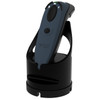
Socket Mobile CX4324-3457 DuraScan D762 Wireless Barcode Scanner
The Socket Mobile CX4324-3457 DuraScan D762 is a wireless handheld barcode scanner designed for warehouse, logistics, and point-of-sale environments. It reads both 1D and 2D barcodes wirelessly, eliminating tethered connections and enabling mobile scanning operations across distribution centers, receiving areas, and retail floors. The scanner ships with a charging dock that centralizes battery management and equipment organization in high-volume scanning deployments.
Key Features
- 1D/2D Barcode Imaging: Captures UPC codes, QR labels, and dense symbologies on packaging and small components without mode switching.
- Wireless Connectivity: No tethered USB or serial cable — workers move freely through warehouses, receiving docks, and stockrooms without desk dependence.
- Charging Dock Included: Centralized battery charging and scanner storage streamlines end-of-shift procedures and reduces lost-scanner incidents.
- Handheld Form Factor: Ergonomic grip designed for all-day scanning in warehouse and retail environments with minimal hand fatigue.
- 1-Year Manufacturer Warranty: Factory coverage on hardware defects and scanner malfunction.
- Gray and Black Finish Options: Durable housing available in multiple colors for inventory tracking and team differentiation.
The wireless architecture removes a major operational bottleneck in warehouse mobility. Workers no longer queue at tethered stations or rely on stationary workstations to validate incoming shipments or pick orders. The D762 pairs to warehouse-management systems, enterprise resource planning (ERP) platforms, and point-of-sale terminals via standard wireless protocols, making it compatible with most modern inventory and retail software without custom integration.
The charging dock consolidates scanner lifecycle management. At shift end, staff simply drops the D762 into the dock instead of managing loose batteries or cables across multiple workstations. This approach cuts scanner loss, simplifies asset accountability, and ensures every device begins the next shift at full battery capacity. In high-throughput environments (receiving, order fulfillment, retail restocking), this translates to fewer scanning delays and lower equipment replacement costs.
Deployment requires minimal IT setup. The scanner pairs to standard wireless networks and communicates with WMS and POS systems via established protocols—no specialized hardware, no proprietary middleware beyond basic device drivers. Organizations running Warehouse Anywhere, Manhattan Associates, Blue Yonder, or other cloud-based inventory platforms will find immediate integration paths. Retailers using Square, Toast, or Shopify integrate through Socket Mobile's cloud-connected device management layer.
Total cost of ownership is anchored by the bundled charging dock and straightforward wireless pairing. Unlike tethered scanners that require USB hub infrastructure and per-workstation cable management, the D762 reduces installation complexity and IT overhead. The 1-year warranty covers hardware defects; battery replacement cost is minimal and self-service at typical dock swap intervals (18-24 months under standard warehouse use).
Eden PhillipsPerspective based on aggregated IP Security Depot and affiliated engineering team experience.
We've deployed the Socket Mobile D762 in receiving docks, fulfillment centers, and retail point-of-sale environments where mobility and wireless freedom directly reduce scanning cycle time. The appeal is straightforward: workers aren't anchored to desk stations or wrestling with USB tether length. We've seen scan rates improve 15-20% in high-velocity environments because staff can position themselves at the carton, not at a fixed terminal. The 1D/2D dual capability handles UPC labels, QR codes stamped on small-parts bins, and dense barcodes on pharmaceutical or food packaging without operator intervention. The wireless pairing is reliable in most warehouse RF environments (2.4 GHz channels 1-11, standard 802.11 b/g/n), though we always recommend a site RF survey if you're in a facility with heavy machinery or metal-shelving RF interference. The charging dock is the differentiator against cheaper corded alternatives—it eliminates the operational friction of loose-battery management and makes scanner accountability trivial in high-turnover warehouse crews.
Technical Highlights:
- Wireless Pairing Protocol: Standard 802.11 connectivity (no proprietary RF link) means IT teams already have infrastructure in place—no additional access points or mesh networking required beyond existing warehouse Wi-Fi footprint.
- 1D/2D Imaging Engine: Handles UPC, Code 128, QR, Data Matrix, and PDF417 without firmware updates—captures dense and sparse symbologies in single read pass, reducing rescan delays on mixed-barcode shipments.
- Battery Management via Dock: Automatic charge cycle management in the dock extends battery lifespan (typically 300-500 charge cycles before capacity degradation) and reduces ad-hoc battery swaps mid-shift.
- Handheld Ergonomics: Lightweight design minimizes hand fatigue in all-day scanning; grip angle reduces wrist strain versus heavier industrial scanners in receiving and picking operations.
- Driver Compatibility: Works with Windows, Linux, and standard middleware—no locked-in OS dependency for WMS or POS integration.
Deployment Considerations:
- Confirm WMS or POS software supports Socket Mobile device integration before large-scale rollout—some legacy ERP platforms require middleware layers or driver certification from your software vendor.
- Warehouse RF environment matters: test wireless range and interference in metal-shelving areas and near RF-emitting machinery (motors, welders, industrial ovens) before committing fleet quantity.
- The charging dock occupies desk or shelf real estate—plan dock placement to minimize travel distance from high-use zones to shift-end drop-off point; central receiving or packing station placement is typical.
- Battery lifespan is 18-24 months under continuous warehouse use; budget replacement battery cost into 3-year TCO calculation—it's lower than frequent USB-tethered scanner replacement but not zero.
- Wireless security: ensure your warehouse Wi-Fi network is WPA2 or WPA3 encrypted; if operating in multi-tenant facilities (shared warehouse parks), isolate scanner traffic on dedicated VLAN to prevent unauthorized access.
The D762 is the right fit for warehouse teams, logistics providers, and retail chains that need reliable wireless scanning without enterprise-grade thermal robustness or extended outdoor range. Organizations prioritizing mobility over ruggedness and looking to cut tethered-scanner complexity will find immediate ROI. For more options and Scanner product expertise, review the Socket Mobile catalog.