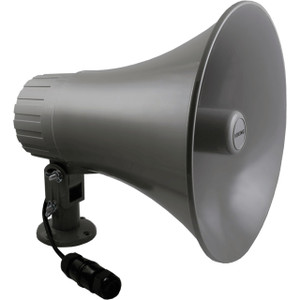
Viking Electronics 300-IP SIP / Multicast Paging Horn
Overview
The Viking Electronics 300-IP is a commercial-grade, 10-inch diameter SIP and multicast paging horn designed for wide-area audio coverage in demanding industrial, warehouse, and outdoor environments. Powered entirely over a standard PoE connection and rated IP66 for direct weather exposure, the 300-IP eliminates the need for a separate power run while delivering 113 dB SPL at one meter — enough output to cut through loud ambient noise on a loading dock or manufacturing floor. If you've ever dealt with a paging system that required separate audio amplifiers, conduit runs for 24VAC, and a weatherproof enclosure, the 300-IP addresses all of that in one self-contained unit.
The 300-IP (often searched as 300 IP) registers directly on a SIP server — Cisco Unified Communications Manager, FreePBX, 3CX, or any RFC 3261-compliant platform — so it behaves like any other endpoint on your phone system. No proprietary controller, no additional driver hardware. For IP paging systems and mass notification deployments, that integration path is a significant operational advantage.
Key Features
- 113 dB SPL Output at 1 Meter: The 6-watt Class D amplifier drives the 10-inch horn to 113 dB SPL — high enough to provide intelligible coverage in environments with 85–95 dB ambient noise typical of active production floors or outdoor yards. Class D topology keeps the amplifier cool and power-efficient, which matters when you're running PoE budget calculations across a multi-zone site.
- PoE Class 3 Power (IEEE 802.3af, <13W): The horn draws under 13 watts from a standard 802.3af PoE port — no mid-span injectors, no local AC wiring. That keeps it within the budget of virtually any managed PoE network switch without requiring the higher-wattage 802.3at ports. One cable carries both data and power to the horn location.
- IP66 Ingress Protection: IP66 means the enclosure withstands sustained heavy rain and direct hose-down — appropriate for covered outdoor docks, parking structures, and exterior wall mounts. It does not cover full submersion; if the install point sees standing water, you need IP67 or higher. The separate 300-IP-EWP variant extends this to up to 100% humidity for truly harsh wash-down environments.
- SIP 2.0 (RFC 3261) Registration: Registers natively on any RFC 3261-compliant SIP server, integrating into existing unified communications platforms without a proprietary controller or audio bridge. Route calls, set schedules, and apply dial-plan rules the same way you manage desk phones.
- Multicast Paging Support: In addition to unicast SIP calls, the 300-IP supports IP multicast for simultaneous broadcast to multiple zones without call-setup overhead. This is the correct architecture for all-call announcements in large facilities — the switch handles the traffic distribution, not the server.
- G.711u, G.722, and G.711a Codec Support (SIP); G.711u and G.722 (Multicast): G.722 wideband audio (50 Hz–7 kHz) produces noticeably clearer speech intelligibility compared to narrowband G.711 — relevant when announcement content includes alphanumeric codes, aisle numbers, or safety instructions that need to be understood clearly at distance.
- -40°F to 140°F Operating Range: Verified operation at -40°F means the horn stays functional in unheated outdoor enclosures during northern winters. The 140°F ceiling accommodates rooftop and attic cable-routing environments that can spike well above ambient on summer afternoons.
- 10-Inch Horn, 11.5-Inch Overall Length: The large-diameter horn provides focused directional projection — appropriate for long aisles, open yards, or stadium-style seating areas where you need throw distance rather than wide dispersion. Confirm coverage angles against your site plan before committing to mounting locations.
- 100BASE-TX Ethernet: Standard Fast Ethernet interface — compatible with any managed or unmanaged switch. No special NIC or VLAN hardware required, though placing paging devices on a dedicated voice VLAN is still recommended practice for QoS management.
- FCC Part 15 / CE / Canada ICES-003 Class A: Multi-jurisdiction regulatory compliance means the unit ships ready to deploy in US, Canadian, and EU facilities without additional certification work.
Integration & Compatibility
The 300-IP integrates with any SIP 2.0 (RFC 3261) compliant platform — Cisco CUCM, Avaya, FreePBX, 3CX, Asterisk, and similar. For multicast deployments, the network switch must support IGMP snooping to prevent multicast traffic from flooding non-target ports. The horn's SIP endpoint registration means it can be targeted by overhead paging features in unified communications systems or triggered via auto-dial from access control or fire-alarm integration panels that support SIP output.
The 300-IP-EWP variant shares the same electrical and network specifications but adds a full weatherproof enclosure rated to 100% humidity — the correct choice for food processing, cold-storage, or chemical wash-down facilities. The 300TB-IP adds a talkback microphone for two-way intercom capability over the same SIP infrastructure, useful for guard stations and entry-point intercoms. For broader Viking Electronics IP audio solutions including door phones and emergency call stations, the 300-IP fits within the same SIP ecosystem.
When planning PoE switch capacity for a multi-zone paging deployment, budget each 300-IP at the full Class 3 ceiling of 13W. For an overview of switch selection and power budgeting, see the PoE planning guide.
Frequently Asked Questions
Q: Does the 300-IP require a dedicated paging controller, or does it register directly on a SIP server?
A: It registers directly on any RFC 3261-compliant SIP 2.0 server — no proprietary controller required. It behaves as a standard SIP endpoint on your phone system.
Q: What is the power requirement for the 300-IP, and will it work with a standard PoE switch?
A: The 300-IP draws under 13 watts and is classified as IEEE 802.3af Class 3. It will power from any standard 802.3af PoE port — no 802.3at (PoE+) required.
Q: Is the 300-IP suitable for outdoor installation?
A: Yes. It carries an IP66 ingress protection rating, which covers direct rain and dust — suitable for covered outdoor areas, loading docks, and exterior walls. For wash-down or 100% humidity environments, the 300-IP-EWP variant is the correct choice.
Q: What audio codecs does the 300-IP support?
A: For SIP calls: G.711u, G.722, and G.711a. For multicast paging: G.711u and G.722. G.722 wideband provides improved speech clarity over narrowband G.711.
Q: What is the 300-IP's operating temperature range?
A: -40°F to 140°F (-40°C to 60°C), making it suitable for unheated outdoor installations in cold climates as well as hot attic or rooftop-adjacent cable runs.
Q: What is the difference between the 300-IP and the 300TB-IP?
A: The 300TB-IP adds a talkback microphone for two-way SIP intercom capability. The 300-IP is a one-way paging horn only. Choose the 300TB-IP when the location also serves as an intercom station.
The 300-IP is one of the cleaner SIP paging deployments I've spec'd for industrial facilities — the 113 dB SPL output from a 6-watt Class D amplifier on a single Cat5e run is genuinely useful, and the -40°F cold-weather rating means you're not hunting for a heated enclosure solution in a northern climate install. If you've been fighting legacy 25V/70V paging infrastructure and want to migrate zone-by-zone onto your IP network, the 300-IP fits that transition well.
Technical Highlights:
- 113 dB SPL / 6W Class D: High output-to-wattage ratio means the horn covers large open spaces without straining PoE power budgets — each unit stays under 13W on an 802.3af port.
- G.722 Wideband Codec: 50 Hz–7 kHz audio bandwidth delivers noticeably clearer speech versus narrowband G.711 — worth specifying when announcements include safety codes or alphanumeric content that must be understood at 50+ feet in ambient noise.
- IP66 + -40°F to 140°F Range: The environmental envelope covers most North American outdoor industrial sites without supplemental enclosures — confirmed rain-tight, dust-tight, and functional in both deep-freeze and high-heat extremes.
Deployment Considerations:
- Place paging horns on a dedicated voice VLAN and enable IGMP snooping on any switch handling multicast zones — without it, multicast traffic floods all ports and can degrade non-paging network segments.
- The 300-IP is one-way audio only. If the mounting location also needs intercom capability — entry points, guard stations, dispatch windows — spec the 300TB-IP from the outset rather than retrofitting later.
Best fit for warehouse distribution centers and manufacturing facilities migrating from legacy analog paging to SIP infrastructure, particularly multi-building campuses where a single Asterisk or CUCM cluster can manage all zones without per-building amplifier racks.