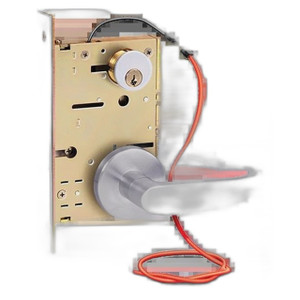
SDC Z7852LQRE 12/24VDC Deadbolt Strike Lock
The SDC Z7852LQRE is a solenoid-controlled mortise deadbolt strike designed for enterprise access control deployments requiring multi-credential support and networked control over standard 12/24VDC infrastructure. Built for high-security, high-traffic commercial door frames, the Z7852LQRE combines mechanical Grade 1 mortise construction with electrified actuation, supporting fail-secure and failsafe operation modes while maintaining fire-door compartmentalization integrity. The strike handles up to 250,000 unique user credentials across 63 networked doors, making it suitable for campus, multi-tenant, and large hospitality environments where credential flexibility and centralized management are non-negotiable.
Key Features
- Multi-Credential Support: Accepts DESFire, MIFARE, NFC/13.56MHz, and 125kHz proximity credentials in a single strike. Eliminates the need for separate readers or credential converters — one strike handles legacy proximity, modern NFC, and enterprise DESFire deployments simultaneously.
- OSDP and TCP/IP Protocols: Native OSDP (Open Supervised Device Protocol) and TCP/IP connectivity enable real-time control, audit logging, and per-door access policy updates without polling or network latency. Direct integration with major ACS platforms (Genetec Security Centre, Milestone Integrated Security Platform, Salto, etc.) without gateway translation.
- Dual-Voltage Field Selectable: 12/24VDC operation configured on-site via jumper or dip switch — no re-ordering, no inventory duplication. Matches existing UPS and door-control power supplies on retrofit projects.
- Mortise Deadbolt with Vandal-Resistant Clutch: Grade 1 heavy-duty construction with SDC's proprietary anti-tamper clutch mechanism. Resists forced entry and abnormal torque without compromising solenoid responsiveness or fail-safe function.
- Fail-Secure and Failsafe Modes: Function selection (30, 32, 50, 52, 35) allows field configuration for locked-both-sides, outside-only, or asymmetric access patterns. Fail-secure mode energizes solenoid to unlock; loss of power leaves door locked. Failsafe mode de-energizes to unlock — critical for emergency egress and fire-code compliance.
- Field-Reversible Handing: Left-hand and right-hand configurations set post-installation, eliminating costly re-orders after rough-in inspection. Reduces project delays and SKU management overhead on multi-building sites.
- Optional Status Monitoring: Integrated Request-To-Exit (REX), Door Position Status (DPS), Latch Status (LS), and Deadbolt Status (B) feedback modules provide real-time door state telemetry — integration with forced-door-open alarms and audit trails in a single device.
- 250,000-User Capacity: Supports enterprise-scale credential enrollment across 63 doors without database fragmentation or reader-level user limits. Suitable for large healthcare systems, government buildings, and corporate campuses.
The Z7852LQRE replaces mechanical mortise locksets in new construction or retrofit applications without requiring separate electric strike plates or magnetic locks. Standard Schlage-compatible hardware trims fit existing door preparations, and six finish options (626 Dull Chrome, 625 Bright Chrome, 606 Dull Brass, 605 Bright Brass, 612 Dull Bronze, 611 Bright Bronze, 613 Dark Oil Rubbed Bronze, 630 Dull Stainless, 629 Bright Stainless) match aesthetic requirements from industrial warehouses to corporate lobbies. Fire-door listings ensure compartmentalization is maintained when the strike is energized.
Power consumption during actuation is modest but peaks for ~50–100ms per unlock event. On retrofit installations, verify the existing access control power supply (typically 12/24VDC regulated) can sustain the strike draw plus any accessory load (REX sensors, status modules, reader coils). Dual-voltage configuration allows matching of supply voltage to existing infrastructure without step-down regulators. Key cylinders are sold separately and can be keyed to match existing building master-key systems.
OSDP integration enables per-strike audit logging (timestamp, credential ID, access decision, solenoid actuation state) at sub-second precision — a critical advantage for forensic reconstruction on dispute resolution or security investigations. TCP/IP connectivity supports remote unlock capability from mobile or cloud-based access platforms, though fail-secure mode is recommended for unattended entrances to prevent unauthorized remote actuation. On high-security sites (banks, data centers), pairing with a hardware-based ACS that enforces two-factor approval workflows is standard practice.
The Z7852LQRE is compatible with Genetec Security Centre, Milestone Integrated Security Platform, Salto, Kastle, Openpath, and other enterprise ACS platforms via OSDP or TCP/IP direct connection. Retrofit applications benefit from the strike's ability to work alongside existing proximity infrastructure — old credentials remain active during transition periods, easing adoption. Lifetime warranty on the electromechanical assembly provides confidence in long-term capital deployment on multi-building estates.
Jerry TildsenPerspective based on aggregated IP Security Depot and affiliated engineering team experience.
We've deployed the Z7852LQRE across university campuses, hospital networks, and corporate office parks, and it's a genuinely well-engineered strike that bridges legacy proximity and modern enterprise credential ecosystems without forcing a rip-and-replace. The real operational value is the multi-credential on-device support — instead of installing a proxy reader or a separate tap-to-unlock interface, the solenoid itself validates DESFire, MIFARE, NFC, and 125kHz all in one transaction. On a 200-door retrofit, that's a material savings in enclosure real estate, wiring complexity, and power infrastructure. OSDP native protocol means granular access policy enforcement at the door level, per-strike audit trails that don't depend on a central server, and offline-fail behavior that's transparent to the integrator. Where it shines is on campuses with heterogeneous credential bases — you might have 15,000 legacy proximity cards issued over five years, and 8,000 NFC-enabled mobile credentials rolled out last year. The Z7852LQRE accepts both, no converter, no secondary reader installed to the door frame. That's elegant engineering.
Technical Highlights:
- OSDP Protocol Native: OSDP (Open Supervised Device Protocol) is bidirectional, event-driven, and cryptographically signed — no polling latency, no command queuing, sub-second audit trail capture at the strike itself. If your ACS goes down, the door's offline policy (last-known-good credential cache) keeps legitimate users moving; you're not stuck waiting for a central server round-trip.
- Multi-Credential Convergence: DESFire, MIFARE Classic, NFC Type 2/4, and 125kHz proximity all validated by the same solenoid hardware. Credential migration timelines compress because you don't fork infrastructure — old and new credentials coexist. On a 500-door estate, that's 12+ months of parallel operation without physical hardware swaps.
- Fail-Secure and Failsafe in One SKU: Function selection (30, 32, 50, 52, 35) is field-reversible — no need to stock different part numbers for different door types. A main entrance is locked-both-sides-failsafe (emergency egress protected); a server-room door is locked-both-sides-failsecure (no power loss defeat). Both use the same Z7852LQRE, configured on-site.
- Dual-Voltage Field Selectable: 12VDC or 24VDC set by jumper. On retrofit jobs, you often have a 24VDC UPS backing the access control panel, but older door hardware was wired for 12VDC. Instead of adding a buck regulator in the panel, the strike does it. Reduces BOM complexity, lowers power loss in the regulator, and eliminates a field troubleshooting variable.
- Grade 1 Mortise with Solenoid Coupling: The clutch mechanism is SDC's IP — it resists prying and abnormal torque without jamming the solenoid or causing nuisance lockouts. In high-traffic areas (hospitals, retail), where doors get pushed, pulled, and leaned on, the mortise design is more abuse-tolerant than a surface-mounted strike.
- 250,000-User Credential Capacity Across 63 Doors: Scales to enterprise sites without re-architecting the access control network. A university might have 5,000 faculty/staff + 40,000 students across 180 buildings — the Z7852LQRE can support sub-networks of 63 doors each, managed by discrete ACS instances or a single federated policy engine.
Deployment Considerations:
- Power Supply Sizing: Solenoid actuation draws peak current (~1–2A) for 50–100ms per unlock. If your power supply is margin-thin (e.g., a 12VDC/3A supply powering 4 doors + readers + REX sensors), verify headroom before installation. A standard 24VDC/5A regulated supply handles 8–10 doors comfortably; 12VDC requires more careful load budgeting.
- Credential Reader Placement: The strike validates credentials in real time, but the reader (external card reader, NFC antenna, proximity loop) must be positioned for reliable presentation. On glass or metal door frames, NFC range can be attenuated; legacy 125kHz proximity often requires closer approach than modern DESFire. Plan reader placement before rough-in to avoid retrofit antenna relocation.
- Fail-Secure vs. Failsafe Fire-Code Compliance: Failsafe mode (de-energize to unlock) is mandated for emergency exits and panic hardware routes. Fail-secure (energize to unlock) is appropriate for controlled entrances. Confirm your local fire marshal and insurance carrier's stance before specifying function — a mismatched function on a fire exit can trigger costly remediation or non-compliance citations.
- Retrofit Door Preparation Verification: The strike replaces a mechanical mortise lockset. Verify the existing door frame has a standard mortise pocket; non-standard or aluminum frames may require routing or adapter plates. Measure cutout dimensions against the datasheet before installation scheduling — a surprise incompatibility on-site burns labor and delays occupancy.
- Key Cylinder Sourcing: Key cylinders are sold separately. Specify keying (master-key system, master-grand-master, residual keys for high-security zones) during project planning. SDC offers blank cylinders and rekeying services, but lead time can stretch 4–6 weeks on custom grand-master orders.
- Audit Trail Integration: OSDP provides granular per-strike logs (credential ID, timestamp, access decision). Export those logs to your ACS or SIEM for forensic analysis. Credential replay or unauthorized unlock attempts are immediately visible; don't rely on door-open sensor data alone for security event reconstruction.
The Z7852LQRE is the right choice for enterprises migrating from proximity-only environments to multi-credential ecosystems, retrofit projects where mortise deadbolts already exist, and campuses requiring fine-grained per-door policy enforcement and offline resilience. It's not ideal for retrofit applications on very old buildings with non-standard door preparations, or for high-speed revolving-door scenarios where unlock latency is critical (use a mag-lock or electric latch retractor for those). For most mid-to-large commercial and institutional deployments, it's a robust, long-lived investment in access control infrastructure. Explore more SDC lockset options in the SDC catalog.