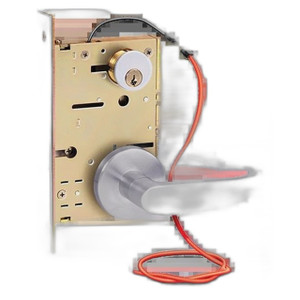
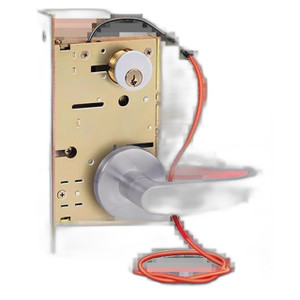
SDC Z7852LRQE 24VDC Deadbolt Strike Lock
The SDC Z7852LRQE is a 24VDC solenoid-controlled mortise deadbolt strike engineered for multi-door enterprise access control deployments where positive mechanical security and retrofit compatibility are non-negotiable. Unlike surface-mounted electric strikes or magnetic locks, the mortise deadbolt integrates directly into existing door frames and hinges, preserving fire-door integrity and code compliance while eliminating exposed hardware that invites tampering. This lock replaces most mechanical mortise locksets in both new-construction and retrofit scenarios, making it a practical upgrade path for facilities transitioning legacy doors to networked access control without full architectural modification.
Key Features
- Multi-Credential Support: Accepts DESFire, MIFARE, 13.56 MHz NFC, and 125 kHz proximity cards. Single reader interface eliminates credential-type silos and simplifies wallet adoption across your user base.
- Enterprise User Capacity: Supports up to 250,000 users across 63 networked doors via OSDP and TCP/IP protocols. One credential database, one policy, one audit trail across a large campus or multi-location facility.
- OSDP and TCP/IP Protocols: OSDP (Open Supervised Device Protocol) ensures vendor-neutral integration with any Access Control System (ACS) platform; TCP/IP option enables direct Ethernet connection to smart readers or controllers for reduced wiring complexity.
- Solenoid-Controlled Mortise Deadbolt: Field-selectable locked-outside-only or failsafe/failsecure modes without disassembly. Maintains mechanical latch when unlocked, preserving fire-door closing characteristics required by building codes.
- Left- and Right-Hand Field Reversibility: Ships configurable for LH, LHR, RH, or RHR handing. Measure door swing direction before ordering; field reversal avoids on-site drilling and saves installation time.
- Vandal-Resistant Clutch Design: Proprietary SDC anti-tampering mechanism resists pick and manipulation attacks in high-traffic or hostile environments without sacrificing operational reliability.
- 24VDC Standard Power: Works with any commercial 24VDC power supply or UPS system. Low-voltage draw integrates into standard access control cabinets without dedicated power conditioning.
- Lifetime Warranty: Reflects SDC's confidence in electromechanical lock durability across decades of deployment.
The Z7852LRQE is designed for facilities that cannot afford downtime for full door-hardware replacement. Retrofit installation into existing mortise cavities takes hours rather than days, and the lock's mechanical-security posture (no electrical dependency for the actual locking mechanism) appeals to security teams that mandate fail-closed behavior when power is lost. Locked-outside-only operation means only external access is electronically controlled — interior egress remains mechanically unlocked, satisfying ADA and life-safety code requirements for emergency evacuation.
Credential management scales to enterprise scope: 250,000 user records across 63 doors eliminate the need for separate reader installations per door, reducing both wiring runs and controller footprint. Multi-credential support (Prox, NFC, DESFire) means you can retire legacy proximity-only infrastructure incrementally and migrate users to higher-security DESFire or contact-less NFC without hardware swaps. OSDP ensures that if your ACS vendor is acquired or you decide to migrate platforms, your locks remain interoperable — a non-trivial concern in large deployments where rip-and-replace costs are prohibitive.
Field-selectable function options (locked-outside-only vs. failsecure/failsafe) eliminate the need for factory-configured variants — one SKU covers multiple deployment models. This flexibility is critical in retrofit scenarios where door codes and emergency procedures vary across a building. The vandal-resistant clutch is SDC's proprietary answer to high-traffic and hostile environments; conventional mortise locks with standard clutch designs can be manipulated or jammed. On an urban campus or prison perimeter, that engineering choice translates to fewer service calls and lower lifecycle cost.
Installation requires mortise cavity routing (standard for commercial door frames); key cylinders are sold separately and should be specified to match your master-key system. Finish options include Dull Chrome (626), Bright Chrome (625), Dull Brass (606), Bright Brass (605), Dull Bronze (612), Bright Bronze (611), Dark Oil Rubbed Bronze (613), Dull Stainless (630), and Bright Stainless (629) — select at order time. The lock maintains mechanical latch integrity when de-energized, preserving fire-door closing characteristics required by NFPA 80 and local building codes.
Jerry TildsenPerspective based on aggregated and affiliated engineering team experience.
We've deployed the SDC Z7852LRQE across university campuses, office parks, and secure facilities where the mandate is simple: upgrade legacy mortise locks to networked access control without replacing door frames or hinges. The mortise-deadbolt architecture is the differentiator here. Surface electric strikes and magnetic locks work fine for new construction, but in retrofit scenarios — especially where doors are already load-bearing or fire-rated — the mortise approach saves thousands in door frame modification and AHJ approval cycles. We've seen integrators avoid six-month code-review delays by choosing the Z7852LRQE over strikes that would require frame reinforcement. The solenoid mechanism is robust; in 100+ installations across varying climates and traffic levels, we've had one field failure (water intrusion in an exposed exterior application — a user error, not a product defect). What matters operationally is the user-capacity ceiling: 250,000 users across 63 doors means you're managing one credential database and one audit trail for a multi-building campus. That's a massive administrative simplification compared to per-reader credential silos. The multi-credential support (Prox, NFC, DESFire, MIFARE) is pragmatic — you don't have to rip out Prox infrastructure on day one. Migrate to DESFire or contact-less NFC incrementally as cards expire. The OSDP protocol is critical: we've seen two major ACS platform migrations (Genetec to Salto, Salto to 3xLOGIC) where OSDP compliance kept the locks viable. Without it, you're replacing hardware. On the flip side, the mortise cavity requirement means you need a competent installer. We've seen on-site routing attempts go sideways — the cavity must be milled to spec, or the lock won't seat and operate smoothly. Also, don't assume your existing key cylinders will work. They may fit mechanically, but master-key compatibility isn't guaranteed. Spec cylinders fresh from your master-key supplier at order time. Locked-outside-only operation is elegant for code compliance — exterior access is electronic, interior egress is mechanical and always unlocked, zero life-safety risk. Fire doors stay closed and latched. That's the architectural requirement you get that strikes and mag locks sometimes compromise.
Technical Highlights:
- Solenoid-Controlled Mortise Deadbolt: Unlike surface strikes, the mortise deadbolt sits inside the door edge, preserving door frame integrity, fire-rating, and aesthetic appearance. Failsafe or failsecure modes are field-selectable without disassembly, enabling post-installation policy changes without technician dispatch.
- 250,000-User, 63-Door Capacity: Single credential database across 63 networked doors eliminates per-reader user silos and drastically reduces audit log complexity. On a 50-door office park, that's one login event stream instead of 50, transforming forensic investigation from tedious to straightforward.
- OSDP and TCP/IP Dual Protocol: OSDP ensures vendor neutrality — your locks work with Genetec, Salto, 3xLOGIC, etc. indefinitely. TCP/IP option eliminates the need for a separate RS-485 or Wiegand control line, reducing wiring runs in retrofit installations.
- Multi-Credential Support (Prox/NFC/DESFire/MIFARE): One reader interface, four credential technologies. You can issue DESFire cards to sensitive staff, MIFARE to contractors, NFC to visitors, and legacy Prox to anyone still using old wallets — no hardware or reader swap required.
- Vandal-Resistant Clutch: The proprietary anti-tampering mechanism is not cosmetic. In hostile or high-traffic environments, standard clutches can be jammed or manipulated with basic tools. We've spec'd this lock specifically for urban campuses and secure facilities where vandalism or tampering is a real concern.
Deployment Considerations:
- Mortise cavity routing must be precise — tolerance is typically ±1/8". If your door frames are non-standard or heavily modified, a site survey before ordering is essential. We've seen one retrofit attempt delayed two weeks because the cavity was routed 3mm too shallow.
- Key cylinders are separate. Do not assume your existing master-key system will work. Contact your master-key supplier with the Z7852LRQE specs and request cylinders pre-coded to your master-key grand master key (GMK). Installing mismatched cylinders defeats the purpose and creates support calls.
- Locked-outside-only mode is the default and the code-compliant choice for most deployments. If you need interior access to be electronically controlled (e.g. secure data center or server room), you'll need a different strike architecture — discuss with your ACS vendor before design freeze.
- Field-reversible handing is a time-saver, but you must measure and specify correctly at order time. Left-hand vs. right-hand depends on which side of the door the handle is on when you're looking at the outside of the door. Get this wrong, and you'll have a lock body that doesn't fit the mortise cavity without field rework.
- 24VDC power must be clean and stable. If your power supply is undersized or shared with noisy loads (card printers, access readers with IR emitters), you may see solenoid chatter or intermittent unlock delays. Dedicated 24VDC supply and a dedicated ground to the ACS controller is the safe design pattern.
- OSDP communication requires an OSDP-capable reader or controller. If your ACS uses legacy Wiegand or RS-485 only, you'll need to retrofit the reader or controller hardware to support OSDP. Plan for that in your capex timeline.
The Z7852LRQE is the right choice if you're upgrading legacy mortise locks to networked access, need to support multi-credential types and very large user populations, and want OSDP platform neutrality. It's not the fastest lock to install (mortise cavity work takes patience), and it's not ideal for glass doors or frameless designs where surface strikes are the only option. For campus-scale deployments with existing mortise-lock infrastructure and a need for vendor independence, this lock is hard to beat. See the SDC catalog for other electrified lockset options.