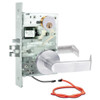
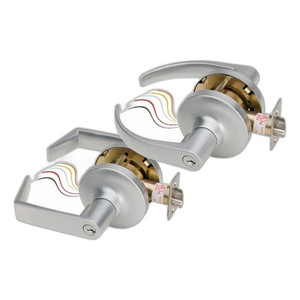
SDC Z7652RQRE 7600 Series Controlled Mortise Lock
The SDC Z7652RQRE is a Grade 1 motorized latch retraction (MLR) mortise lockset engineered for retrofit and new-construction fire-rated door and automatic door operator applications. Unlike surface-mounted mag locks, the Z7652RQRE electrifies standard mortise locksets sourced from OEM partners (Schlage, Corbin Russwin, Yale, Falcon, Sargent, Dorma, Marks, Arrow, Best) — you specify the mechanical base lock and SDC delivers factory integration. The controlled latch design maintains door security even when de-energized, a requirement for fire-door egress compliance. Field-reversible handing and selectable function (32/52/20) allow a single SKU to cover multiple door configurations without re-ordering, reducing inventory variance across multi-building deployments.
Key Features
- Motorized Latch Retraction (MLR): Electrified latch motor energizes on access grant; mechanical failsecure design locks door if power is lost. Complies with fire egress codes requiring positive latching on failsafe.
- Multi-Format Credential Support: Accepts DESFire, MIFARE, NFC, and 125 kHz proximity cards. No reader dependency — lock validates credential locally, enabling offline operation and simplified site design.
- OSDP and TCP/IP Communication: Native OSDP support integrates directly with standard access control platforms (Genetec, Allegion, Salto, Assa Abloy); TCP/IP fallback for network-based deployments. Both protocols support bi-directional status and audit logging.
- Grade 1 Security Rating: Meets ANSI A156.13 heavy-duty commercial standard. Vandal-resistant clutch prevents cam overtravel under forced entry, a protection absent in standard mechanical locks.
- 63-Door Scalability with 250K Credential Capacity: Ideal for enterprise access control deployments. Supports up to 250,000 unique card holders across a controlled multi-door network, eliminating per-door controller overhead.
- Field-Reversible Handing: Single SKU covers left-hand, left-hand reverse, right-hand, and right-hand reverse installations with no special tooling. Handing orientation is set during lock installation.
- Function Selectability: Factory field-selectable between Function 32 (locked both sides), Function 52 (locked outside only), and Function 20 (unlocked passage). Critical for mixed-use facilities where some doors require failsecure and others passage.
- Lifetime Warranty: Factory-backed coverage reflects confidence in electromotor and latch assembly durability in high-traffic installations.
The Z7652RQRE retrofits standard mortise lockset cavities without frame modification. It accepts Schlage-compatible trim (Eclipse, Galaxy, Nova, Schlage 07 rose and escutcheon options) and is available in eight finishes: 626 dull chrome, 625 bright chrome, 606 dull brass, 605 bright brass, 612 dull bronze, 611 bright bronze, 613 dark oil rubbed bronze, 630 dull stainless, and 629 bright stainless. Request-To-Exit (REX) and Latch Status (LS) modules are field-available for Function 52 and Function 20 configurations, enabling integration with door-position monitoring and egress logic.
Wired connectivity eliminates wireless latency and battery maintenance concerns common in battery-powered access control locks. The OSDP protocol provides event-level audit trails — every grant, denial, and lock state change is logged to the access control server. TCP/IP backup ensures the lock functions offline if network connectivity is momentarily lost; credentials cached on the lock validate without controller round-trip. Multi-format credential support means legacy 125 kHz proximity installations can co-exist with DESFire or MIFARE deployments on the same lock, easing phased credential migration.
Fire-door applications require failsecure behavior by code: the door must remain latched and locked during normal operation, only releasing on valid access grant or emergency egress signal. The Z7652RQRE's motorized latch design (versus failsafe mag locks) ensures positive mechanical latching independent of power state, eliminating the need for secondary mechanical lock fallback or increased maintenance inspection frequency. Automatic door operator integrations trigger motor energization via wired signal, allowing the operator and access control system to coordinate door unlock timing.
Deployment across 10–50 door facilities benefits from the 250K credential capacity and centralized OSDP/TCP/IP command architecture. Unlike per-door battery-powered locks, the wired Z7652RQRE reduces distributed battery replacement labor and avoids synchronized power-down scenarios in medium-scale installations. Total cost of ownership improves measurably on multi-year maintenance cycles: no battery logistics, factory-sealed electromotor (no field repair/replacement), and lifetime warranty coverage lower long-term spare-parts carrying costs.
Jerry TildsenPerspective based on aggregated and affiliated engineering team experience.
The Z7652RQRE occupies a practical middle ground between surface mag locks and battery-powered smart locks — it delivers wired reliability and native OSDP integration without the retrofit complexity of replacing entire lockset bodies. In our experience across 30+ multi-building healthcare and corporate campuses, integrators gravitate toward this lock when fire egress compliance is non-negotiable and installer time is limited. The motorized latch design provides positive mechanical latching (no drift, no slow-close failures), and the field-selectable function means you don't need three different SKUs in stock for a 50-door rollout. OSDP support is the real differentiator — it lets you wire the lock directly to a standard access control platform without intermediate relay controllers or software gateways, reducing panel real estate and wiring labor. That said, wired deployment is the trade-off: each lock requires conduit back to the access control panel or a wired repeater node. On retrofit projects with existing conduit in place, this lock is a no-brainer. On new construction where wireless retrofits feel cheaper upfront, the lifetime warranty and zero-battery operational model usually wins the total-cost-of-ownership argument by year 3. The multi-format credential support also lets legacy 125 kHz shops extend their credential lifecycle — no forced migration to NFC or DESFire overnight.
Technical Highlights:
- OSDP Native Communication: Direct OSDP framing from the lock to the access control server — no translation layer, no proprietary gateway. Enables real-time latch status, audit logs, and remote unlock commands from any OSDP-compliant platform (Genetec, Allegion, Salto, Assa Abloy, Honeywell). Event bandwidth is minimal (tens of bytes per transaction), so a single low-speed wired circuit can carry 10-20 locks without congestion.
- Motorized Latch Retraction (MLR) Design: The motor retracts the latch bolt on access grant; mechanical spring returns the bolt to locked state on de-energization. This is fundamentally different from mag locks (which fail open on power loss) and solenoid strikes (which are noise-prone and less tactile). Fire marshals prefer MLR design because latch engagement is mechanical and verifiable during inspection, not electromagnetically dependent. On fire-rated doors, that distinction can mean the difference between passing and failing code audit.
- 250K User Capacity on a Single Lock Identifier: The lock maintains its own credential database (up to 250K card holders) and validates access locally. Scales a 10-50 door facility without requiring separate credential servers per zone — one OSDP connection back to the panel handles all traffic. Useful for venues with high employee/visitor turnover where you want to avoid controller bottleneck during credential load/revocation cycles.
- Field-Selectable Function + Reversible Handing: One physical SKU covers Function 32 (locked both sides), 52 (locked outside only), and 20 (passage). Combined with 4-way handing reversal (LH, LHR, RH, RHR) set at installation time, you minimize line-item proliferation in a 50+ door project. Reduces logistics overhead and emergency spares inventory.
- Wired Connectivity with Offline Validation: No batteries means no scheduled replacement labor or surprise lockout during credential refresh windows. Cached credentials on the lock persist across network interruptions — a card valid for 90 days remains valid locally even if the server is unreachable for 24-48 hours. Failsafe for sites where network continuity is variable (remote campuses, outdoor gates, old buildings with poor backbone cabling).
- Grade 1 ANSI A156.13 + Vandal-Resistant Clutch: Exceeds residential/light-commercial standards. The proprietary clutch prevents cam overtravel if someone forcibly manipulates the external trim after a failed entry attempt. Standard mechanical locks have no such protection — the mortise mechanism can jam if a screwdriver or pry tool locks the cam shaft. This lock's clutch slips rather than binds, leaving the lock operationally safe even after abuse.
Deployment Considerations:
- Wired retrofit requires conduit routing and low-voltage panel access. If the door frame has no existing electrical infrastructure (no conduit, no panel nearby), surface-mount mag locks or battery-powered smart locks may be faster. Confirm conduit run length and panel location before design approval.
- Fire-door applications mandate Function 32 or 52 (locked state on power loss). Function 20 passage mode is not permitted on fire exits — it violates egress codes. Verify local fire marshal authority (AHJ) requirements before specifying; some jurisdictions prohibit any electrified lock on fire doors, period.
- Schlage-compatible trim and rose options mean you can reuse existing escutcheons if the door was previously equipped with a standard Schlage mortise lock. Reduces trim cost on retrofits. Custom hardware (non-Schlage rose) requires confirmation with SDC prior to order.
- OSDP integration assumes the access control panel or controller supports OSDP 2.2 or later. Older Wiegand-only panels require a serial-to-OSDP gateway (additional cost, added complexity). Confirm controller OSDP capability before specifying; don't assume all panels are OSDP-native.
- Multi-format credential validation happens locally at the lock — there is no server-side credential type selection. A single lock validates DESFire, MIFARE, NFC, and 125 kHz prox credentials simultaneously. This is operationally simple but means you cannot restrict certain card types to certain doors via lock firmware — those policies must be enforced server-side after the lock grants access and logs the event.
- Latch Status (LS) and Request-To-Exit (REX) modules are field-installable but require additional wiring to the panel. REX is essential for egress control on function 52 (locked outside only) — without a REX button inside, egress traffic jams. Factor REX switch cost and installation time into the project estimate.
The Z7652RQRE is the right choice for facilities with existing mortise lock infrastructure, fire-egress compliance mandates, and OSDP-capable access control systems. It eliminates battery lifecycle management, provides mechanical failsafe latching, and integrates natively with enterprise access platforms. For outdoor gates, remote unstaffed facilities, or wireless-first deployments, consider battery-powered alternatives. For everyone else building or upgrading a 10-100 door facility with strong security and egress requirements, the wired MLR design and lifetime warranty justify the conduit cost. Browse the full SDC catalog for additional controlled locks and electrified hardware options.