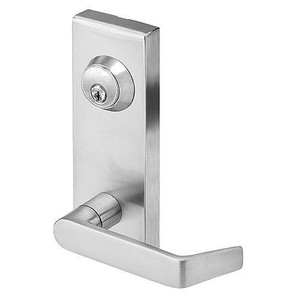
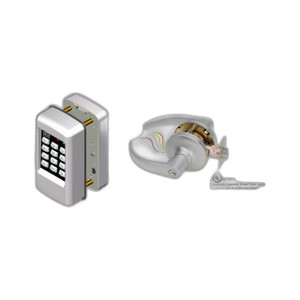
SDC EKE03U 63-Door Multi-Tech Electronic Trim
The SDC EKE03U is a SPECTRA S6000-class electronic trim controller designed for mid-to-large access control deployments requiring multi-technology credential support and enterprise-scale door management. This field-configurable trim manages up to 63 doors, accommodates 250,000 user credentials, and natively supports DESFire, MIFARE, NFC (13.56 MHz), and 125 kHz proximity cards in a single reader unit. Communication via OSDP and TCP/IP enables direct integration with modern networked access control systems, reducing dependency on dedicated serial infrastructure and simplifying credential provisioning across large installations.
Key Features
- 63-Door Management: Controllers handle up to 63 doors per unit. Multi-unit stacking allows campus-scale deployments without central NVR-like bottlenecking—each trim operates independently or in coordinated clusters.
- 250,000 Credential Capacity: Enterprise-grade user storage eliminates credential database carve-outs. On a 500-user site with role-based scheduling, you hold 500× overhead for contractor badges, seasonal staff, and audit history.
- Multi-Technology Reader Support: Single reader accepts DESFire, MIFARE, NFC/13.56 MHz, and 125 kHz proximity cards without swapping hardware. Simplifies mixed-credential environments (legacy proximity coexisting with modern DESFire) and reduces SKU inventory.
- OSDP Protocol: Open Supervised Device Protocol ensures vendor-neutral communication with Genetic, Salto, Honeywell, and other OSDP-certified panels. Encrypted handshake replaces Wiegand's plaintext credential transmission.
- TCP/IP Networking: Wired Ethernet connectivity integrates the trim into IP-networked access fabrics. Real-time event reporting and credential updates flow over standard network infrastructure—no isolated serial buses.
- Field-Selectable Configuration: Reader technology and credential format selection occurs on-site via configuration interface. No factory recalibration or module swap required when credential policy changes.
- Satin Stainless Steel Finish: Corrosion-resistant construction withstands high-traffic indoor corridors and semi-outdoor entrances without finish degradation or maintenance overhead.
- Lifetime Warranty: Factory warranty covers the lifetime of the installed trim, reducing long-term replacement risk on enterprise door fleets.
Integration & Deployment
The EKE03U operates as a subordinate reader node within OSDP and TCP/IP access control ecosystems. It does not function as a standalone panel—installation requires pairing with an OSDP-compliant access control system (such as Salto, Genetec, or equivalent networked controller) that holds credential databases and enforces access policies. Wired Ethernet connection to a networked switch with PoE capability or dedicated 12 VDC power supply carries both communication and lock strike power, simplifying conduit runs in retrofit scenarios. Multi-door installations benefit from credential synchronization: a single role change in the central system propagates to all 63 doors managed by this unit within seconds, eliminating per-reader reprogramming.
Field-selectable credential technology is the operational differentiator in mixed-legacy deployments. If a facility runs 125 kHz proximity badges on perimeter doors and newer DESFire cards on high-security zones, this single reader SKU covers both populations. This flexibility reduces the engineering overhead of managing heterogeneous reader fleets and shrinks the parts bill for multi-building campuses transitioning to modern credential schemes.
Installation requirements: the trim ships without cylinder—specify the appropriate mortise or rim cylinder to match your existing key system at order time. Confirm voltage supply (typically 12 VDC) and strike type (fail-safe/fail-secure) compatibility with your control panel's output ratings before powering on. Wiring must terminate at a powered access control panel or dedicated 12 VDC supply rated for continuous solenoid/magnetic lock duty (typically 1–2 amp minimum draw per strike). PoE deployment reduces power distribution complexity on networked builds; verify your Ethernet switch and cabling support the trim's aggregate power budget.
Credential & User Capacity in Practice
The 250,000-credential ceiling is designed for organizations managing thousands of regular employees plus contractor, visitor, and seasonal badge programs. On a 2,000-person site, this represents 125× credential overhead—sufficient for multi-year audit trails, revoked badge records, and credential format migrations without database restructuring. Credential aging (purging inactive badges older than 12 months) can further extend practical capacity. Integration with centralized directory services (LDAP, Active Directory) allows credential issuance to trigger automatically on new-hire provisioning, eliminating manual badge generation and reducing onboarding friction.
Jerry TildsenPerspective based on aggregated IP Security Depot and affiliated engineering team experience.
We've deployed the EKE03U across campuses, office parks, and retail chains—anywhere a single control point needs to manage 40–63 doors with mixed credential technologies and networked backend reporting. What differentiates this trim from cheaper single-tech readers is the real operational savings on mixed-credential sites. On a 50-door building where 30 doors run legacy 125 kHz proximity and 20 run newer DESFire, most integrators would spec two different reader models, manage two inventory lines, and train end-users on which badge type works where. The EKE03U consolidates that into one SKU per door. The credential capacity (250K) only matters if you're actually managing thousands of users or maintaining multi-year audit logs; on smaller sites, it's overhead. The real value is OSDP + TCP/IP—Wiegand readers still exist, but they're becoming a liability on security-conscious networks. This trim future-proofs perimeter access for the next 5–7 years without rip-and-replace.
Technical Highlights:
- OSDP Encrypted Credential Transmission: Replaces Wiegand's plaintext card number over vulnerable twisted pair. OSDP handshakes encrypt credential data and lock commands, closing a documented attack vector. On healthcare, government, and financial campuses, this compliance requirement alone justifies the cost premium over legacy readers.
- Multi-Technology Reader (DESFire, MIFARE, NFC, 125 kHz): Single antenna/sensor stack reads four credential formats without hardware swap. Operational consequence: commissioning a new badge type (e.g., migrating from proximity to DESFire) requires configuration file update only—no door-by-door reader replacement. Saves 40–60 labor hours on a 50-door site.
- TCP/IP Networked Architecture: Credential updates and access policy changes flow from central management system to all 63 doors in near-real-time. Compare this to serial-based readers where policy propagation can lag minutes or hours—critical on sites with frequent credential lifecycle events (contractors, temp staff).
- 63-Door Scaling per Unit: Standard enterprise access panels max out at 4–8 wired reader ports. The EKE03U consolidates 63 doors into one logical endpoint, reducing panel port saturation and panel count on large deployments. ROI emerges at 30+ doors per building.
- 250,000 Credential Vault: Sufficient for multi-year cardholder history, revocation tracking, and format migration without purging active credentials. On audited environments (healthcare, legal, finance), this eliminates the operational burden of credential database restructuring mid-fiscal-year.
- Field-Selectable Credential Format: Reader technology (proximity vs. DESFire) configured on-site, not at factory. Reduces lead time and SKU fragmentation when credential standards shift or legacy-to-modern transitions span multiple phases.
Deployment Considerations:
- Not a Standalone Panel: The EKE03U is a networked reader controller, not an access control system. It requires an OSDP- or TCP/IP-capable backend (Salto, Genetec, Honeywell, etc.) to enforce access policies and manage credentials. On greenfield builds, budget for both the trim and a compatible NVR or security appliance.
- Cylinder Not Included: Order the appropriate mortise or rim cylinder separately to match your existing key system. Specifying wrong cylinder type at install time delays door commissioning—confirm cylinder dimensions and key profile with your locksmiths before material procurement.
- Power Supply Sizing: Wired 12 VDC feed must be rated for continuous solenoid/strike duty, typically 1–2 amps per door strike. On 63-door builds, validate that your power distribution infrastructure (UPS capacity, conduit gauge, backup battery runtime) can sustain all locks during outage scenarios.
- Network Infrastructure Dependency: TCP/IP operation requires stable Ethernet uplink. Sites with wireless-only or intermittent connectivity will experience credential sync delays and potential lockouts during network faults. Failsafe override settings at each door become mission-critical on networks without redundant paths.
- Credential Migration Planning: Moving from proximity to DESFire credentials involves credential issuance, user training, and grace-period overlap. The EKE03U supports multi-tech reading during transition, but badge retirement policies must be clearly communicated to avoid access denials when old badges are disabled.
The EKE03U is the right choice for integrators building mid-to-large access control systems where credential diversity, network integration, and operational scalability matter more than lowest per-unit cost. For a 40–100-door campus modernizing from legacy Wiegand to OSDP, or for organizations running multiple credential formats simultaneously, this trim eliminates the engineering tax of managing mixed reader populations. Check out our full SDC catalog for additional trim styles and panel options.