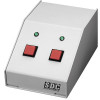
SDC DTMOMA-2 Mini Desktop Console
The SDC DTMOMA-2 is a compact desktop control console designed for single to dual-door access control in HID-based systems. Operating at 30VDC, this unit delivers direct relay output (5A @ 30VDC) to electromagnetic strikes, shear locks, bolt locks, delayed egress systems, and electrical exit hardware without requiring external relay buffering for standard solenoid draws. The beige aluminum enclosure (4.1" × 3.1" × 6.3") and hardwired contact-closure interface fit entry vestibules, security checkpoints, nurse stations, and back-office control stations where local manual override or direct door release is required without network dependency. Tri-color LED indicators (red, amber, green) provide visual status feedback when paired with door position sensors or strike feedback switches.
Key Features
- 30VDC Direct Power Operation: 30VDC input eliminates the need for separate power supplies in HID infrastructure. Compatible with existing access control power distribution at common voltage standard.
- 5A @ 30VDC Relay Output: SPDT relay rated 5A continuous — sufficient for standard electromagnetic strikes and exit hardware without external relay module. Verify solenoid coil current before installation; oversized hardware requires external buffering.
- HID Credential Reader Integration: Hardwired contact-closure input accepts HID reader or access control panel signal. Works with card readers, keypad outputs, or access control momentary triggers.
- Multi-Strike Support: Single unit controls 1–2 doors via separate relay channels. Button logic handles electromagnetic strikes, shear locks, bolt locks, and delayed egress exit systems.
- Tri-Color LED Status Indicators: Red, amber, green feedback for door and lock state monitoring. Integrates with door position sensor or strike feedback switch for closed-loop verification.
- Compact Desktop Form Factor: 4.1" × 3.1" × 6.3" aluminum enclosure fits desk surfaces, wall brackets, or mounting rails in tight spaces. Beige finish blends into interior security checkpoints and office vestibules.
- Lifetime Warranty: Factory-backed coverage on hardware defects and relay contacts across product lifespan.
Wiring and Compatibility
The DTMOMA-2 wires directly into HID access control infrastructure. Incoming 30VDC power connects to terminal block input; outgoing SPDT relay contacts wire to strike coils, exit-button logic, or delayed-egress panel inputs. The unit accepts momentary or continuous contact closure from HID readers, door controllers, or manual push-button interlock circuits. Because the relay is rated 5A at 30VDC, confirm your solenoid draw before installation — if strike current exceeds 5A, add an external relay or a higher-capacity auxiliary power supply. The LED power draw (approximately 30mA @ 24VDC) is negligible on standard access control power supplies; no separate 24V feed is required if your main supply is stable.
Deployment contexts include: (1) Dual-door secured entry vestibules where a receptionist or guard needs local manual release capability; (2) Medication rooms, server cabinets, or equipment lockers where badge readers trigger a reader-controlled strike but a staff override button must bypass wait-time or allow emergency egress; (3) Parking gate or loading-dock door stations where a push-button release supplements automated access control; (4) Healthcare or manufacturing environments where environmental isolation (dust, moisture, temperature swings) favors a hardwired local console over IP-based remote unlock. The DTMOMA-2 eliminates the overhead of network connectivity and remote unlock authentication for these localized, high-frequency use cases.
Installation is straightforward: mount the enclosure on a desktop surface or wall using the base hole pattern, connect 30VDC power input to your access supply, and wire the relay contacts to your strike or exit logic. Tri-color LEDs simplify troubleshooting — red indicates strike de-energized, green indicates strike energized, amber shows sensor or feedback state. Standard electrician tools (wire stripper, continuity tester, screwdriver) are sufficient; no programming or firmware updates are required. If your strike voltage differs from 30VDC or your site runs 24VDC PoE access control, verify power compatibility and relay contact rating before ordering.
Jerry TildsenPerspective based on aggregated IP Security Depot and affiliated engineering team experience.
We've installed the DTMOMA-2 in dozens of HID deployments across healthcare facilities, corporate offices, and light manufacturing — and the appeal is straightforward: it solves the local-override problem without introducing network attack surface or requiring a full-blown access control panel. Most HID customers we work with run centralized ProxPro or Edge system infrastructure, but there's always a handful of high-traffic doors (reception vestibules, nurse stations, server rooms) where local staff need push-button manual release capability — either for emergency egress, temporary facility access during card-reader maintenance, or simply to avoid the cognitive overhead of authenticating every unlock remotely. The DTMOMA-2's hardwired contact-closure interface and direct 5A relay output cut that friction completely. It's essentially a smart relay in a desktop form factor.
The operational advantage is worth spelling out. A typical HID deployment uses networked ProxPro readers and a centralized Edge or ProxPro panel for unlock logic. That architecture is sound for perimeter security and auditability, but for a receptionist who releases a dozen visitors per day, the latency and authentication friction of a mobile app or networked keypad becomes a point of failure. The DTMOMA-2 — wired to a local HID reader and a push-button — is instantaneous: tap badge, hit release button, door opens. No IP gateway, no credential validation, no timeout. And because it runs on the same 30VDC supply as your HID infrastructure, you're not introducing new power pathways or relying on a separate 12V battery backup. Where we've seen this shine is in tandem with HID Signo reader modules — badge recognition triggers the reader, the reader's relay output (or a simple push-button momentary switch) wires to the DTMOMA-2, and the DTMOMA-2 holds the strike open for a configurable dwell time. Two-wire installation, no programming.
Technical Highlights:
- 5A @ 30VDC Relay Rating: Standard EM strikes (Pullman Latches, HES 5000, RCI 4109) draw 0.6–2A at 30VDC — well within the DTMOMA-2 relay spec. Delayed-egress systems and high-holding-force latch-bolt locks can creep toward 3–4A; always test with a current probe on the actual hardware at your site before final installation.
- Hardwired Contact Closure: No IP, no ONVIF, no serial protocol — just volt-free switch logic. Integrates cleanly with any HID reader that outputs a relay or momentary contact. Eliminates single points of failure related to network connectivity or access control system downtime.
- Tri-Color LED Feedback: Red (de-energized), green (energized), amber (sensor state) — allows front-desk staff and maintenance personnel to diagnose strike jams or reader failures without needing specialized VMS or HID software access. Mechanical clarity in an increasingly networked world.
- 30VDC Standardization: HID ProxPro and most legacy access systems run 30VDC or 24VDC. The DTMOMA-2 operates native 30VDC, eliminating transformer isolation losses and simplifying troubleshooting. If your site is 24VDC, verify compatibility before purchase — relay contact rating holds, but LED brightness and solenoid performance may differ.
Deployment Considerations:
- Solenoid Amperage: The 5A rating is a ceiling. Many standard EM strikes are 0.6–2A, but delayed-egress and bolt-lock hardware can approach or exceed this limit. Measure actual coil current on the target hardware; if it exceeds 5A, add an external relay (Potter & Brumfield KRPA or equivalent 12–30VDC relay rated for your strike current) to buffer the DTMOMA-2 output.
- Contact Closure Logic: The DTMOMA-2 expects momentary or continuous switch input from an HID reader or manual push-button. It does not interpret card data or communicate with access control software. If you need conditional unlock logic (e.g., unlock only between 8am–5pm, or only for badge holders in a specific access group), that logic must reside in your HID ProxPro or Edge panel — the DTMOMA-2 is a dumb relay triggered by that panel's output.
- Power Supply Capacity: Ensure your 30VDC access control power supply has headroom for the strike and the DTMOMA-2 together. A typical Pulseworx or Securitron 30VDC 2A supply is adequate for one standard EM strike plus this console; larger multi-door setups may require a larger supply (Altronix AL1012ULXM or equivalent 12A @ 30VDC).
- Environmental Tolerance: The aluminum enclosure is rated for office/indoor use. For outdoor or wet-environment deployment, consider a vented or stainless-steel enclosure alternative and potted terminal blocks to prevent corrosion on relay contacts — contact SDC support for recommendations.
- Mounting and Accessibility: Desktop mounting is straightforward, but ensure the console is within arm's reach of the door you're controlling. If the console is more than 50 feet from the strike, consider a hardwired push-button at the door as well, or evaluate a networked unlock solution (HID mobile access or cloud-based unlock) for remote facilities.
The DTMOMA-2 is ideal for integrators who need local override capability in HID shops without introducing IP-based unlock infrastructure or third-party API dependencies. If your customer is a healthcare system, corporate office, or government facility where air-gapped physical security is a compliance requirement, this console delivers that guarantee. For larger multi-building or geographically distributed deployments, consider HID's cloud-based mobile access platform instead. For more information on SDC door control solutions, visit the SDC catalog.