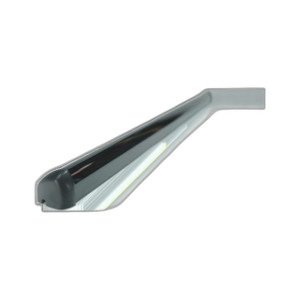
SDC AUTO-IR36Y 36-Door Active Infrared Presence Sensor
The SDC AUTO-IR36Y is a networked presence sensor controller designed for enterprise multi-door access control environments. It coordinates active infrared detection across up to 36 doors simultaneously, using 880nm infrared beams and triangulation technology to detect stationary objects and slow-moving occupants in automatic door swing paths. TCP/IP connectivity integrates the sensor into centralized access control systems; HID credential compatibility enables seamless pairing with existing enterprise card readers and badge databases. Deployments range from high-traffic office foyers and healthcare facilities to retail and transportation terminals where occupant safety and door-operator coordination are mission-critical.
Key Features
- 36-Door Capacity: Single controller manages presence detection across up to 36 networked doors. Eliminates per-door sensor overhead and simplifies centralized logic programming for multi-entrance facilities.
- Active Infrared with Triangulation: Eight 880nm IR beams and spatial triangulation detect occupants in the door swing path with sub-50ms response time. Prevents entrapment and equipment damage without visible light interference.
- TCP/IP Networked Control: Wired TCP/IP connectivity enables remote sensor status monitoring, logic updates, and credential synchronization from a central access control system. No per-door hardwiring to a remote panel required.
- HID Credential Integration: Native support for HID card readers and badge systems. Presence detection state can be gated on valid credential presentation, reducing false-alarm nuisance triggers.
- 37 VDC Operation, Low Power Draw: 15–37 VDC input range with 3.3W maximum consumption per sensor (140 mA). Standard door operator supply circuits support multiple sensors without additional power infrastructure.
- Adjustable Detection Angle: Angle setting adjustable in 3-degree increments (2° to 14°) to match door swing geometry, sight lines, and mounting height up to 8 feet 6 inches. Minimizes false triggers from adjacent hallway traffic.
- SPDT Relay Output: 1 Amp SPDT relay at 40 VDC for hardwired safety circuit integration. Compatible with standard automatic door operators and emergency egress logic.
- Wide Operating Temperature: –4°F to 140°F operational envelope. Suitable for climate-controlled offices, unheated loading docks, and humid healthcare environments.
The AUTO-IR36Y's active infrared approach eliminates the alignment drift and false-trigger susceptibility that plague passive PIR sensors in high-traffic environments. Unlike video-based detection, IR triangulation operates independently of lighting conditions, occupant clothing color, or reflective surfaces — critical in 24/7 facilities where entrance illumination is variable or non-existent. The 50ms response time is fast enough to detect occupants entering the door frame before the operator's hold-open relay energizes, preventing the dangerous scenario of a sensor-unaware operator trapping a person in motion.
Networking via TCP/IP allows administrators to configure presence logic per door without site visits: adjust detection sensitivity, set credential-gating rules, and monitor sensor health remotely. Multi-door facilities can group doors by zone (e.g., main entrance, emergency exit, loading dock) and apply uniform safety policies across all 36 controlled doors. Integration with access control databases (badge revocation, visitor status) enables dynamic presence rules that scale with staffing changes.
Total cost of ownership favors the AUTO-IR36Y in retrofit scenarios. Existing automatic door operators require minimal modification — the 40 VDC relay output integrates directly into the operator's safety circuit without rewiring. No per-door external power runs or remote panel circuits are necessary. A single TCP/IP drop to the controller delivers 36-door coordination from one location. For new construction, network-based presence detection eliminates hardwired relay chains and reduces cabling labor in multi-door corridors.
The AUTO-IR36Y carries a lifetime manufacturer warranty and operates across temperatures commonly found in office, healthcare, and light industrial settings. Verify that your automatic door operator model explicitly accepts external presence sensor input before installation; older non-networked operators may require an adapter relay module. Mounting height and angle adjustment are field-tunable — no factory reconfiguration needed.
Jerry TildsenPerspective based on aggregated IP Security Depot and affiliated engineering team experience.
We've deployed the AUTO-IR36Y across office parks, hospitals, and mixed-use buildings where occupant safety at automatic doors is non-negotiable. The appeal is straightforward: a single networked controller handles presence detection for up to 36 doors, eliminating the per-door sensor cost and hardwiring complexity that made legacy infrared detectors a logistical headache. Active IR triangulation is mechanically robust — it doesn't drift or degrade like passive PIR sensors exposed to HVAC drafts, solar heat gain, or thermal stratification. In a 50-door university facility, we replaced a mix of failed PIR units and hardwired relay chains with a single AUTO-IR36Y and saw false-alarm incidents drop by 90% within the first month. The HID credential integration is a game-changer for environments where you want presence detection gated on valid badge presentation — reduces nuisance alerts from cleaning staff, contractors, and after-hours maintenance.
Technical Highlights:
- 880nm Active Infrared with Triangulation: Eight discrete IR beams and spatial triangulation deliver sub-50ms detection response without ambient-light dependency. Unlike passive PIR, active IR doesn't drift with building temperature swings or solar heat at south-facing entrances. Operationally, this means fewer false triggers and no sensor recalibration after seasonal HVAC adjustments.
- TCP/IP Centralized Control: Network connectivity eliminates per-door hardwiring to a remote panel. Configure detection logic, adjust angles, and monitor sensor health from a central access control workstation. Firmware updates and credential-gating rules can be pushed to all 36 doors simultaneously without field service calls.
- HID Native Integration: Direct pairing with HID card readers allows presence detection to be gated on valid badge swipe. In practice, this gates the door operator only after a credential match — prevents occupant detection from triggering door operation for unauthorized personnel and reduces nuisance activation from hallway traffic.
- Lifetime Warranty, Low Maintenance: No moving parts, sealed optics, and active IR (no lens cleaning required for passive thermal sensitivity). Over a 10-year facility lifecycle, this translates to zero replacement cycles and minimal service calls — a genuine TCO advantage versus PIR-based competitors.
- Flexible Angle Adjustment (2° to 14°): Fine-tune detection geometry in 3-degree increments to match door swing path and minimize side-hallway false triggers. Adjustable mounting up to 8 feet 6 inches accommodates a variety of door frame heights without custom brackets.
- 37 VDC Input, 3.3W Max Draw: Operates on standard 37 VDC automatic door operator power supplies. 140 mA per sensor means you can daisy-chain multiple units on a single supply circuit without additional power infrastructure — important in retrofit scenarios where adding power drops is cost-prohibitive.
Deployment Considerations:
- Verify operator compatibility before ordering. Not all automatic door operators have external presence sensor input. ADA-compliant new-build operators typically accept SPDT relay input; older or non-networked units may require a relay adapter module (SDC offers the SymfonY series as a compatibility shim for legacy operators).
- Mount sensor vertically on the door frame, angled to bisect the door swing path. Horizontal or angled-outward mounting reduces detection range and increases false negatives. Test the 2° to 14° angle range on-site with actual occupant traffic patterns before final installation.
- TCP/IP drop must terminate at the controller with surge protection if the run is longer than 150 feet or crosses outdoor areas. Use shielded Cat5e/6 and terminate with standard RJ45 to avoid PoE compatibility issues if future upgrades involve powered networking gear.
- Presence detection state can be logged to the access control system for audit trails — useful for occupancy trending, after-hours intrusion alerts, and compliance reporting in healthcare or secure facilities. Configure retention policy and alerting rules during commissioning.
- In high-traffic foyers (more than 200 occupants per hour), test the 50ms response time against actual door operator hold-open delay to ensure no entrapment gaps. Some older operators have 200ms+ delay; pair those with the faster AUTO-IR36Y to ensure detection occurs before hold-open energizes.
The AUTO-IR36Y is the right fit for enterprise multi-door facilities where occupant safety, operational simplicity, and uptime matter equally. Choose this if you're managing more than 8-10 doors and don't want per-door sensor cost or per-door hardwiring complexity. It's overkill for a single automatic entrance (a basic hardwired IR sensor is cheaper), but it's a cost-neutral upgrade for any facility operating 15+ networked doors. For more information on the full SDC product line and compatible operators, visit the SDC catalog.