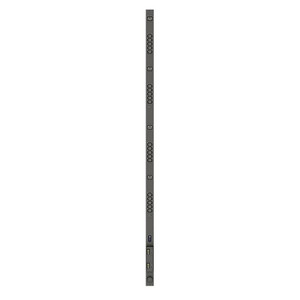
Vertiv VP7N30AP Switched Outlet-Level Monitoring Rack PDU
Overview
The Vertiv VP7N30AP is a 0U vertical rack PDU built for data centers and high-density server environments that need granular, per-outlet power control alongside real-time current, voltage, and power monitoring. Designed around a NEMA L6-30P input plug drawing up to 30A at 200–240V (4.9 kW), the VP7N30AP delivers switched outlet-level management across 24 receptacles — giving operators the ability to remotely reboot locked hardware, sequence startup loads, and enforce power budgets without touching the physical rack.
Key Features
- Switched Outlet-Level Control: Each of the 24 outlets can be individually switched on, off, or power-cycled from the management interface. When a remote server or network device locks up at 2 AM, you reboot it from the software — no one drives to the data center. This is the core differentiator over monitored-only PDUs.
- 24 Combo C13/C19 Outlets: The mixed C13/C19 receptacle layout handles both standard 1U/2U server power supplies (C13) and high-draw devices like GPU servers or storage arrays pulling dual-corded C19 connections. You're not locked into a single connector family, which matters in heterogeneous racks.
- Real-Time Current, Voltage, and Power Monitoring: The VP7N30AP tracks all three electrical parameters at the outlet level — not just at the PDU input. This lets you catch a PSU drawing abnormally high current before it trips a breaker, and gives facilities teams the data to validate actual load versus budgeted capacity.
- 30A / 208V Input at 4.9 kW: The NEMA L6-30P plug connects to standard 30A two-pole circuits common in raised-floor data centers. At 4.9 kW usable capacity, this PDU handles a dense 2-post or 4-post rack without requiring a 60A feed.
- Dual RJ-45 Management Ports: Two Ethernet ports support daisy-chaining — you can chain multiple PDUs together and manage them through a single IP address, reducing switch port consumption in high-PDU-density deployments. The daisy-chain capability is a real cable and port saver in colocation environments.
- Enterprise Protocol Stack: The VP7N30AP speaks SNMP v1/v2c/v3, HTTPS, SSH, RADIUS, LDAP, TACACS+, Modbus TCP, Syslog, and NTP. That is not a minimal feature set — TACACS+ and RADIUS mean you can integrate this into your AAA infrastructure and enforce role-based access without managing local accounts on every PDU. SNMP v3 with encryption satisfies most corporate security audits.
- IPv4 and IPv6 Support: Dual-stack networking means the VP7N30AP fits into both legacy and next-generation infrastructure without requiring NAT workarounds or separate VLANs for IPv6 management.
- LCD Display with LED Indicators: The onsite LCD provides at-a-glance load readings without requiring a laptop or network connection — useful during initial commissioning or when network access is unavailable. LED indicators surface per-outlet status instantly.
- Vertical 0U Form Factor: Mounts vertically in the cable management channel of a standard rack, consuming zero rack units. A 42U rack stays fully populated with servers while the PDU runs down the side rail. The 3-meter input cord reaches most overhead or under-floor power drops without extension cabling.
- Reset Button: A physical reset button allows credential recovery or firmware reset without decommissioning the PDU — valuable in environments where management access is lost due to misconfiguration.
Integration and Compatibility
The VP7N30AP integrates with power distribution management platforms and Vertiv's broader infrastructure management lineup via SNMP v3, Modbus TCP, and HTTPS APIs. The RADIUS and LDAP support allows enterprises to federate authentication against Active Directory or FreeRADIUS without deploying per-PDU credentials. TACACS+ integration suits network operations teams already running Cisco ISE or similar AAA environments.
For environments running IP network management or DCIM platforms, the VP7N30AP's Syslog output and SNMP traps feed directly into event correlation engines — outlet-level power events appear as discrete log entries, not just aggregate PDU-level alarms. Modbus TCP broadens compatibility with building management systems (BMS) and industrial SCADA platforms.
The daisy-chain architecture through the dual RJ-45 ports means a row of PDUs can share a single network uplink — relevant when deploying in high-density colocation cages where switch port count is constrained. Check your specific management software's PDU driver support to confirm daisy-chain discovery behavior before deploying at scale.
For complete rack power accessories and complementary infrastructure, pair this PDU with appropriate rack enclosures sized for vertical 0U mounting. Review your upstream breaker panel for NEMA L6-30 circuit availability before ordering — L6-30P is a 208V twist-lock, not a standard 120V NEMA 5-15/5-20 or L5-30 circuit.
Frequently Asked Questions
Q: What input plug does the VP7N30AP use, and what circuit does it require?
A: The VP7N30AP ships with a NEMA L6-30P input plug, which requires a 30A, 208V (200–240V) two-pole twist-lock circuit. This is a standard data center power circuit but is not interchangeable with 120V NEMA L5-30 or standard 15/20A outlets. Verify your panel has an available L6-30 breaker position before ordering.
Q: What is the difference between a switched PDU and a monitored PDU?
A: A monitored PDU measures current, voltage, and power but cannot control outlet state — it reports only. A switched PDU like the VP7N30AP adds remote on/off/reboot control per outlet, enabling remote power cycling of locked devices without a physical site visit. The VP7N30AP combines both: outlet-level switching plus real-time monitoring.
Q: Can the VP7N30AP be managed via SNMP with existing NMS platforms?
A: Yes. The VP7N30AP supports SNMP v1, v2c, and v3. SNMP v3 includes authentication and encryption, satisfying most enterprise security policies. It also supports Syslog for event forwarding and Modbus TCP for BMS/SCADA integration.
Q: How does the daisy-chain feature work, and how many units can be chained?
A: The VP7N30AP includes two RJ-45 Ethernet ports that support daisy-chaining multiple PDUs under a single IP address, reducing switch port consumption. Verify the maximum chain depth with Vertiv's current firmware documentation, as chain limits can vary by firmware version.
Q: What outlet types are on the VP7N30AP, and how are they distributed?
A: The 24 outlets are a combination of IEC C13 and IEC C19 receptacles. C13 handles standard server and networking power supplies; C19 handles higher-draw equipment. The mix accommodates heterogeneous rack populations without adapters.
Q: Does the VP7N30AP support role-based access control and enterprise authentication?
A: Yes. The VP7N30AP supports RADIUS, LDAP, and TACACS+ for authentication, enabling integration with enterprise AAA infrastructure (Active Directory, Cisco ISE, FreeRADIUS). This eliminates the need for local account management across large PDU deployments.
The VP7N30AP is the PDU I recommend when a customer needs more than passive monitoring but doesn't want to pay for a full intelligent PDU with environmental sensors they'll never use. The 24-outlet switched layout — mixing C13 and C19 on a single 30A/208V L6-30P feed — covers a typical high-density compute rack, and the outlet-level switching means you can reboot a hung BMC or a locked iDRAC from your NOC without dispatching a hands-and-eyes visit.
Technical Highlights:
- SNMP v3 with Encryption: Most PDU deployments I see are still running SNMP v1 community strings in plaintext. SNMP v3 on the VP7N30AP lets you lock this down to authenticated, encrypted polling — a one-line checkbox on a PCI-DSS or SOC 2 audit.
- TACACS+ / RADIUS / LDAP Auth: Three AAA protocols on a PDU is unusual at this price tier. In a 20-PDU colocation deployment, managing local accounts on each unit is operationally unacceptable. Federate to LDAP and you're done.
- Dual RJ-45 with Daisy-Chain: Two management ports mean you run one network cable to the first PDU in a row and chain the rest. In a cage with 8 PDUs, that's 7 fewer switch ports consumed — and 7 fewer IP addresses to track in IPAM.
Deployment Considerations:
- The maximum rated current is 16A at the outlet level — even though the PDU input is 30A. Plan your per-outlet draw budgets accordingly; do not assume each C19 receptacle can deliver the full input capacity.
- The NEMA L6-30P plug is a 208V twist-lock. If your site's panels are wired for 120V NEMA L5-30 or standard duplex outlets, this PDU will not connect without a circuit change. Confirm panel circuit type at the colo or your own facility before the unit ships.
This PDU is the right fit for mid-density enterprise server rooms and colocation deployments running 208V power distribution where remote outlet control, enterprise AAA integration, and SNMP v3 management are all hard requirements — specifically where the operations team needs to reboot individual devices remotely without relying on out-of-band management cards on every server.