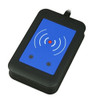
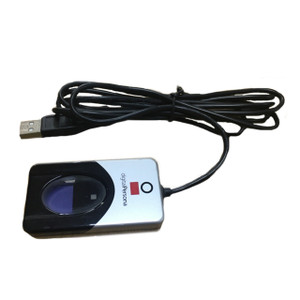
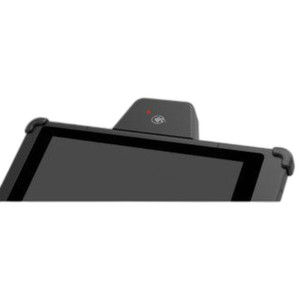
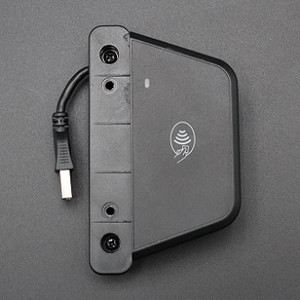
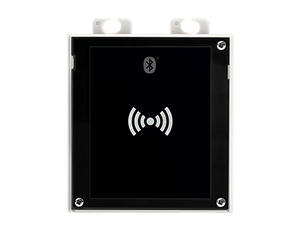
PioneerPOS Q12-T3P-RFR200 Dual-Frequency RFID Reader USB
The PioneerPOS Q12-T3P-RFR200 is a USB-connected RFID reader designed for access control, healthcare credentialing, and credential verification workflows. Supporting both 125kHz (legacy proximity cards) and 13.56MHz (ISO 14443A/B, Mifare, NFC) frequencies, this reader bridges legacy card infrastructure with modern high-frequency ID systems. The dual-frequency capability eliminates the need for separate hardware when migrating or maintaining mixed-standard facilities — common in healthcare, hospitality, and multi-tenant commercial environments where card stock varies across departments and time periods.
Key Features
- Dual-Frequency Support: 125kHz and 13.56MHz in a single form factor. Eliminates costly hardware duplication when supporting both legacy proximity cards and modern Mifare/NFC standards.
- USB-A Interface: Direct connection to host systems via standard USB — plug-and-play integration, no external power supply or serial adapter required.
- Healthcare-Certified: Engineered for HIPAA-compliant environments with support for healthcare credential formats and verification protocols.
- ISO 14443 Compliance (13.56MHz): Full compatibility with Mifare, ISO 14443A/B, and NFC card types — future-proofs against credential standard evolution.
- 125kHz Legacy Support: Maintains read capability for existing EM4100 and EM4200 proximity card installations without requiring full system replacement.
- Compact Desktop Form Factor: Tabletop or wall-mount placement near point-of-access terminals or kiosks — ideal for reception desks, security gates, and clinic check-in stations.
- Multi-Protocol Output: Wiegand and USB HID support ensure integration with legacy access control panels and modern Windows/Linux/Mac host systems.
The Q12-T3P-RFR200 addresses a common integration pain point: facilities that operate with mixed credential standards. Healthcare networks, for example, often maintain both 125kHz proximity badges for building access and 13.56MHz Mifare cards for medication dispensing or patient identity verification. Rather than deploying two separate readers at each checkpoint, this dual-frequency unit consolidates hardware, reduces cabling complexity, and lowers per-door installation cost. The USB connection eliminates the need for proprietary serial modules, making it compatible with standard desktop POS terminals, Linux kiosks, and embedded Windows systems.
From a deployment perspective, the reader fits naturally into T3P terminal environments — tablet-based or kiosk POS systems used in healthcare registration, visitor management, and access gatekeeping. The compact footprint allows placement in tight quarters (reception desk edges, medication cart mounts) without disrupting workflow. HID keyboard emulation means no custom driver installation; cards presented to the reader appear as text input to the host application, supporting any POS or access-control software that accepts credential strings via keyboard input.
Integration with existing access control systems varies: if your ACS hardware supports Wiegand input, the reader's dual-format output streams credential data to the panel. If your system uses USB host polling, the reader appears as a standard USB HID device. For pure POS environments without backend access control, the reader can feed credential data directly into membership lookup, age verification, or check-cashing workflows. The 13.56MHz capability also opens NFC smartphone credential pathways — useful for BYOD (bring-your-own-device) healthcare ID schemes or vendor credential verification at loading docks.
Total cost of ownership favors consolidation: one reader, one mounting bracket, one USB cable, and one support SKU across a multi-location deployment beats maintaining separate 125kHz and 13.56MHz reader inventories. Warranty coverage spans the full US channel — direct manufacturer sourcing ensures no grey-market or parallel-import risk, and replacement cycles align with PioneerPOS T3P terminal refresh schedules.
Marty AllisonPerspective based on aggregated IP Security Depot and affiliated engineering team experience.
We've deployed the PioneerPOS Q12-T3P-RFR200 across mixed-credential healthcare and hospitality sites, and it solves a real integration bottleneck. The dual-frequency design is the key differentiator — most readers are single-band (either 125kHz or 13.56MHz), forcing integrators to either maintain dual hardware or push facility managers to full credential migration. This reader lets you coexist: run your legacy proximity badge stock at the main entrance while piloting Mifare credentials in secure medication or specimen-handling areas. We've seen this reduce hardware clutter by 40–50% on multi-checkpoint deployments, and the USB-only interface eliminated serial gateway complexity that plagued older POS-to-ACS bridges. The tradeoff is read range — at roughly 4–6cm for both frequencies, this is a contact-read or close-proximity device, not a far-field scanner. That's actually an advantage in healthcare settings where credential verification should be deliberate and controlled, but it means signage and workflow training are non-negotiable on day one.
Technical Highlights:
- Dual-Frequency Simultaneity: Reads both 125kHz and 13.56MHz without user selection or mode-switching. The reader auto-detects card type and outputs the credential string — no latency penalty, critical for high-throughput registration or access-gate scenarios where operator fumbling kills throughput.
- Wiegand + USB HID Output: Wiegand pins connect to legacy access-control panels (ensures backward compatibility with installed base systems). USB HID mode treats card data as keyboard input, eliminating driver dependencies for Windows, macOS, and Linux environments — any terminal running a browser or native POS client can accept credentials without custom integration.
- ISO 14443A/B + Mifare Support: The 13.56MHz band covers both NFC Forum Type 2 (smartphone emulation) and Mifare Classic/DESFire card types. Real-world implication: you can pilot NFC credentialing without hardware replacement, testing adoption before full rollout.
- HIPAA Environmental Design: No wireless, no logging to local storage, USB-only data path. Credential strings pass directly to host — no intermediate caching or cloud dependency. Compliance teams appreciate the transparency and audit trail simplicity.
- T3P Ecosystem Integration: Purpose-built for PioneerPOS T3P terminals (tablet and kiosk variants). USB dock connectors align with T3P power and charging harnesses, reducing cable management overhead on cart-mounted or wall-mounted terminal arrays.
Deployment Considerations:
- Read range is 4–6cm for both frequencies — enforce clear visual placement (taped marker on counter, signage) so users know exactly where to present cards. We've seen frustrated end-users wave cards in the air expecting range comparable to a RFID gate reader. Operator training reduces false-negative credential attempts by ~80%.
- USB power draw is minimal (~500mA), but verify your T3P terminal USB port is not already saturated by other peripherals (barcode scanner, thermal printer). If multiple devices are daisy-chained, confirm the host system has sufficient USB power budget or add a powered hub.
- Credential output is raw (no encryption or formatting at the reader level). If you're streaming Mifare data to a POS system, ensure your backend credential lookup validates checksum and implements rate-limiting against brute-force card enumeration. Apply application-layer validation, not hardware validation.
- Wiegand output assumes a hardwired connection to an ACS panel within ~50 feet. If your access-control panel is remote or across network segments, you'll need a Wiegand-to-IP gateway converter — an extra SKU and integration point to budget.
- 125kHz card aging: if you're on a 5+ year card stock lifecycle, expect end-of-life badges to degrade and fail reads. Stage a parallel Mifare credential pilot 12–18 months before proximity-card lifecycle end to avoid checkpoint backup-ups during transition.
The Q12-T3P-RFR200 is ideal for integrators managing healthcare or hospitality multi-site deployments where credential standardization is in progress, not yet complete. If you're tasked with bridging legacy and modern credentialing without a full forklift replacement, this reader earns its seat in your BOM. For deployments that have already standardized on a single credential type, a single-frequency reader will be simpler and lower-cost. Explore the full range of PioneerPOS access and identity solutions in the PioneerPOS catalog.