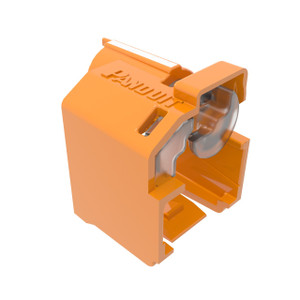
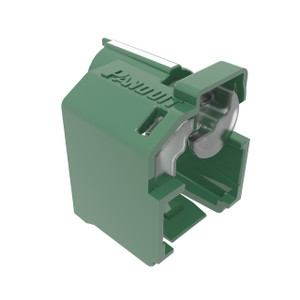
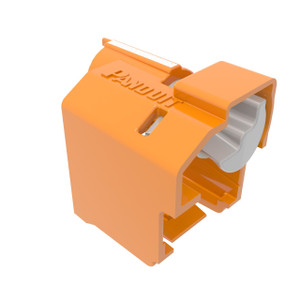
Panduit PSL-DCPLRE-BL Recessed RJ45 Port Lock
The Panduit PSL-DCPLRE-BL recessed port lock secures patch cord connections against unauthorized access and accidental disconnection in data centers, server rooms, and multi-tenant network installations. This black polycarbonate locking device is engineered for panels where RJ45 jacks are mounted slightly deeper than the front surface—common in high-density patch panels and flush-mount wall plates. The extended hood design protects the locking mechanism from damage during routine maintenance while maintaining full compatibility with standard Cat5e, Cat6, and Cat6A patch cords. Each package includes 10 locks and a dedicated removal tool for authorized changes.
Key Features
- Recessed design for jacks mounted below panel surface—solves compatibility issues with deep-set ports that standard locks cannot reach
- Extended hood shields locking mechanism from accidental impact during cable management or adjacent port access
- Polycarbonate construction withstands repeated removals and reinstallations without cracking or deforming in temperature-variable environments
- 10-pack configuration with included removal tool reduces per-port cost for large-scale deployments across server racks and distribution frames
- Tool-required removal enforces change-control procedures—locks cannot be defeated with fingernails or improvised tools
- Low-profile footprint (0.74" H × 0.55" W) maintains airflow in densely populated panels and prevents interference with adjacent ports
- Black finish matches standard network infrastructure for visual consistency across patch fields
Physical port security addresses a critical gap in network access control: while VLANs and 802.1X authenticate devices electronically, they cannot prevent an unauthorized user from unplugging a camera, access point, or VoIP phone and connecting a rogue device before authentication even begins. The PSL-DCPLRE-BL creates a mechanical barrier that forces attackers to leave visible evidence of tampering—a requirement for SOC 2 physical security controls and PCI-DSS 9.1.2 compliance in cardholder data environments. The recessed variant specifically serves installations where panel depth or jack insertion force has pushed connectors farther back than flush-mount positions, a common scenario with high-density modular panels (48-port 1U configurations) or panels mounted inside shallow electrical boxes. Standard port locks leave a gap between the lock body and the cable boot in these scenarios, allowing sideways prying that defeats the locking tab; the PSL-DCPLRE-BL's extended reach eliminates that gap.
Installation takes approximately 10 seconds per port: insert the patch cord fully into the jack until it clicks, then slide the lock over the cable boot and press firmly until the internal tab engages the RJ45 latch. The lock cannot be installed unless the connector is fully seated, which serves as a visual confirmation of proper termination—a useful side benefit during initial cable pulls. Removal requires the included extraction tool, a small plastic key that compresses the locking tab while you pull the cable; integrators typically store one tool per rack or wiring closet rather than distributing them to end users. This creates an auditable access control point: only personnel with physical access to the tool storage location (typically a locked IT room or secured cabinet) can make moves, adds, or changes. For multi-tenant office buildings or colocation facilities, this prevents tenants from accidentally (or intentionally) unplugging neighboring tenants' connections during their own IT work.
The polycarbonate material specification is significant for long-term reliability: cheaper ABS or nylon locks become brittle after 18-24 months in temperature-cycled environments (server rooms that reduce HVAC on weekends, outdoor-rated enclosures with wall-mount switches), leading to cracking during removal and fragments falling into equipment. Panduit's polycarbonate formulation maintains flexibility across -10°C to 60°C, the typical range for telecommunications spaces and unconditioned IDFs. The 10-pack configuration with per-package removal tool optimizes procurement for projects in the 50-500 port range—large enough to justify bulk pricing, small enough to distribute across multiple job sites without excess inventory. For compliance-driven deployments where every secured port must be documented, the defined package quantity simplifies inventory reconciliation: 10 locks issued per wiring closet means 10 connections were designated as physically secured in your asset management database.