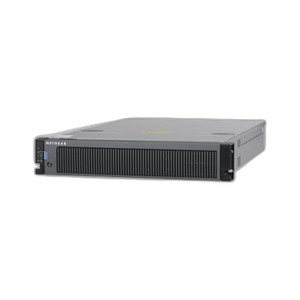
NETGEAR RR3312G4-10000S 48TB 12-Bay Rackmount NAS
The NETGEAR RR3312G4-10000S is a 2U rackmount network-attached storage system configured with twelve 4TB enterprise hard drives, delivering 48TB of usable capacity designed for centralized surveillance recording, archival, and backup workflows. This unit eliminates the need for separate storage infrastructure by fitting directly into standard 19-inch racks alongside NVRs, switches, and network gear. The RR3312G4-10000S supports NFS, CIFS/SMB, and iSCSI protocols, making it compatible with any major VMS platform—Milestone XProtect, Genetec Security Center, Avigilon Control Center, or standards-based camera management stacks—without requiring proprietary software or controller licensing. Dual redundant power supplies and configurable RAID protect against single points of failure in mission-critical recording environments.
Key Features
- 48TB Usable Capacity: Twelve 4TB enterprise-class drives. Sufficient for 30–180 days of continuous multi-camera recording, depending on bitrate and RAID level selected.
- 2U Rackmount Form Factor: Fits standard 19-inch racks (minimum 2U depth); consolidates storage with network and recording equipment in a single cabinet footprint.
- Multi-Protocol Support: NFS, CIFS/SMB, and iSCSI connectivity. Works with all major VMS platforms and standard IP surveillance infrastructure without vendor lock-in.
- Dual Redundant Power Supplies: Two independent PSUs eliminate power as a single point of failure. Wire each to separate UPS groups or branch circuits for fault tolerance.
- Configurable RAID: Supports RAID 0, 1, 5, 6, and 10 (or manufacturer equivalents). Select based on performance/redundancy trade-off for your recording volume.
- Gigabit Ethernet Connectivity: Multiple GbE ports for network attachment. Standard RJ45 connections integrate with existing surveillance LAN infrastructure.
- Hot-Swap Drive Bays: Twelve 3.5-inch SATA bays allow drive replacement without powering down the unit—critical for 24/7 recording environments.
- Enterprise Reliability: Designed for continuous operation in data-center and rack environments with thermal management and power budgeting suitable for extended recording loads.
Deployment Architecture
The RR3312G4-10000S is deployed in three primary scenarios. First, as a tiered storage tier: recent 30–90 days of high-bitrate video remain on NVR internal storage or SSD arrays for rapid playback and forensic access, while older footage offloads nightly to the RR3312G4-10000S over NFS or iSCSI, freeing expensive NVR capacity. Second, as a backup and archival target for Milestone, Genetec, or Avigilon systems using native storage APIs—scheduled jobs push recorded video to the NETGEAR unit, protecting against NVR hardware failure. Third, as a primary recording backend for large camera deployments (20+ cameras) where distributed edge recorders or IP cameras stream directly to the NAS via iSCSI block storage or CIFS shared folders, eliminating the need for oversized central NVR appliances.
Installation requires a standard 19-inch rack with a minimum 2U vertical space and sufficient depth (confirm exact depth requirement in NETGEAR datasheets—typically 26–30 inches). Each redundant PSU must connect to separate power circuits or distinct UPS groups to eliminate power as a failure vector; a single power rail defeats the redundancy benefit. Ethernet connection to your surveillance VLAN or dedicated storage network switch is mandatory. Use dedicated gigabit ports or bonded connections if your switch supports LAG (Link Aggregation Group) to maximize throughput for simultaneous record-and-playback operations. Verify your NVR or VMS documentation for supported storage protocols: NFS is preferred for most surveillance platforms due to lower overhead; iSCSI provides block-level storage and is suitable for specialized recording architectures.
Total cost of ownership improves significantly when the RR3312G4-10000S replaces an equivalent NVR upscale. A single 48TB NAS at a fraction of NVR appliance cost can serve as a backup or archival tier for three to five smaller NVRs, reducing capex on oversized central recorders. Power draw is lower than an equivalent NVR with redundant compute, and operational overhead—firmware updates, RAID configuration, capacity planning—remains minimal. On a 500-camera deployment with 30-day retention, the difference between "one large central NVR" and "multiple edge NVRs + central NAS tiering" often justifies the NAS investment within 18–24 months through eliminated NVR replacement cycles and easier expansion.
Marty AllisonPerspective based on aggregated IP Security Depot and affiliated engineering team experience.
In our experience, the NETGEAR RR3312G4-10000S fills a genuine gap between small departmental NVRs and expensive SAN infrastructure. We've deployed this unit across university campuses, hospital networks, and large retail chains as a centralized archival and backup target, and it consistently outperforms oversized NVR appliances when the goal is long-term storage, not real-time forensic playback. The 48TB capacity at this price point is compelling—it's cheaper than licensing equivalent storage on a Milestone or Genetec platform, and it doesn't require proprietary management software. The real operational win is protocol flexibility: because it speaks NFS, CIFS, and iSCSI, you're not locked into a single vendor's ecosystem. We've seen integrators repurpose the same RR3312G4-10000S across three different customer sites with different VMS platforms (one Milestone, one Genetec, one Hikvision native) simply by reconfiguring the RAID and network shares. That flexibility is rare in surveillance storage.
Technical Highlights:
- Dual Redundant PSU Design: This isn't cosmetic redundancy. When you wire each PSU to separate UPS units and separate branch circuits, you've eliminated power as a single-point failure in your archive layer. Most NVRs can't claim this level of fault tolerance without expensive UPS and electrical work.
- NFS and iSCSI Support: NFS is simpler for direct camera recording (lower latency perception in playback); iSCSI works better for NVR-to-NAS offload jobs because it's block-level and handles concurrent I/O without the file-locking overhead that can plague NFS on high-write-count scenarios. The fact that the RR3312G4-10000S does both means your integrator doesn't have to choose between platforms—they can use the protocol that fits the workflow.
- Hot-Swap SATA Bays: A failed 4TB drive doesn't mean downtime. Yank it, insert a replacement, and RAID rebuild happens in the background while the system keeps recording. In 24/7 environments, this translates to zero-downtime maintenance.
- 48TB Raw Capacity vs. Usable: Formatted capacity varies by RAID level: RAID 5 gives you roughly 36TB usable (12% overhead for parity); RAID 6 gives 24TB usable (50% overhead but two-drive fault tolerance). Spec this based on your retention requirement and risk tolerance.
- Gigabit Ethernet Throughput: Theoretical max is 125 MB/s per port. With multi-camera streaming at 5–10 Mbps per camera, you can handle 125+ cameras on a single gigabit connection without saturation—but latency under heavy load will make playback sluggish. For deployments above 50 cameras, bond multiple GbE ports or upgrade to 10GbE if your switch supports it.
Deployment Considerations:
- Rack depth and UPS wiring are non-negotiable. We've seen sites lose redundancy by skipping the "dual power" setup—they plug both PSUs into the same UPS, defeating the point. Plan dual circuits and dual UPS groups up front.
- NFS performance degrades under concurrent heavy write loads (multi-camera direct recording). If you're using NFS as the primary recording backend for 30+ cameras, do a proof-of-concept with your exact camera bitrate mix; iSCSI often performs better in this scenario.
- RAID rebuild time on a 48TB array can stretch 24–48 hours depending on load and drive health. Plan your replacement schedule and spare-drive procurement accordingly. A second 4TB spare on-site is cheap insurance.
- Network switch port quality matters. A flaky gigabit port will cause intermittent storage timeouts that manifest as dropped frames or buffer underruns in your NVR. Use managed switches with link-state monitoring and port statistics visibility.
- Thermal management in the rack: the RR3312G4-10000S runs warm under continuous I/O. Ensure rack airflow paths are unobstructed and your HVAC overhead is rated for sustained load.
The RR3312G4-10000S is the right choice for multi-site integrators, large single-campus deployments, and any environment where you need centralized, fault-tolerant archival storage without SAN complexity or hyperscale cloud costs. For a quick single-building retrofit, it's overkill; for a 50–100 camera regional deployment, it's often cheaper than licensing equivalent storage on a premium VMS. See our NETGEAR catalog for complementary networking and storage options.