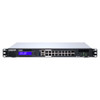
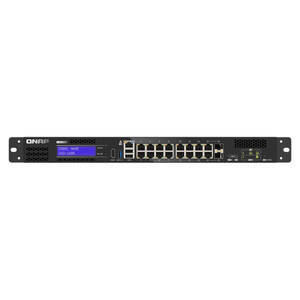
QNAP QGD-1600P-8G-US 16-Port PoE Managed Switch with Built-In Virtualization
The QNAP QGD-1600P-8G-US is a 16-port Gigabit PoE managed switch with something most switches don't have: a real x86 processor running QNAP's QTS operating system directly on the hardware. That means you're not just pushing packets — you can run virtual machines, lightweight NVR software, or edge applications on the switch itself, eliminating a dedicated edge server in smaller deployments. For security integrators building out IP camera infrastructure or IT architects consolidating edge compute, this is the device that lets you collapse two racks into one.
Overview
Built around an Intel Celeron J4115 quad-core processor running at 1.8 GHz (bursting to 2.5 GHz) on a 64-bit x86 architecture, the QGD-1600P-8G-US runs QTS natively — the same OS powering QNAP's NAS lineup. That matters because QTS supports containerized apps, virtualization via Virtualization Station, and a full app ecosystem. This isn't a microcontroller running firmware; it's a general-purpose compute platform in a switch form factor. The 8GB of RAM in this configuration gives you enough headroom to run a VM alongside active switch management without memory pressure killing performance on either side.
The port layout is purpose-built for PoE switch deployments: 14 standard 1GbE RJ45 ports and 2 combo SFP/RJ45 uplink ports, all 16 delivering PoE. Four ports support 60W (802.3bt Class 4 territory — enough for PTZ cameras, dual-radio APs, or high-watt intercoms), and the remaining 12 deliver 30W (802.3at PoE+). The split matters: you can feed your power-hungry endpoints on the 60W ports without rewiring, and run standard IP cameras on the 30W ports without over-provisioning.
Key Features
- QTS Built-In OS: The switch runs QNAP's QTS operating system on a real Intel Celeron J4115 CPU — not a stripped firmware environment. This means you can install and run NVR software (QNAP's own QVR Pro, for example) or container workloads directly on the switch, removing the need for a separate edge server in camera deployments up to a few dozen channels.
- Intel Celeron J4115, 1.8 GHz / 2.5 GHz Burst: The 64-bit x86 quad-core isn't fast by workstation standards, but it's more than adequate for routing management traffic, running a lightweight VM, and handling switch functions simultaneously. The 2.5 GHz burst handles transient loads without throttling under normal mixed workloads.
- 16 Total PoE Ports (4× 60W + 12× 30W): Four ports deliver up to 60W each — covering high-watt PTZ cameras, multi-radio access points, or PoE-powered workstations. The 12 standard 30W ports handle the bulk of an IP camera fleet without requiring a separate injector or mid-span. This eliminates a whole layer of power infrastructure in edge closets.
- 2× 1GbE SFP/RJ45 Combo Uplinks: The two combo uplink ports let you connect fiber for longer runs between IDF closets or uplink to a core switch without a separate media converter. If your building runs conduit between floors, this is your fiber handoff point — no additional hardware needed.
- Web Managed Interface: Web management means no proprietary NMS license required for basic configuration — VLANs, port isolation, QoS prioritization, and PoE scheduling are accessible via browser. For integrators deploying on customer sites without dedicated IT staff, that's a lower ongoing support burden than CLI-only competitors.
- Internal Network Bandwidth — 2× 1GbE: The internal compute side connects to the switch fabric via two 1GbE links. This is the path between the QTS processor and the physical ports — sufficient for NVR recording streams or VM management traffic, but not a high-throughput path for bulk data transfers. Size your VM workloads accordingly.
- 8GB RAM Configuration: 8GB is the right balance for the QGD-1600P-8G-US use case — enough to run QTS, a lightweight VM (say, a 4-channel NVR instance), and active switch management without swapping. If you're planning heavier VM workloads, check whether a higher-RAM configuration or an upgraded model fits better.
Integration and Deployment Context
The QGD-1600P-8G-US is purpose-designed for network video recorder and edge surveillance deployments where you want to eliminate a separate compute node. Running QVR Pro or a compatible VMS directly on the switch means one device handles PoE power delivery, switching, and recording — valuable in retail sites, small branch offices, or remote locations where rack space and IT staffing are limited.
The switch's x86 architecture also makes it compatible with standard virtualization tools and containerized apps available through the QNAP App Center. Integrators familiar with the broader QNAP surveillance and networking line will find the management interface consistent with QNAP NAS and NVR products, reducing the learning curve on mixed QNAP deployments. For network switch planning in camera systems, the PoE port split (4× 60W / 12× 30W) should be mapped against your camera power draw chart before finalizing cable home-run assignments — PTZ cameras and thermal imagers often land in the 25–50W range and should be pre-assigned to the 60W ports.
The 2× 1GbE internal bandwidth between the compute module and the switch fabric is a deployment ceiling to keep in mind: if you're recording 16 streams simultaneously at high bitrates, verify that aggregate recording bandwidth fits within ~2 Gbps before sizing the system. This is not a limitation in most small-to-mid camera deployments, but it matters for high-bitrate 4K multi-stream scenarios.
Frequently Asked Questions
Q: What operating system does the QGD-1600P-8G-US run, and can it run NVR software natively?
A: The QGD-1600P-8G-US runs QNAP's QTS operating system natively on an Intel Celeron J4115 processor. QTS supports QNAP's QVR Pro NVR application and other apps from the QNAP App Center, so you can run NVR functions directly on the switch without a separate recording server.
Q: What is the PoE wattage per port on the QGD-1600P-8G-US?
A: Four ports deliver up to 60W each, and the remaining 12 ports deliver up to 30W each. All 16 ports are PoE-capable. Plan high-power devices (PTZ cameras, multi-radio APs) on the 60W ports.
Q: Can I use fiber uplinks with the QGD-1600P-8G-US?
A: Yes. The QGD-1600P-8G-US includes 2 combo SFP/RJ45 ports, which accept standard SFP fiber modules for uplinks to a core switch or IDF-to-MDF fiber runs — no external media converter needed.
Q: What is the difference between the QGD-1600P-8G-US and the QGD-1602P?
A: The QGD-1602P is QNAP's upgraded model in the same smart PoE switch family. It features a higher-core-count CPU, 2.5GbE networking, 10GbE uplink, 20 Gbps internal bandwidth, 90W PoE ports, and supports up to 64GB RAM — better suited for heavier VM workloads or larger camera deployments. The QGD-1600P-8G-US is the right fit for smaller-scale edge deployments where 1GbE and 60W PoE are sufficient.
Q: Does the QGD-1600P-8G-US require a separate management software license?
A: No. The switch uses a web-based management interface built into QTS — no proprietary NMS license is required for standard configuration tasks including VLANs, QoS, and PoE management.
Q: What does the internal network bandwidth spec mean for recording performance?
A: The 2× 1GbE internal bandwidth describes the connection between the QTS compute module and the switch fabric. For NVR recording workloads, this means aggregate camera stream data traveling to the built-in recording function is capped at approximately 2 Gbps — adequate for most standard IP camera deployments but worth validating against your total stream bitrates for high-density 4K systems.
The QGD-1600P-8G-US is the device I recommend when a customer wants to shrink their edge closet footprint without giving up recording redundancy. The fact that it runs QTS on a real Intel Celeron J4115 — not a stripped-down embedded OS — means you can actually deploy QVR Pro on it and treat it as both your PoE switch and your primary NVR in one chassis. That's a meaningful reduction in hardware, licensing, and cabling complexity for sites with 8–16 cameras.
Technical Highlights:
- 4× 60W PoE Ports: Most PoE switches in this class max out at 30W across all ports. The four 60W ports on the QGD-1600P-8G-US give you headroom for PTZ cameras (which frequently draw 35–50W under load), eliminating the need for a separate PoE injector rack just to power your pan-tilt units.
- Intel Celeron J4115, 64-bit x86: This is a general-purpose x86 processor, not a dedicated switching ASIC. At 1.8 GHz base / 2.5 GHz burst across four cores, it comfortably handles simultaneous QTS management traffic, active VLANs, and a lightweight NVR VM without the thermal or resource contention you'd see on embedded ARM switches trying to do the same job.
- 2× SFP/RJ45 Combo Uplinks: The combo uplink ports support fiber SFP modules, which means IDF-to-MDF runs over existing conduit don't require a separate media converter shelf. For multi-floor retail or warehouse deployments, this alone can eliminate one device per floor.
Deployment Considerations:
- Pre-assign your 60W ports before deployment — map your PTZ cameras and high-watt APs to those four ports during planning, not after installation. Swapping cable home-runs in a finished ceiling is expensive.
- The internal compute-to-fabric path is 2× 1GbE. If you're recording 16 cameras at 8–10 Mbps each (≈160 Mbps aggregate), you're well within budget. But if you're pushing 4K streams at 25+ Mbps per channel, verify aggregate bitrate against the 2 Gbps ceiling before committing to this platform.
Best fit: small-to-mid retail branch, remote warehouse office, or municipal facility with 8–16 IP cameras where the goal is a single-chassis PoE + recording solution — and where the QGD-1602P's higher-performance specs aren't justified by the camera count or budget.