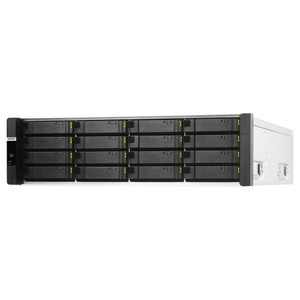
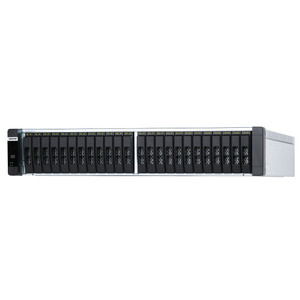
QNAP ES1686DC-R2-2142IT-96G-US 16-Bay Active-Active Dual-Controller Enterprise NAS
The QNAP ES1686DC-R2-2142IT-96G-US is a 16-bay, active-active dual-controller enterprise NAS built for organizations that cannot tolerate a single point of storage failure — think broadcast media archives, surveillance video repositories, or financial data stores where controller failure means immediate operational downtime. Each controller runs its own Intel® Xeon® D-2142IT 8-core processor at 1.90 GHz (bursting to 3.0 GHz), backed by 64GB RDIMM DDR4 ECC RAM, giving the unit genuine symmetric processing power across both heads rather than a passive standby arrangement.
Overview
Active-active dual-controller architecture means both controller modules handle I/O simultaneously — if one fails, the surviving controller picks up the full workload without a manual failover step or a storage timeout that brings down connected clients. For network-attached storage deployments anchored to SAS 12Gb/s drives and SSDs, this matters: SAS backplanes in this class are typically wired for path redundancy, and the ES1686DC-R2-2142IT-96G-US (often searched as ES1686DC R2 2142IT 96G US) is designed to exploit that. The 16 drive bays accommodate a practical mix of high-capacity SAS HDDs and SAS SSDs depending on whether your workload is throughput-optimized or latency-sensitive.
Key Features
- Active-Active Dual-Controller (2 Controller Modules): Both controllers process I/O simultaneously — no warm-standby penalty, no manual failover script. If a controller module fails during a recording window or a database write, connected clients stay online. This is the primary reason to choose this unit over a single-controller NAS in any application with uptime SLAs.
- Dual Intel® Xeon® D-2142IT 8-Core Processors (1.90 GHz / Burst 3.0 GHz): Each controller carries its own Xeon D-2142IT. The 64-bit x86 architecture means you can run QNAP's full QTS Hero or QuTS hero software stack, including deduplication, thin provisioning, and snapshots, without offloading compute pressure to a shared CPU pool. The burst headroom to 3.0 GHz handles peak RAID rebuild or snapshot consolidation without starving active client I/O.
- 64GB RDIMM DDR4 ECC per Controller (Up to 512GB Max): Starting at 64GB of registered ECC RAM per controller is meaningful in an enterprise context — ECC eliminates silent bit errors in memory that can corrupt metadata silently on large RAID sets. The 512GB ceiling per controller leaves substantial room to expand for memory-hungry workloads like large ZFS ARC caches or in-memory deduplication tables.
- SAS 12Gb/s Drive Interface (16 Bays): SAS 12Gb/s delivers roughly double the per-drive bandwidth of SATA 6Gb/s and supports dual-ported drives — meaning each drive has two independent data paths, so a single cable or expander failure does not take a drive offline. For a enterprise NAS used in video surveillance or media production, this redundancy at the drive level directly reduces unplanned outages.
- 4x 10GbE Network Ports: Four 10GbE ports allow link aggregation for throughput or active-active bonding for host-path redundancy. In a multi-server environment feeding multiple workstations or NVR clients simultaneously, 4x 10GbE gives you 40Gbps of aggregate theoretical bandwidth — enough to saturate most mid-range SAS RAID configurations without the network becoming the bottleneck.
- 2x PCIe Gen 3 Slots: The two PCIe Gen 3 expansion slots allow the unit to grow with infrastructure. Common expansions include 25GbE or 100GbE NICs as network fabrics upgrade, FC HBAs for iSCSI or Fibre Channel SAN integration, or NVMe expansion cards. This matters for long-lifecycle deployments where the network standard will change before the storage hardware reaches end of life.
- 64-bit x86 CPU Architecture: Running a mainstream x86 instruction set means the NAS is not locked to a proprietary software stack. Snapshots, thin provisioning, deduplication, and QTS Hero's ZFS-based features all run natively without ARM-class compute limitations. It also simplifies any future virtualization use cases where the NAS doubles as a lightweight container or VM host.
Integration and Compatibility
The ES1686DC-R2-2142IT-96G-US connects over standard 10GbE, making it compatible with any switch infrastructure that supports IEEE 802.3ae — no proprietary interconnects required. The PCIe Gen 3 slots accept standard SFP+ or QSFP NIC form factors for higher-speed uplinks. SAS 12Gb/s drive compatibility spans a wide range of enterprise HDD and SSD vendors. For organizations already in the QNAP storage ecosystem, QTS Hero's snapshot and replication features integrate natively with QNAP's own backup and tiering tools. Administrators familiar with iSCSI or NFS-based storage will find the protocol support straightforward to configure in QuTS hero. Review the NAS storage selection guide for guidance on matching controller class to workload profile before sizing drives and memory.
Frequently Asked Questions
Q: What does active-active dual-controller mean for day-to-day operations on the ES1686DC-R2-2142IT-96G-US?
A: Both controller modules are active simultaneously, handling I/O in parallel rather than one sitting in standby. If a controller fails, the remaining controller assumes the full workload automatically — client connections do not drop and no administrator intervention is required for the failover to complete.
Q: How much RAM does the ES1686DC-R2-2142IT-96G-US ship with, and what is the maximum?
A: Each controller module ships with 64GB RDIMM DDR4 ECC (configured as 4 x 16GB per controller). Maximum supported memory is 512GB per controller, giving the unit substantial headroom for ZFS ARC expansion, deduplication, or other memory-intensive workloads.
Q: Does the ES1686DC-R2-2142IT-96G-US support SAS SSDs in addition to SAS HDDs?
A: Yes. The 16 drive bays use a SAS 12Gb/s interface, which supports both SAS HDDs and SAS SSDs. This allows hybrid configurations — for example, SAS SSDs in a dedicated pool for high-IOPS workloads alongside SAS HDDs for high-capacity sequential storage.
Q: What CPU does each controller use, and does it affect software feature support?
A: Each controller runs an Intel® Xeon® D-2142IT 8-core processor at 1.90 GHz (burst to 3.0 GHz) with 64-bit x86 architecture. The x86 platform supports QNAP's full QTS Hero and QuTS hero software feature sets, including ZFS-based storage, thin provisioning, snapshots, and deduplication — none of which require external compute offloading.
Q: Can the PCIe Gen 3 slots be used for higher-speed networking?
A: Yes. The two PCIe Gen 3 slots accept standard expansion cards, including 25GbE, 40GbE, or 100GbE NICs, as well as Fibre Channel HBAs. This provides a clear upgrade path as network infrastructure scales beyond the built-in 4x 10GbE ports.
Q: What is the difference between the ES1686DC-R2-2142IT-96G-US and the 128G variant?
A: The primary difference is memory per controller — the 96G variant ships with 64GB RDIMM DDR4 ECC per controller, while the 128G variant ships with 128GB per controller. Both share the same Intel Xeon D-2142IT processor, 16 SAS bays, 4x 10GbE ports, and PCIe Gen 3 slots. Choose the 128G if your workload (large ZFS ARC, aggressive deduplication) benefits from a larger starting memory pool; the 96G is expandable to 512GB either way.
The ES1686DC-R2-2142IT-96G-US sits at a specific intersection that not every enterprise NAS buyer recognizes until they've dealt with a controller-failure incident: it runs both controllers active simultaneously, each backed by an independent Intel Xeon D-2142IT running at up to 3.0 GHz burst with 64GB of registered ECC RAM. That is not a redundant-controller marketing checkbox — it is a fundamentally different I/O model that keeps sessions alive through a hardware failure without a failover timer.
Technical Highlights:
- SAS 12Gb/s Dual-Ported Drives: SAS 12Gb/s at 16 bays gives you dual-ported drive access — each physical drive has two independent paths to the backplane. Combined with the dual-controller architecture, you get redundancy at the interface layer, not just at the controller layer. A single SAS cable failure does not strand a drive.
- 64GB RDIMM DDR4 ECC per Controller, Expandable to 512GB: Registered ECC RAM prevents the silent metadata corruption events that can silently damage large RAID sets over months of operation. Starting at 64GB per controller gives the ZFS ARC a working cache without configuration, and the 512GB ceiling leaves room for workloads like large-scale deduplication tables that would exhaust non-ECC systems much faster.
- 4x 10GbE + 2x PCIe Gen 3: The four built-in 10GbE ports support link aggregation for throughput or active-active bonding for network-path redundancy. The two PCIe Gen 3 slots are the upgrade valve — when 40GbE or 100GbE becomes the network standard in the facility, you install a NIC rather than replace the storage head.
Deployment Considerations:
- Active-active controller configurations require careful volume-ownership planning during initial setup — understand which controller owns which volume groups before populating drives, as misconfigured ownership can create asymmetric load even in an active-active arrangement.
- The 96G-US variant ships with 64GB per controller; if your primary use case is a large ZFS ARC (say, caching a high-IOPS surveillance or media workload), budget for memory expansion at time of purchase rather than retrofitting under load — memory upgrades on live enterprise systems require scheduled maintenance windows.
This unit is the right call for surveillance infrastructure architects deploying centralized video repositories behind multiple NVR clusters, where controller failure during a recording window is not recoverable from a single-controller NAS — and where SAS 12Gb/s drive redundancy is a design requirement, not a nice-to-have.