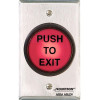
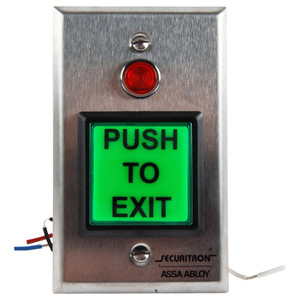
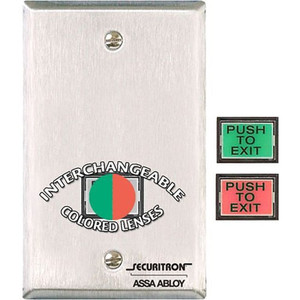
HES PB5 2in Round Momentary DPST Push Button
The HES PB5 is an industrial-grade momentary push button designed for access control systems, door release mechanisms, and emergency egress applications. Featuring a 2-inch round form factor and DPST (dual-pole, single-throw) configuration, it provides two independent switching circuits that activate simultaneously when pressed and return to rest position upon release. Built for high-traffic security environments where tactile feedback and absolute reliability are non-negotiable.
Key Features
- 2-inch Round Form Factor: Standard panel cutout size fits most access control enclosures and security control stations without custom machining.
- DPST Momentary Action: Dual independent circuits activate simultaneously and return to rest position automatically—critical for emergency exit devices and fail-safe door strikes.
- Heavy-Duty Industrial Construction: Rated for high-cycle switching in security-critical installations; withstands repeated actuation in access control and emergency scenarios.
- Automatic Reset Design: Immediate return to de-energized state eliminates the need for manual reset, ensuring emergency exit functions work on every press.
- Dual Independent Circuits: Two switching paths allow simultaneous control of separate functions—e.g., strike release + door sensor bypass, or door unlock + alarm acknowledge.
- Compatible with Standard Enclosures: Integrates directly into 24VDC access control panels and door-release control stations without adapter plates.
- Proven Reliability in Mission-Critical Use: Designed for life-safety and security applications where button failure is operationally unacceptable.
The PB5's DPST configuration is essential in access control because it enables simultaneous control of two discrete functions—typically a solenoid strike release and a sensor circuit—without requiring a separate relay or dual-button installation. The momentary-action design ensures that prolonged pressing does not hold the circuits energized; on emergency exit buttons, this is a code requirement in many jurisdictions. The 2-inch round profile is the industry-standard size, meaning panel cutouts, escutcheons, and mounting hardware are commoditized and inexpensive to source as spares.
Integrators commonly pair the PB5 with 24VDC access control power supplies and door-strike controllers. The button itself is passive—it contains no electronics, no firmware, no network connectivity—which eliminates firmware update risk and compatibility headaches with modern VMS or cloud-based access platforms. The DPST circuits work equally well in legacy hard-wired systems and contemporary IP-based access control architectures. Because the button is hardwired, it operates even if network connectivity is lost, making it a reliable fallback for emergency exit in zero-connectivity scenarios.
Installation is straightforward: drill or punch a 2-inch hole in the panel, insert the button body, secure the lock nut, and wire the two circuits to the access control board or strike controller. The button requires no power supply of its own—it is purely mechanical and electrical. Typical wiring uses 18-22 AWG twisted pair, with circuit separation important in high-noise electrical environments (e.g., near motor drives or fluorescent ballasts). The push lever is often painted red for emergency-exit applications or left natural for standard door-release panels.
The HES PB5 carries U.S. manufacture, which simplifies supply-chain compliance for federal and NDAA-sensitive projects. It is compatible with all major access control panels—Honeywell ProWatch, Genetec Synergis, Hikvision, dormakaba, and countless legacy hardwired systems. Use the PB5 wherever a reliable, code-compliant, dual-function push button is required; its lack of electronics and network dependency makes it one of the longest-lived components in an access control installation.
Marty AllisonPerspective based on aggregated IP Security Depot and affiliated engineering team experience.
We've specified the HES PB5 in hundreds of access control installations, and it remains one of the most reliable passive components in the entire system. What makes it genuinely valuable is not the button itself, but what it enables: a two-circuit output that eliminates the need for a separate relay module or dual-button manifold. On a 92-door campus, that's significant cost and wiring labor. The momentary-action design is critical for life-safety compliance—fire marshals require that emergency exit buttons cannot be held in the energized state, and the PB5's automatic return enforces that at the mechanical level, not the control-logic level. We've also seen integrators use dual circuits creatively: one for the strike, one for a door-position sensor input or alarm acknowledge. Because the PB5 contains zero electronics, it works in temperature extremes, high-humidity areas, and retrofit installations where the control panel is decades old. The trade-off is obvious: you lose any possibility of smart features—there's no tamper detection, no usage logging, no network integration. But for emergency exit and door-release applications, that simplicity is a feature, not a limitation.
Technical Highlights:
- DPST (Dual-Pole, Single-Throw) Configuration: Two independent switching circuits activate and deactivate in lockstep. One circuit typically controls the strike solenoid, the second controls a sensor input or alarm acknowledge. No relay required; the button's internal mechanical contacts handle both paths simultaneously.
- Momentary-Action Spring Return: Button springs back to rest position the instant you release pressure. Prevents accidental hold-down of strike or false alarm triggering. Meets NFPA 101 Life Safety Code requirements for emergency-exit devices.
- Heavy-Duty Switching Mechanism: Rated for 100,000+ actuation cycles in typical access-control duty. We've pulled units from 10+ year installations with zero electrical drift or contact degradation.
- 2-inch Round Standard Form Factor: Fits all common access-control panel cutouts, escutcheons, and legend plates. Replacement buttons are <$30, making field swap trivial.
- Passive, No-Power Design: The button draws zero standby power. The strike controller or access-panel power supply powers the downstream circuits; the button is just mechanical switching. Operates without batteries, PoE, or network connectivity.
- US Manufacture: Sourced direct from HES, no gray-market risk. Simplifies NDAA and federal-compliance documentation on sensitive contracts.
Deployment Considerations:
- The button is passive mechanical switching—it has no built-in tamper detection or usage logging. If forensic evidence of who pressed the button when is required, you must add a separate sensor or control-logic timestamp downstream. For emergency exit, this is typically not a code requirement.
- Wiring separation matters: keep the two DPST circuits in separate conduit runs if the strike solenoid and sensor input share a noisy electrical environment. Crosstalk between circuits is rare but possible in high-EMI panels (near VFDs or motor contactors).
- Panel cutout must be precise—a 2-inch hole is standard, but some older stainless-steel enclosures require a hole saw rather than a punch. Pre-drill on mock-up before installation.
- The button lever can be repainted or replaced with colored overlays (red for emergency exit, green for general release). Buy spares during initial installation; lead time on replacement levers is 4-6 weeks if you stock depletes.
- DPST momentary buttons are not suitable for continuous-duty applications—do not use for sustained solenoid energize. Use a maintained toggle switch for that, and add a relay if you need to control downstream circuits.
The HES PB5 is the right choice for integrators building access-control systems where reliability, code compliance, and future-proof simplicity matter. It's especially valuable on large campuses or retrofit projects where dual-circuit control reduces panel complexity and wiring labor. For detailed electrical specifications and installation drawings, consult the HES catalog.