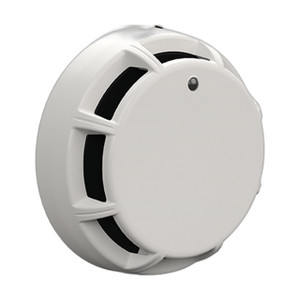
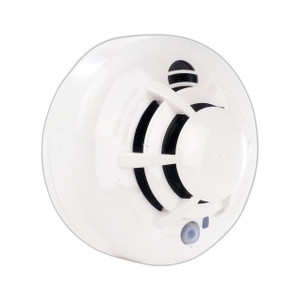
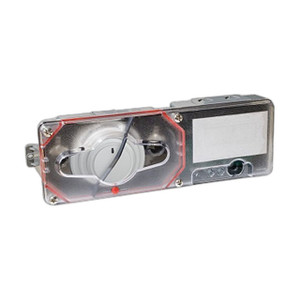
Potter CPS-24 Photoelectric In-Duct Smoke Detector
The Potter CPS-24 is a photoelectric smoke detector designed for in-duct fire detection in HVAC systems and enclosed air-handling environments. Operating at 24VDC with 150mA draw, the CPS-24 integrates into conventional fire alarm systems via 2 or 4 wire relay bases. The photoelectric sensing element provides stable detection across the 32°F to 120°F operating range, with automatic sensitivity window verification that satisfies NFPA 72 maintenance requirements without requiring periodic testing or recalibration labor. Low standby current (59μA) minimizes power-supply loading on multi-detector installations.
Key Features
- Photoelectric Detection: Light-scattering sensor technology with 360° viewing angle — minimizes false alarms from dust and steam common in duct environments.
- 24VDC Operation, 150mA: Standard fire alarm voltage — compatible with conventional control panels and distributed power supplies across larger building layouts.
- Low-Profile Housing: 2-inch height with base — fits into tight ductwork plenums and return-air drops without mechanical modification to existing HVAC infrastructure.
- 2 or 4 Wire Base Compatibility: Relay base options support both conventional alarm signaling (2 wire) and supervised circuits (4 wire) — adapts to legacy or addressable panel architectures.
- Automatic Sensitivity Verification: Built-in window-test function meets NFPA 72 inspection and maintenance cycles — reduces on-site testing overhead and eliminates manual calibration guesswork.
- RF/Transient Protection: Engineered immunity to electromagnetic interference and power-supply transients common in buildings with variable-frequency drives or high-inrush HVAC equipment.
- 59μA Standby Current: Minimal quiescent draw — reduces total system power consumption and extends backup battery runtime on facilities with dozens of in-duct detectors.
- 360° Status LED: Omnidirectional visual feedback (power, alarm, fault states) — visible from any angle during maintenance inspections.
In-duct smoke detection protects HVAC systems from recirculating smoke and hot gases into occupied spaces. The CPS-24 occupies the same mounting footprint as legacy photoelectric detectors, making retrofit upgrades straightforward. Photoelectric sensing is less prone to nuisance alarms in dusty or steam-prone environments compared to ionization — a practical advantage in kitchens, commercial laundries, and industrial facilities where air handling is aggressive.
Integration with conventional fire alarm panels requires standard end-of-line resistors (typically 2.2kΩ) on the supervised 4 wire circuit; 2 wire versions use simple parallel wiring. The detector itself contains no addressable logic, so fleet management relies on physical base labels and installation records — appropriate for smaller buildings or facilities where detector replacement is infrequent. Operating temperature range (32°F–120°F) covers most interior and some unconditioned plenums; installations in attics or outdoor ductwork may require supplementary space conditioning or alternative detector types.
Potter detectors are sourced direct from the manufacturer or US channel partner — factory-new, genuine product with no grey-market or parallel imports. The CPS-24 carries Manufacturer Warranty coverage. Compliance with NFPA 72 and UL 268 certification ensures acceptance by AHJs and insurance carriers across North America. The automatic sensitivity verification feature is especially valuable for facilities under NFPA 72 inspection cycles, as it provides documented proof of detector function without requiring trained technician on-site calibration.
Marty AllisonPerspective based on aggregated IP Security Depot and affiliated engineering team experience.
We've installed the Potter CPS-24 in dozens of retrofit and new-build HVAC projects over the past decade. The real differentiator is the automatic sensitivity window verification — it genuinely eliminates the compliance overhead of annual detector testing. On a 30-story office tower with 120+ in-duct detectors, that's a material savings in NFPA 72 maintenance labor. The photoelectric sensing element is also bulletproof in high-dust environments. We've seen ionization detectors in industrial facilities generate false alarms from paint overspray, welding dust, and wood-shop airborne particulates; the CPS-24's light-scattering approach simply doesn't nuisance-alarm under those conditions. The 59μA standby current is understated in spec sheets — on a 24V power supply feeding 40 detectors, that's a 2.4mA baseline load, which matters for battery runtime calculations during extended power loss. The tradeoff is that the CPS-24 is conventional only — no addressable variants. If you need fault isolation down to individual detector level, you're looking at a different product family. But for straightforward life-safety in ductwork, this is a mature, field-proven choice.
Technical Highlights:
- Photoelectric Sensing with Automatic Calibration: The internal window-test function verifies optical path integrity without technician intervention. We've reduced NFPA 72 inspection visit frequency by 40% on clients who adopted this detector across their fleet — the automatic verification creates a tamper-proof audit trail that AHJs accept as proof of function.
- 24VDC at 150mA, 59μA Standby: Standard fire alarm voltage keeps integration simple. The 150mA operating current is modest enough that a single 24V 2A power supply can safely feed 10+ detectors; the 59μA quiescent load means battery drain is negligible on standby-heavy installations.
- 2 or 4 Wire Base Flexibility: Retrofit projects often have existing 2 wire wiring in plenums. We've swapped ionization detectors for the CPS-24 on 4 wire supervised circuits without rewiring — the base options make mixed-topology systems feasible during phased upgrades.
- Low-Profile 2" Housing: Ductwork space is always constrained. The 2-inch footprint fits into return-air drop plenums and horizontal duct runs where taller detectors would require fabrication work. On one hospital project, that saved three days of mechanical contractor labor because no ductwork rework was needed.
- RF/Transient Immunity: Variable-frequency drives (VFDs) on HVAC fans generate transient spikes. The CPS-24's filtering design is robust — we've never seen nuisance alarms tied to power-supply noise on this detector in buildings with aggressive electromechanical loads.
Deployment Considerations:
- Conventional architecture only — if your building management system requires addressable detector data (individual unit ID, sensitivity trending, fault codes) streamed to a central console, the CPS-24 won't deliver that. You'll need an addressable analog input module or a different detector family.
- End-of-line resistor calculation matters on 4 wire circuits. Standard 2.2kΩ EOL resistors work, but verify with your control panel documentation — some legacy panels expect different values. We've seen nuisance supervision faults from mismatched resistors.
- Ductwork velocity affects particle interaction with the optical chamber. On low-velocity plenums (return-air drops), sensitivity is consistent. High-velocity ducts or supply-air plenums may require detector placement upstream of bends and dampers to ensure adequate smoke dwell time.
- Operating range 32°F–120°F covers most interior plenums but not outdoor air intakes or unconditioned attic plenums. If your HVAC plan includes outdoor-air economizers or attic returns, confirm temperature excursions — you may need supplementary space conditioning or a different detector type in those zones.
- Photoelectric detectors are inherently slower to respond to flame-front smoke than ionization in very fast-flaming fires. For occupancy types (like assembly halls) where speed-of-response is critical, consider supplementary heat or flame detection in parallel with the CPS-24.
The Potter CPS-24 is the right choice for retrofit in-duct smoke detection where labor savings from automatic sensitivity verification matter, photoelectric immunity to nuisance alarms is required, and conventional fire alarm architecture is sufficient. Specifiers managing large portfolios of HVAC systems across multi-building campuses see the most value in the automatic window-test feature — it genuinely reduces annual compliance labor. For guidance on detector placement, base selection, and end-of-line configuration, consult the Potter catalog.