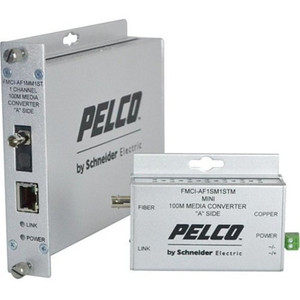
Pelco FMCI-AF1SM1ST Single-Mode Fiber Converter
Overview
The Pelco FMCI-AF1SM1ST is an A-side Fast Ethernet (100 Mbps) WDM fiber media converter designed to extend security camera deployments across large campuses and perimeter installations where copper runs become impractical. This single-mode fiber converter with ST connectors uses wavelength-division multiplexing (WDM) to send and receive data over a single fiber strand, reducing fiber count requirements and infrastructure cost compared to traditional two-fiber or copper Ethernet runs.
Single-mode fiber itself offers two critical advantages: it carries signals much farther than multimode fiber (often 10+ kilometers without a repeater) and it is completely immune to electromagnetic interference—a major factor when routing cable near high-voltage equipment, motors, or radio transmitters on industrial campuses. The FMCI-AF1SM1ST pairs only with the B-side FMCI-BF1SM1ST converter; the units are directional and not interchangeable. If your installation uses multimode fiber instead, you'll need the FMCI-AF1MM1ST / FMCI-BF1MM1ST pair.
Key Features
- 100 Mbps Fast Ethernet over single-mode fiber: Sufficient for one or two high-resolution IP cameras per converter pair, or several lower-bitrate streams. Gigabit applications require the FSFP-series modules or FMCI-PF1 platform.
- WDM (wavelength-division multiplexing) on one fiber strand: Cuts fiber infrastructure costs in half compared to separate transmit and receive fibers. Fewer cable runs, easier conduit routing, lower splicing labor.
- ST connectors: Established standard in many older campus and utility networks. Verify your fiber infrastructure supports ST termination before ordering.
- External power supply included: Standard-size enclosure fits into 19-inch racks or mounts on a wall via DIN rail (verify mounting hardware availability separately).
- NDAA Section 889 compliant: Meets U.S. federal procurement restrictions for defense and regulated government contracts. Eliminates compliance friction in sensitive deployments.
- A-side unit only: This converter must be paired with the B-side model at the opposite end of the fiber run. Do not attempt single-unit deployment.
Integration & Compatibility
The FMCI-AF1SM1ST integrates with any Pelco IP camera system and third-party ONVIF-compliant cameras that output standard Ethernet frames. It is transparent to camera configuration and VMS software—no special drivers or firmware updates are required. The converter operates at Layer 2 (link layer) and does not inspect or modify IP packets.
Fiber infrastructure must terminate in ST connectors on both ends. If your campus uses SC, LC, or other connector types, you will need adapter panels or re-termination labor. Plan for single-mode fiber installation (not multimode) to achieve stated distance performance.
When to Choose a Different Model
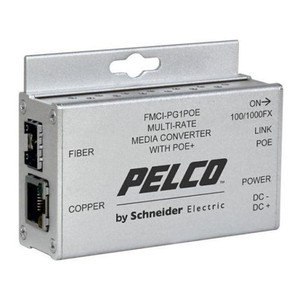
If you require Gigabit throughput for 4K multi-camera streams or multiple high-bitrate feeds, consider the FMCI-PF1 platform or FSFP-series SFP modules, which support 1000 Mbps. If your fiber infrastructure is already terminated in multimode fiber and you cannot re-terminate to single-mode, select the FMCI-AF1MM1ST / FMCI-BF1MM1ST pair instead—note that multimode range is limited (typically 2–5 km depending on fiber grade).
Deployment Considerations
Fiber media converters are passive devices in terms of power and signal path: they do not introduce latency or jitter into the Ethernet link. However, always install the A and B units in matching pairs and verify fiber continuity and polarity before energizing the system. Inspect ST connectors for dirt or damage; clean with lens paper if needed. Test link LEDs on both units (typically amber on power, green on active link) before connecting cameras.
Cost-benefit analysis: justify fiber conversion only if the copper run distance exceeds ~300–500 meters or if EMI risk is high. For short runs, Cat6A shielded twisted pair or PoE injectors may be more economical.
Ted PerryPerspective based on aggregated IPSD and affiliated engineering team experience.
The FMCI-AF1SM1ST shines in campus surveillance where fiber runs reach 5–20 km and EMI from HVAC, industrial equipment, or radio towers is a real concern. Single-mode fiber's distance capability and immunity make it the practical choice when copper would require repeaters or signal conditioning.
Technical Highlights:
- 100 Mbps throughput: Handles two 4MP cameras at 15 fps each, or one 1080p 30 fps stream comfortably. Do the math: a 5MP 30 fps H.265 stream is roughly 8–12 Mbps; 100 Mbps supports eight to twelve such streams before saturation. Plan conservatively.
- Single-fiber WDM: Reduces fiber infrastructure cost and installation labor by eliminating the need for a second fiber pair or a four-strand cable. Significant when you're running cable miles across a campus.
- ST connectors: Legacy standard, not the newer LC or SC used in modern datacenters. Verify your fiber plant before committing.
- NDAA compliance: Non-negotiable for government contracts. Saves procurement review cycles.
Deployment Considerations:
- A-side and B-side units are directional and not interchangeable. Reversing them will break the link. Label clearly during installation.
- Single-mode fiber requires proper termination and splicing discipline. Misaligned ST connectors or contaminated ferrules degrade signal quality. Budget for professional fiber termination, not DIY.
- 100 Mbps is the hard limit. If you add a third camera or switch to H.264 (higher bitrate than H.265), throughput degradation is immediate. Plan expansion paths early.
Best fit: enterprise campuses with long fiber runs, outdoor perimeter surveillance where EMI is endemic, or regulated government deployments requiring NDAA compliance. Not ideal for dense, short-distance installations where PoE switches and Cat6A cabling are simpler and cheaper.
Frequently Asked Questions
Q: Can I use the FMCI-AF1SM1ST with multimode fiber?
A: No. This unit is designed exclusively for single-mode fiber with ST connectors. If your fiber infrastructure is multimode, order the FMCI-AF1MM1ST / FMCI-BF1MM1ST pair instead.
Q: Is the FMCI-AF1SM1ST NDAA Section 889 compliant?
A: Yes. It meets U.S. federal procurement restrictions and is suitable for government and defense contracts.
Q: What is the maximum distance this converter can support?
A: Single-mode fiber typically supports 10–20 km without a repeater, depending on signal quality and termination. Multimode is much shorter (2–5 km). Plan for a fiber optic test at installation to verify link integrity.
Q: Does the FMCI-AF1SM1ST require special drivers or firmware?
A: No. It operates at Layer 2 (link layer) and is transparent to camera and VMS software. No drivers or configuration changes are needed.
Q: What happens if I reverse the A and B units?
A: The link will not function. A-side and B-side converters are directional; their wavelengths are paired. Always install them as a matched pair in the correct orientation.
Q: Can I upgrade to Gigabit throughput later?
A: Yes, but you'll need to replace both converters with Gigabit-capable units such as the FMCI-PF1 platform or FSFP-series SFP modules.