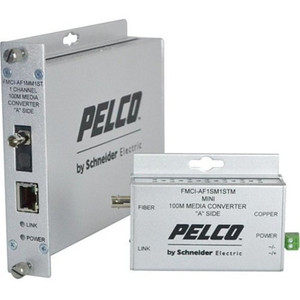
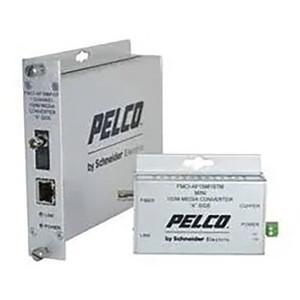
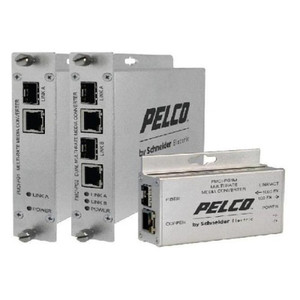
Pelco FMCI-AF1MM1STM Mini Fiber Media Converter
Overview
The Pelco FMCI-AF1MM1STM is a compact fiber media converter designed to extend Ethernet connectivity for camera deployments beyond the standard 100-meter copper cable limitation. Operating at 100 Mbps over single-mode multimode fiber with ST connectors, this A-side unit solves the distance and EMI challenges that plague large-scale surveillance infrastructure projects. The converter transforms standard copper Ethernet signals into fiber optics, allowing your camera feeds to travel much farther without signal degradation or the cost and complexity of running parallel cabling runs.
Fiber extension is not optional in campus-scale or perimeter security systems — it's often the only practical solution when camera locations exceed 100 meters from your switch closet or central recording facility. The FMCI-AF1MM1STM (often searched as FMCI AF1MM1STM) plugs directly into existing multimode fiber infrastructure, making it ideal for retrofits into facilities that already have fiber backbones in place.
Key Features
- 100 Mbps Ethernet-to-fiber conversion: Sufficient bandwidth for standard-definition and 1080p camera streams. This throughput means you can run 4–6 typical 1080p cameras over a single fiber pair without congestion, depending on frame rate and compression. Larger deployments require either multiple fiber pairs or upgrading to gigabit converters in the Pelco family.
- Single multimode fiber with ST connector: ST connectors are a legacy standard found in most enterprise fiber patch panels and wall-mount termination boxes. Multimode fiber over short to medium distances (up to several kilometers) avoids the cost premium of single-mode gear. If your facility already has multimode fiber runs installed, compatibility is instant.
- Matched-pair requirement — must pair with FMCI-BF1MM1STM B-side unit: Fiber media converters work in pairs: one at the switch end (A-side), one at the remote camera end (B-side). You cannot use this converter alone. Budget for both units and ensure you have fiber runs in place before ordering.
- Mini form factor: Compact size reduces rack and wall-mount real estate. In field installations or cramped equipment rooms, smaller footprint matters for airflow and cable management. Typically mounts on DIN rail or in a 1U shelf.
- Compatible with Pelco camera systems and legacy multimode infrastructure: Works with Pelco IP cameras and any ONVIF-compliant device on the Ethernet side. On the fiber side, it integrates with standard patch panels, media panels, and existing multimode cabling.
- NDAA Section 889 compliant: Meets federal procurement requirements for government and critical-infrastructure contracts. If you're selling into federal, state, or defense supply-chain customers, this certification removes a procurement barrier.
Integration & Compatibility
The FMCI-AF1MM1STM integrates with any network switch or PoE injector that supports standard Ethernet. On the camera side, any IP camera or encoder accepting Ethernet input will work. The fiber run between A-side and B-side units must be pre-installed and tested — fiber cabling is typically contracted separately and requires qualified termination. Verify your facility's multimode fiber type (OM1, OM2, OM3, or OM4) matches the converter's multimode support; the unit supports the full legacy range, but consult your fiber contractor to confirm distance and bandwidth margins for your specific run.
Fiber media converters are stateless devices — there is no configuration, no IP address, no web interface. Install, plug in power, and it works. This simplicity also means no firmware updates or security patches to manage, reducing operational overhead in deployments where the converter sits in a harsh or remote environment.
When to Choose a Different Model
If your deployment requires gigabit bandwidth — for example, multiple 4K cameras or 8+ simultaneous 1080p streams — consider upgrading to a gigabit-rated converter in the Pelco portfolio. If your camera location is under 100 meters from the switch and interference is not a concern, standard copper CAT6 cabling is cheaper and simpler. For single-mode fiber deployments at extreme distances (10+ kilometers), Pelco offers single-mode converter models; confirm your fiber type with your infrastructure team before ordering.
What's in the Box
The package contains the FMCI-AF1MM1STM converter unit only. Power supply, fiber jumper cables, and mounting hardware must be sourced separately. Typical deployments require a 12VDC power supply at the A-side unit; verify voltage and polarity from the product datasheet.
Frequently Asked Questions
Q: Do I need two FMCI-AF1MM1STM units, or just one?
A: You need one FMCI-AF1MM1STM (A-side) and one FMCI-BF1MM1STM (B-side). Fiber media converters always work in pairs — one at each end of the fiber run. A single unit cannot operate independently.
Q: Is the FMCI-AF1MM1STM NDAA Section 889 compliant?
A: Yes. The FMCI-AF1MM1STM is NDAA Section 889 compliant, meeting federal procurement requirements for government and critical-infrastructure contracts.
Q: What is the warranty on the FMCI-AF1MM1STM?
A: The unit is backed by a 1-year manufacturer warranty. Support and RMA services are available through Pelco's global service network and specialty distributor. Enterprise customers receive priority technical support.
Q: Can I use the FMCI-AF1MM1STM with single-mode fiber, or only multimode?
A: The FMCI-AF1MM1STM is designed for multimode fiber with ST connectors. If you have single-mode fiber infrastructure, contact Pelco for a compatible single-mode converter model.
Q: What power supply does the FMCI-AF1MM1STM require?
A: The converter requires a 12VDC power supply (not included). Verify voltage and connector type from the product datasheet before ordering a supply. Typical current draw is modest, but confirm from the specification sheet to ensure your power budget.
Q: Will the FMCI-AF1MM1STM work with non-Pelco cameras?
A: Yes. The FMCI-AF1MM1STM converts standard Ethernet signals to fiber and back. Any ONVIF-compliant IP camera or encoder will work on the Ethernet side, regardless of manufacturer.
Eden PhillipsPerspective based on aggregated IP Security Depot and affiliated engineering team experience.
The FMCI-AF1MM1STM is a straightforward fiber-optics bridge for teams dealing with camera placement beyond the 100-meter copper limit. It's not flashy, but it solves a real infrastructure problem — distance and EMI immunity — without introducing complexity into your video network. At 100 Mbps, it handles typical 1080p and lower-resolution feeds reliably, provided you don't saturate the link with multiple high-bitrate streams.
Technical Highlights:
- 100 Mbps throughput: Adequate for 4–6 standard 1080p camera streams at 30 fps, depending on compression codec. If you have four cameras running H.264 at 8 Mbps each, you're consuming 32 Mbps — well within headroom. Add uncompressed traffic (control packets, NTP sync) and aim for 60–70% link utilization to avoid jitter.
- Multimode ST fiber compatibility: ST connectors are legacy but ubiquitous in enterprise fiber infrastructure. Multimode fiber cost is roughly one-third that of single-mode, and distances up to 2 kilometers are practical on OM2/OM3 fiber. If your facility has older multimode infrastructure, integration is immediate — no rewiring required.
- NDAA Section 889 certification: Removes procurement friction in government and critical-infrastructure bids. One less compliance checkbox to manage during contract negotiation.
Deployment Considerations:
- Mandatory B-side pairing: Do not order the FMCI-AF1MM1STM without confirming you have the matching FMCI-BF1MM1STM on hand. A-side without B-side is inert. Plan procurement and delivery to avoid field-level delays.
- Fiber run pre-installation: Fiber cabling does not come with the converter. Your facility's fiber backbone must be tested and certified before deployment. Multimode fiber bandwidth degrades with distance; for runs over 1 kilometer, verify distance and modal-dispersion margins with your cabling contractor. OM3 fiber handles up to 300 meters at 10 Gbps; at 100 Mbps, distance is virtually unlimited within practical building layouts.
- Power supply separate: 12VDC power is not included. Typical current draw is modest, but field confirmation prevents installation surprises. Do not assume your rack PDU has spare 12V capacity — measure first.
Best suited for retrofit fiber backbones in large campuses or perimeter systems where copper runs exceed 100 meters and EMI is a documented issue. If you're building new infrastructure, evaluate whether gigabit fiber converters or direct gigabit camera deployments offer better long-term scalability — 100 Mbps is comfortable today but will feel tight in a few years if camera resolutions climb or streaming bitrates increase.